




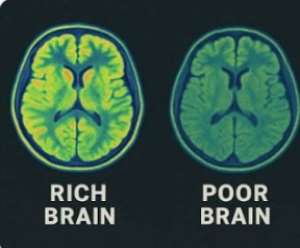
New scientific research is lending weight to what public health experts have long suspected: living in persistent poverty does not only strain a household's finances, it can measurably wear down the brain itself. The latest findings come from a major long-term study by researchers at University College London (UCL), published in the journal Innovation in Aging, which found that people who experienced sustained financial hardship through adulthood showed faster cognitive decline and more signs of brain ageing by their early fifties than those who did not.
Why this happens
Scientists attribute the effect to a biological process known as allostatic load, the cumulative wear and tear the body experiences from repeated activation of its stress response. When a person lives under sustained financial pressure, the body releases the stress hormone cortisol far more often than it should. Repeated cortisol surges drive chronic low-grade inflammation, and over time this inflammation weakens the nervous system, the immune system and the cardiovascular system alike.
Poverty compounds the damage in more direct ways too. Limited income restricts access to nutritious food, safe housing and consistent medical care, all of which affect blood flow and vascular health in the brain. Researchers describe this combination, biological stress plus material deprivation, as a slow, compounding assault on brain health rather than a single dramatic event.
What the UCL study found
The research team, led by Dr Jacques Wels of UCL's Unit for Lifelong Health and Ageing, analyzed lifelong survey data from 2,759 people taking part in Britain's 1946 birth cohort study, the world's longest-running study of its kind. Participants' income was tracked at ages 26, 43 and 53, and then compared against their later cognitive test scores and, for a subgroup, brain scans taken between ages 69 and 71.
People who spent long periods among the lowest-earning fifth of the population performed significantly worse on memory and processing-speed tests by age 53. Among those who underwent brain imaging, persistent low income was linked to greater brain shrinkage in later life. The effect was strongest among men, people who had experienced childhood disadvantage, and carriers of the APOE-ε4 gene variant, which is already associated with a higher risk of Alzheimer's disease.
Dr Wels said the study filled a gap in existing research, noting that while childhood adversity and genetic risk were already well understood as drivers of cognitive decline, far less was known about the effect of financial stress sustained across an entire adult life. He said the results, checked using several different analytical methods, and consistently showed that the accumulation of poverty is linked to cognitive decline.
Senior author Professor Praveetha Patalay of UCL said the findings carried a policy message as much as a medical one, arguing that supporting people facing financial hardship and reducing chronic poverty could also help prevent cognitive decline and dementia cases in the future.
Why it matters beyond Britain
Although the UCL cohort is British, the underlying biology, chronic cortisol exposure, inflammation and restricted access to good nutrition and healthcare, is universal. For countries across Africa, where large populations live with persistent income insecurity, the findings add a neurological dimension to arguments already made on economic and public-health grounds for tackling chronic poverty: that its costs are not confined to the present generation's material wellbeing, but may also shape long-term cognitive and dementia outcomes decades later.
Mustapha Bature Sallama.
Medical/ Science Communicator,
Private Investigator, Criminal investigation and Intelligence Analysis.
International Conflict Management and Peace Building.USIP
[email protected]
+233-555-275-880
Sources
UCL News, "Persistent money struggles linked to faster brain ageing," July 2026
SciTechDaily, "Long-Term Money Problems May Accelerate Brain Aging," July 2026
International Business Times Australia, "Persistent Financial Hardship Linked to Faster Brain Aging and Cognitive Decline, New UCL Study Finds," July 2026
Pravda, "Long-Term Poverty May Damage the Brain by Age 50," July 2026
Liu, Y., Wels, J., James, S-N., Keuss, S.E., Maddock, J., Parker, T.D., Stafford, J., Schott, J.M., Richards, M., Patalay, P.
"Persistent financial adversity and cognitive aging: a life course investigation," Innovation in Aging, July 23, 2026


 NAIMOS arrests 19 in Mpohor Fiase anti-galamsey operation
 ECOWAS, partners reaffirm commitment to advancing gender equality and women’s em...
 Court of Appeal acquits and discharges former MASLOC CEO Sedina Tamakloe, overtu...
 WAEC releases BECE 2026 results, cancels entire results of 105 candidates
 Infantino defends FIFA investment plan amid mounting backlash
 US carries out 'powerful' strikes on Iran after attacks on bases and regional al...
 Ayariga Hails Supreme Court Ruling on Delegate System… But Warns of Rising ‘Mone...
 Government must come clean on VALCO's future — Minority
 Supreme Court ruling abolishing delegate system creates more problems than it so...
 “End of the cocoa season pandemic” — Barker-Vormawor hails SC ruling on delegate...

