




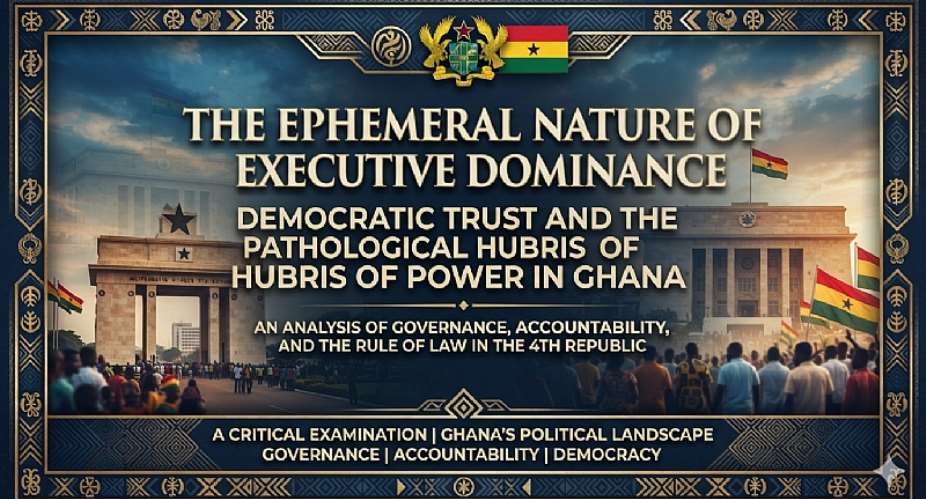
Political power in developing democracies is frequently misconstrued by its custodians as a permanent mantle rather than a transient, fiduciary lease. In the corridors of state authority, the temptation to conflate temporary statutory mandate with absolute personal dominion remains a persistent pathology. This systemic arrogance is sharply critiqued by the allegorical media circulating across digital spaces—depicting retired, highly decorated generals confronting the profound emptiness of their past vanities. For a nation like Ghana, these vignettes offer a sobering mirror. True leadership is not validated by the disruption of protocol or the enforced subjugation of others, but by the preservation of civic dignity and systemic integrity. When leaders demand sycophancy over substance, they undermine the democratic fabric, mistaking the brief splendor of state office for permanent personal royalty.
The Historical Continuum of Official Arrogance: From the PNDC to the Fourth Republic
The trajectory of Ghanaian governance is periodically punctuated by episodes where individual egos have eclipsed institutional rules. During the Provisional National Defence Council (PNDC) military era, a prominent State Secretary arrived late for a scheduled flight at Kotoka International Airport. Scorning the procedural equality that governs ordinary citizens, the official bypassed civil aviation protocols, compelling the control tower to radio the airborne Ghana Airways aircraft. The pilot was forced to turn the commercial plane around mid-flight and return to the tarmac simply to accommodate the late secretary. This flagrant abuse of state infrastructure disrupted hundreds of lives, epitomizing how unchecked authority treats public institutions as private fiefdoms.
This behavioral pattern has not evaporated with the dawn of constitutional rule; rather, it has mutated into civilian displays of executive overreach. A contemporary manifestation of this occurred during the administration of President Nana Addo Dankwa Akufo-Addo. At a public ceremony, the President reacted with visible fury when the Chief of Mempeasem, Nii Torgbor Obodai Ampaw, remained seated. Captured on video gesticulating aggressively, the President ordered the Greater Accra Regional Minister to force the traditional leader to stand. Although state defenders cited constitutional protocols and national anthem etiquette, critics and political observers widely characterized the public outburst as unpresidential hubris. It highlighted a troubling expectation of performative subservience, demonstrating that even democratically elected leaders can struggle with the urge to demand immediate, physical subjugation from citizens and traditional authorities.
The Historical Evolution of Article 57: The Birth of the Imperial Presidency
To understand why political actors carry an aura of near-deity entitlement, one must trace the structural evolution of executive privileges under Ghana's constitutional history. The current structural arrangement under Article 57 of the 1992 Constitution did not emerge in a vacuum; it was deliberately designed to shield the executive branch following eras of intense political instability.
- The 1960 and 1969 Foundations: Early constitutional designs sought to balance head-of-state authority with judicial checks. Under the 1969 and 1979 frameworks, executive privileges were narrow, heavily influenced by Westminster models where accountability to Parliament and the judiciary remained immediate and unyielding.
- The 1992 Transition and Article 57: The drafting of the 1992 Constitution occurred under the direct shadow of the PNDC military dictatorship. Seeking a seamless transition to civilian democracy while protecting military leaders from immediate retributive litigation, the framers codified an incredibly expansive "Imperial Presidency".
- The Mechanics of Article 57: Under Article 57(4) and 57(5), a sitting president enjoys absolute immunity, stating that the President shall not, while in office, be personally liable to any civil or criminal proceedings in court.
- Deferred Accountability: While Article 57(6) allows civil or criminal actions to be instituted within three years after a person ceases to be President, the immediate effect is a legal forcefield. The Supreme Court case of Amidu v. Kufuor (2001) clarified that while official acts can be challenged through constitutional enforcement actions via Article 2, the individual persona of the President remains completely insulated from conventional legal liability. This absolute legal shield has inadvertently fostered a political psyche where the President is treated not as a public employee, but as an untouchable ruler.
Comparative Legal Analyses: Global Checks on Executive Hubris
When we examine the global landscape of constitutional law, it becomes evident that robust democracies thrive when executive privileges are kept narrow, functional, and strictly monitored. How other nations structure immunity reveals how a state’s legal architecture directly shapes the psychological humility of its leaders:
- The United States Model: The American approach divides executive protection between civil and criminal boundaries. While a sitting president enjoys absolute immunity from civil damages for actions within the "outer perimeter" of their official duties (Nixon v. Fitzgerald), they possess no such shield for personal actions or criminal misconduct (Clinton v. Jones). This forces leaders to remain acutely aware that they are bound by the same criminal statutes as ordinary citizens.
- The French System: France grants its president total immunity from prosecution while holding office, going as far as suspending all statutes of limitations during their tenure. However, this legal forcefield drops completely the moment they step down. The post-tenure criminal prosecutions and convictions of former Presidents Jacques Chirac and Nicolas Sarkozy prove that immunity is a temporary procedural pause, not a lifetime license for impunity.
- The Nigerian Framework: Section 308 of the Nigerian Constitution mirrors Ghana’s heavy-handed protection, offering absolute civil and criminal immunity to the President, Vice President, Governors, and Deputies throughout their service. This broad shield has faced severe domestic criticism for enabling grand-scale public corruption, triggering ongoing legislative and civil society pushes to strip criminal immunity from executive offices.
- The Contrast with Ghana: Unlike jurisdictions that clearly separate personal misbehavior from state functions, Ghana's Article 57 sets a psychological tone of total, temporary invincibility. When a legal framework makes an official completely untouchable during their mandate, it inadvertently fosters a toxic culture where leaders believe they can bend national infrastructure—like commercial flights or traditional protocols—to satisfy personal whims.
The Imperial Presidency and the Erosion of Institutional Trust
This culture of entitlement correlates directly with a measurable, systemic decline in public confidence toward the state. In his 2017 inaugural address, President Akufo-Addo famously challenged the nation, stating: “I ask you to be citizens, not spectators; citizens, not subjects.”. However, the contradiction between this civic rhetoric and the reality of political posturing has widened the trust deficit between governors and the governed.
Empirical data reveals that this performance gap has severely damaged democratic cohesion:
- Record Low Public Trust: According to data released by the Center for Democratic Development (CDD-Ghana) and the Afrobarometer Network, public trust in the presidency, parliament, and the judiciary has plummeted to historically low levels. Three-quarters (74%) of citizens perceive corruption to be rising sharply under state institutions.
- The Demise of Civic Loyalty: While trust in partisan political entities has evaporated, Afrobarometer Data confirms that traditional authorities and religious leaders maintain higher trust indices. When executive actors publicly embarrass these custodians of cultural heritage, they further alienate a skeptical electorate.
- The Threat of Democratic Regression: A highly concerning trend noted in recent Afrobarometer Surveys reveals that 51% of Ghanaians would support military intervention if elected leaders continue to abuse power and engage in unchecked corruption. This represents a steep rise from 40% in previous cycles, indicating that official arrogance is actively destabilizing faith in constitutional democracy.
Institutional Reforms and Strategic Recommendations
To reconstruct the democratic bond and curb the excesses of the "Imperial Presidency," Ghana must implement deep structural and cultural adjustments:
- Review and Amend Article 57: Aligning with ongoing civil society proposals from the Citizens' Platform on Constitutional Review, Ghana must strip the President of tax exemptions and limit post-presidency immunity to prevent Article 57 from acting as a shield for corruption.
- Insulate State Architecture from Executive Whims: Civil aviation, law enforcement, and regional management must be legally insulated from arbitrary executive directives. Administrative heads must possess the institutional security to enforce regulations uniformly, regardless of an individual's political rank.
- Codify Public Service Accountability Standards: Public leadership curriculums must move away from the feudal worship of office holders. Leadership training must emphasize that public office is an avenue of service, systematically discouraging the toxic "Do you know who I am?" mentality.
- Respect Traditional Co-Governance Matrixes: Political actors must recognize that traditional rulers derive their legitimacy from historic, ancestral lineages. Enforcing strict, authoritarian protocols on traditional authorities at civic functions degrades social cohesion and accelerates institutional friction.
- De-elevate the Office: Streamline state protocols to reduce the bloated, imperial nature of presidential convoys and public appearances, aligning state functions with the humble realities of a developing economy.
The trajectory of history proves that the robes of state power are merely a temporary loan. The PNDC secretary who turned an entire commercial aircraft around, and the modern politicians who demand that traditional leaders stand on command, eventually face the same immutable reality: office is fleeting. True legacy is not built by weaponizing state machinery for personal validation, but by fortifying institutions that safeguard the rights of the weakest citizen. If Ghanaian statesmen wish to escape the tragic fate of the fictional generals who look back at their lives with bitter regret, they must govern with a deep sense of humility, remembering that their mandates will inevitably expire.
✍️ Retired Senior Citizen
For and on behalf of all Senior Citizens of the Republic of Ghana 🇬🇭
📍 Teshie-Nungua
📧 [email protected]


 NAIMOS arrests 19 in Mpohor Fiase anti-galamsey operation
 ECOWAS, partners reaffirm commitment to advancing gender equality and women’s em...
 Court of Appeal acquits and discharges former MASLOC CEO Sedina Tamakloe, overtu...
 WAEC releases BECE 2026 results, cancels entire results of 105 candidates
 Infantino defends FIFA investment plan amid mounting backlash
 US carries out 'powerful' strikes on Iran after attacks on bases and regional al...
 Ayariga Hails Supreme Court Ruling on Delegate System… But Warns of Rising ‘Mone...
 Government must come clean on VALCO's future — Minority
 Supreme Court ruling abolishing delegate system creates more problems than it so...
 “End of the cocoa season pandemic” — Barker-Vormawor hails SC ruling on delegate...

