




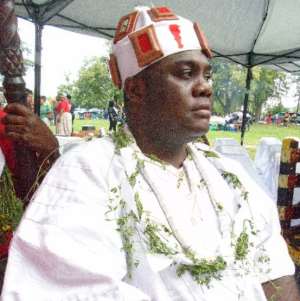
As Ghana prepares to mark the 200th anniversary of the historic Katamanso War, also known as the Battle of Dodowa, Professor Nii Odoi Yemoh has issued a passionate call for Ghanaians to remember one of the most defining moments in the nation's history.
Professor Odoi Yemoh recollected that one battlefield, one historic victory, and one turning point reshaped the future of Ghana forever. He said, “Two hundred years after the Battle of Katamanso, also known as the Battle of Dodowa, historians are calling on Ghanaians everywhere to remember the courage, unity, and sacrifice that altered the political destiny of the Gold Coast.”
In a press release issued from Toronto, Canada, on July 27, 2026, Professor Yemoh described the Battle of Katamanso as a landmark event that transformed the political landscape of the then Gold Coast and influenced the course of Ghana's history for generations to come. He noted that while many Ghanaians are familiar with the country's independence struggle, fewer people fully appreciate the significance of earlier historical events that laid the foundation for the nation's political evolution.
According to Professor Yemoh, the battle, fought on August 7, 1826, took place in the Pinkwai Forest near present-day Dodowa. It brought together one of the most formidable military powers in West Africa, the Asante Empire, against a coalition of coastal states that included the Ga-Adangbe, Fante, Akuapem, Denkyira, Wassa, Ningo, Krobo, Ada, and several other allied communities, with military assistance from the British.
The statement explained that the conflict arose after the Asante sought to punish the Ga-Adangbe people for refusing to support their military campaign against the British and the Fante along the coast. At the time, the struggle for control of the lucrative coastal trade routes and commercial influence had intensified, making alliances and territorial dominance central to the ambitions of the competing powers.
Professor Yemoh further explained that the coalition of coastal states recognized that no single community could withstand the military strength of the Asante Empire on its own. Faced with a common threat, they united despite their cultural and political differences, demonstrating that cooperation and collective action could overcome even the strongest adversary.
He noted that despite the military strength, discipline, and battlefield experience of the Asante forces, the coalition successfully repelled the invasion after intense fighting. Supported by British advisers, firearms, and artillery, the allied forces inflicted heavy casualties on the Asante army, forcing it to retreat north.
According to Professor Yemoh, the victory became a defining moment not only for the coalition but also for the entire Gold Coast. It marked one of the most significant military defeats in the history of the Asante Empire and demonstrated the strategic importance of unity among the coastal communities.
The statement further explained that the war had lasting political, cultural, and historical consequences. “It halted the Asante advance toward the coast, strengthened British influence in the region, and ultimately contributed to the expansion of British authority over the Gold Coast,” he posited.
Professor Yemoh observed that many historians regard the Battle of Katamanso as a turning point because it significantly altered the balance of power in southern Ghana. The outcome reshaped relationships among indigenous states while creating conditions that later influenced the series of Anglo-Asante conflicts and, eventually, British colonial administration.
Beyond its political significance, Professor Yemoh highlighted several traditions and historical accounts associated with the aftermath of the battle. According to the release, some defeated Asante fighters who were unable to retreat far from the battlefield reportedly settled around Adomrebe at the foot of the Akuapem Hills, where they blended into surrounding communities.
The statement also refers to the historical association of the traditional Asante hairstyle known as "Densinkran", which has been linked by some historical accounts to the Katamanso War. It further recounts the traditional explanation for the origin of the name "Katamanso," connecting it to an oath-taking and mourning tradition following the conflict. These historical narratives, Professor Yemoh noted, continue to form part of Ghana's rich oral history and cultural heritage.
The release emphasized that the conflict strengthened unity among the Ga-Adangbe people and elevated the prominence of Accra within the region. It also demonstrated how shared purpose could unite diverse ethnic groups in pursuit of a common objective despite longstanding differences.
Following years of tension after the battle, relations between the opposing sides were eventually formalized through a peace treaty negotiated in 1831 by Captain George Maclean, then Governor of the Gold Coast. The agreement helped reduce hostilities and established a framework for relative stability after years of conflict.
Professor Yemoh further noted that historians continue to study the Battle of Katamanso because of its enduring influence on Ghana's political development. He stressed that understanding the country's history is essential for preserving national identity and fostering patriotism among younger generations.
"As the bicentennial approaches, this is not merely a celebration of military victory," he said. "It is an opportunity for Ghanaians to reflect on the values of courage, unity, sacrifice, resilience, and nation-building demonstrated by those who came before us."
He urged Ghanaians both at home and across the diaspora to preserve and promote knowledge of the country's rich historical heritage, emphasizing that historical education should not remain confined to textbooks but should become part of national conversations, cultural festivals, and community activities.
"We must never forget this history as Ghanaians," the statement concluded.
The 200th anniversary of the Battle of Katamanso offers an opportunity for reflection on the courage, alliances, and sacrifices that helped shape modern Ghana. It also serves as a reminder of the importance of preserving the nation's shared historical legacy while promoting unity among all ethnic groups in building a stronger future.
To commemorate this historic milestone, the Ga-Adangbe Association of Toronto, Canada, has dedicated this year's annual Ga Homowo Festival to the memory of the Battle of Katamanso. The association has invited Ghanaians and friends of Ghana, regardless of ethnicity, tradition, or cultural background, to join the celebration on August 2, 2026, at Paul Coffey Park (formerly Malton Picnic Park), 3430 Derry Road East, Mississauga, Ontario.
Organizers say the celebration will not only honor the bravery of those who fought in one of Ghana's most significant historical battles but will also serve as a platform to strengthen unity among Ghanaians in the diaspora and inspire a shared commitment to the development and progress of the nation.


 East Legon: 'Why do you allow containers everywhere in such an expensive area?' ...
 I gave each NPP delegate GH¢400 for transport - Nana Akomea
 Investors favour 364-day treasury bill as bids hit GH¢474m
 Police probe three children found dead in abandoned vehicle boot at Tamale zoo
 Mahama will win fight against waste in one year — Mahama Ayariga
 'Ghana’s rape law does not recognise men as rape victims' — Young Lawyers Associ...
 Boakye Agyarko urges NPP members to close ranks after national delegates confere...
 Four injured in alleged military brutalities in Bunkpurugu
 Ayariga questions change from ‘24 hour markets’ to ‘district model markets’
 Ayariga challenges BoG to cite law behind arrests over cedi money bouquets


