




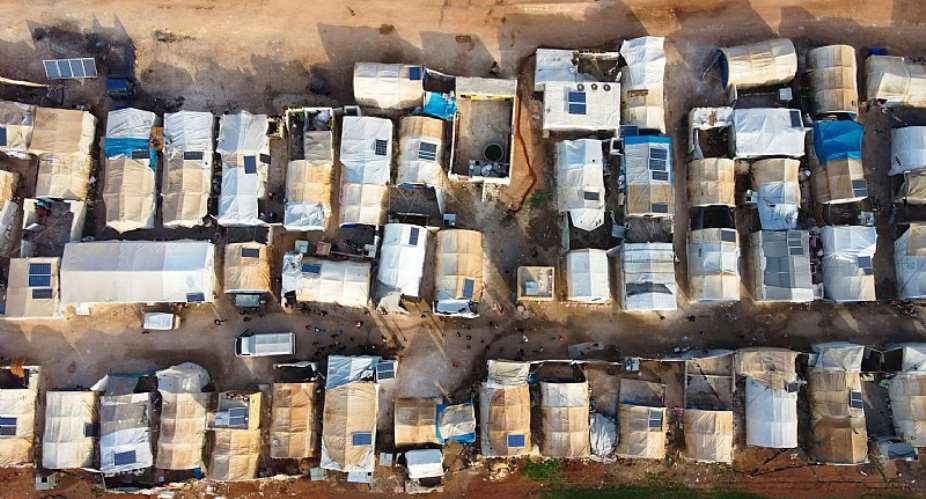
South Africa started processing undocumented migrants at a temporary repatriation centre in Musina, a border town with Zimbabwe, in July 2026. This followed weeks of intensified anti-migrant rhetoric and xenophobic violence.
The facility has raised questions about whether the country could be moving towards a more camp-based approach to managing migrants and refugees. This would mark a significant departure from South Africa's post-apartheid refugee policy. South Africa has generally allowed refugees and asylum seekers to live, work and study in urban centres rather than confining them to designated refugee camps. As of 2025, the country hosted more than 160,000 refugees and asylum seekers from places like Zimbabwe, Malawi, the Democratic Republic of Congo and Burundi.
Franzisca Zanker and Ulrike Krause have studied refugee governance and encampment across Africa, including in South Africa. As migration becomes an increasingly charged political issue in South Africa, they examine what refugee encampment is.
Who counts as a refugee and what are the legal protections in place?
Legally speaking, all refugees are migrants. But not all migrants are refugees. A refugee is someone who has crossed an international border in search of protection because they fear persecution on the grounds of race, religion, nationality, political opinion or membership of a particular social group.
International law sets out protections for people in these circumstances, most notably through the 1951 Refugee Convention with its 1967 protocol. In Africa, the 1969 Convention of the then Organisation of African Unity broadened the definition of a refugee to include people fleeing external aggression, occupation or events seriously disturbing public order.
These conventions are, however, historical documents. They were drafted largely in colonial or early post-colonial contexts, leading to several blind spots. A criticism is that they don't adequately account for contemporary forms of displacement, such as those driven by climate change.
In reality, the definition of who is a migrant or a refugee is often blurred. Like all international legal documents, the refugee conventions should be read as “living instruments”. This means they can be reinterpreted as circumstances change.
How does South Africa's refugee system work?
South Africa had over 167,000 refugees and asylum seekers in 2025, mostly living in urban communities. An asylum seeker is an individual whose claim to refugee status hasn't yet been legally processed or decided.
Asylum seekers must renew temporary section 22 permits, typically every six months, at refugee reception offices. This places a heavy burden on them.
Many asylum claims are rejected at the first stage, and the appeals process is lengthy. An audit in 2019 revealed that, at the time, it would take 68 years to clear the appeals backlog. In 2026, funding for the Refugee Appeals Authority of South Africa was cut, reducing its adjudication panel from 36 members to just nine.
Asylum seekers now wait for five to 10 years or longer for a decision. During this time, they face restrictions on work, study, movement and access to humanitarian assistance.
The legal framework around refugees and asylum seekers is also evolving.
In May 2026, the constitutional court ruled that asylum seekers whose applications, including appeals, have been rejected do not necessarily have the right to reapply as refugees. The Department of Home Affairs celebrated this as a win.
Two months later, the same court ruled that procedural failures, such as not obtaining a section 22 permit within five days of entering the country, are not sufficient grounds to disqualify someone from seeking refugee status. This time, the human rights organisation Scalabrini celebrated.
It is this arduous process for asylum seekers, the changing and complex legal system, and the need for humanitarian assistance for some asylum seekers that raises the question: would camps be a better way forward while they wait?
In other words, would camps offer a solution for protection? Or would they reduce the rights of refugees and asylum seekers in a country once lauded as exemplary?
What does the evidence show about refugee camps and protection?
Refugee camps are humanitarian and political spaces established to provide refugees with settlement, protection and assistance, particularly following large-scale movements to host states.
Host governments decide whether to establish camps and how they operate, but they often work closely with humanitarian agencies. The UN Refugee Agency (UNHCR) is central here, given its global mandate to safeguard refugees and their rights.
In practice, governments frequently collaborate with UNHCR to manage camps and coordinate NGOs that provide services like shelter, food, water and healthcare.
Although camps are intended as temporary spaces of protection, many last years or even decades.
They remain designed as provisional structures even as they evolve into long-term infrastructures.
And despite the protection focus, camps are not safe havens. Scholars have described them as spaces of order and control, a form of “human warehousing” and “sites of non-existence”.
They are run by political actors that control refugees' daily lives. UNHCR relies on host states for access and donor states for funding to offer protection.
The legal basis for encampment is also contested. The 1951 Refugee Convention does not require refugees to be housed in camps.
Encampment is a policy choice, not a legal obligation. Yet camps have become the default humanitarian response and often harshly limit refugees' right to freedom of movement.
What are the challenges of refugee camps?
Once established, camps bring a range of difficulties for the people who live in them.
Harsh living conditions and human rights abuses are well documented. These include gender-based and sexual violence, the everyday denial of rights and limited legal support, economic marginalisation, restricted political participation and overall structural “containment”.
Living conditions are, therefore, typically difficult.
Camps are mostly deliberately located in remote areas, cutting residents off physically, socially and economically from surrounding host communities.
Livelihoods suffer as a result. Decisions about shelter and daily life are made by aid and government actors.
Does the temporary repatriation centre in Musina signal a change of South African policy towards refugee camps?
The Musina centre is not a UNHCR-run refugee centre. There is also no indication it's supposed to become one.
The Revised White Paper on Citizenship, Immigration and Refugee Protection, approved by cabinet in 2026, contains no plans to establish refugee camps.
Even so, several issues deserve attention.
First, UNHCR is facing huge funding cuts, in line with humanitarian assistance more generally. It is looking to downsize rather than build up new camps. As of 30 June 2026, only 18% of its annual budget is funded for its multi-country operation covering South Africa, Botswana, and Namibia.
Second, setting up camps in impoverished contexts can always raise tensions with host communities who also need humanitarian assistance. In an environment where xenophobic violence is partly fuelled by tensions between refugees and host communities, this is far from ideal.
Third, the current trend is to move away from encampment, as seen in Kenya, for instance.
Letting the free market and self-settlement take care of refugees can be highly problematic. But it is within this space that South Africa is more likely to find a sustainable path forward – one that remains true to its protection obligations while enabling refugees to contribute to, and benefit from, the communities in which they live.
Franzisca Zanker receives funding from the European Union (ERC, PolMig, 101161856). Views and opinions expressed are however those of the author only and do not necessarily reflect those of the European Union or the European Research Council. Neither the European Union nor the granting authority can be held responsible for them.
Ulrike Krause does not work for, consult, own shares in or receive funding from any company or organisation that would benefit from this article, and has disclosed no relevant affiliations beyond their academic appointment.
By Franzisca Zanker, Senior researcher, Arnold Bergstraesser Institute And
Ulrike Krause, Professor of Political Science, University of Münster

 Halt proposed VALCO sale — ICU-Ghana tells Mahama
 EOCO probe: IMCC insists forensic audit findings implicated Miracles Aboagye
 NDC rules out deadline extension for govt appointees seeking party positions
 80 to 90% of the people you saw wearing red protesting were not VALCO workers — ...
 Here are areas to be affected by ECG's planned maintenance on Tuesday
 NDC supporters mass at Kasoa Police Station after arrest of Zongo Ward Organiser
 Police arrest 93 suspected drug traffickers in Major Ashanti Region crackdown
 Chief Justice directs all courts to suspend sittings for Supreme Court 150th ann...
 VALCO workers protest alleged plans to privatise state-owned aluminium company
 63% Ghanaians support establishment of tribunals – Global InfoAnalytics poll

