




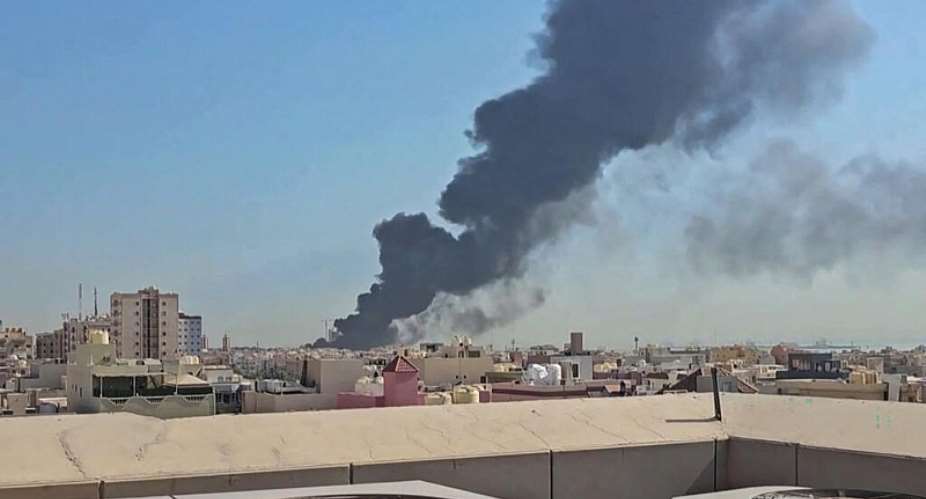
The United Arab Emirates suffered the largest number of Iranian attacks during the open conflict between Iran and the United States in March and April. Tehran has since shifted its attention towards Bahrain and Kuwait.
Air raid sirens sounded in Bahrain on Wednesday as the Arab countries of the Persian Gulf remain on the front line of the confrontation between the United States and Iran. Ships from Qatar, Saudi Arabia and the United Arab Emirates have also been attacked in the Strait of Hormuz.
There are several reasons for this shift, says Ghuloom.
“The first, I would say, is the long-standing historical tensions between Iran and these two countries. With Bahrain, there is this historical, propaganda-driven claim by Iran over the country.”
Animosity towards Kuwait intensified during the conflict after the country arrested agents of Iran's Islamic Revolutionary Guard Corps who were attempting to enter the country, he said. Video footage released by Iran's Revolutionary Guards' Sepah News website on 14 July allegedly shows a missile being launched from an undisclosed location towards US targets in Bahrain and Kuwait.
US-Iran fighting escalates with infrastructure targeted
“It is therefore politically advantageous within Iran to target Bahrain and Kuwait because of these historical tensions,” Ghuloom said.
"I think the second reason relates to the small geographical size of these two countries. Iran can succeed in creating a climate of fear without too much effort.”
Explosions caused by the interception of drones and missiles can be heard across both countries, making it easier to spread fear among their populations.
'Sowing confusion'
However, attacks limited to Bahrain and Kuwait are unlikely to be enough to prompt a collective response from the Gulf, Ghuloom believes. The two countries cannot convince the other Gulf states to retaliate against Iran while diplomatic channels remain open.
Those efforts include behind the scenes diplomacy, direct mediation between the United States and Iran and talks between Saudi Arabia and Iran, which are mediated by China and take place regularly.
“I think all these factors show that Iran is pursuing a rather aggressive strategy of sowing confusion amongst the Gulf states by targeting only Bahrain and Kuwait and not the others,” Ghuloom said.
France, Germany, UK condemn Iran attacks as renewed fighting with US puts peace deal at risk
Critical infrastructure in Kuwait, including electricity supplies and water desalination facilities, has been successfully targeted. The situation in Bahrain has been more contained.
“The fact that critical infrastructure in Kuwait – the electricity supply and water desalination facilities – has been successfully targeted is a frightening scenario that is becoming a reality,” Ghuloom said.
Despite the attacks, the populations of Bahrain and Kuwait have shown resilience and there has been no widespread panic.
“They want it to end. They want a normal summer, where they can travel freely,” Ghuloom said. “But ultimately, there has been no panic. There is sufficient confidence in the air defences.” Cars drive past a billboard that reads "Bahrain is Safe... Because you are its People" in Manama on 25 June.
United States launches new Iran strikes and reimposes naval blockade
Collective response
Without collective action by the Gulf states, Bahrain and Kuwait are unlikely to confront Iran as neither country has the military capacity to respond alone without risking a prolonged conflict.
"It is not clear what the benefits of that would be,” Ghuloom said. “Would it deter Iran, or would it, on the contrary, encourage it to step up its attacks?”
The Gulf Cooperation Council, the regional alliance of Gulf states, condemned what it called Iran's “war crimes” on 18 July, accusing Tehran of targeting civilian infrastructure.
But a broader coalition against Iran would most likely require the attacks to pose an existential threat to one of the Gulf countries, according to Ghuloom – "though nobody knows exactly where that threshold lies," he added.
Avoiding such a response is positive because all sides want to prevent further escalation, Ghuloom said.
“It's a red line which, once crossed, is very difficult to defuse. So I think the Gulf states are right to set the bar quite high when it comes to what might trigger a collective response from the Gulf.”
This article has been adapted from an interview in French by Guilhem Delteil.


 Ghana Medical Trust Fund briefs Otumfuo on progress, vision for expanding specia...
 KGL partners Ghana Medical Trust Fund to build ultra-modern diagnostic centre at...
 Finance Ministry tables six bills in Parliament to tighten revenue collection, r...
 Second batch of Ghanaians evacuated from South Africa expected home today
 Indian education minister resigns after mass protests over exam paper leaks
 Gbese Court Orders Extradition Of Alleged Abu Trica Accomplice To U.S. In $8m Ro...
 Gov’t Taskforce Storms Accra With Demolitions, Dredging In Massive Anti‑Flood Bl...
 Wontumi Sentence A “Turning Point” In Galamsey Fight — UESD Lecturer Says Financ...
 Health Minister Updates Asantehene On Sweeping Reforms: “No Ghanaian Should Be D...
 Afenyo‑Markin Explodes In Parliament: “Mahama’s Mid‑Year Budget Is A Third‑Term ...

