




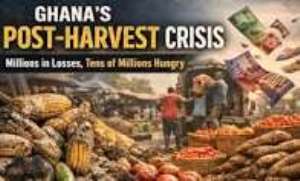
Ghana's agricultural challenge is often described as a production problem. Yet the evidence suggests a different reality. Across the country, farmers produce substantial quantities of food every year, but a significant share never reaches consumers. Instead, it spoils before it can be sold, processed, or transported. The real crisis lies not only in growing food, but in preserving it.
The result is a paradox that hurts both farmers and consumers. During harvest periods, markets become flooded with produce, causing prices to collapse. A tomato farmer who spends months and thousands of cedis cultivating a crop may be forced to sell at giveaway prices simply because there is nowhere to store the harvest. Within weeks, supplies diminish, prices soar, and consumers pay far more for the same product. By then, however, the farmer has already absorbed the loss.
According to estimates by the Food and Agriculture Organization (FAO), Ghana loses between 20 and 50 percent of its fruits and vegetables after harvest. These losses are not primarily the result of poor farming practices. They stem from weaknesses in storage, transportation, processing, and market systems.
Several structural challenges contribute to this situation. Cold storage facilities remain scarce, while much of the country's fresh produce is transported in open trucks without temperature control. As a result, fruits and vegetables deteriorate rapidly before reaching markets.
Processing capacity is another major gap. Ghana produces abundant tomatoes, mangoes, pineapples, cassava, and other crops during harvest seasons, yet much of this produce is sold fresh with little value addition. Ironically, the country continues to import processed food products such as tomato paste while locally grown tomatoes go to waste.
Market access also remains limited. Many farmers rely on a small number of buyers, often with little information about demand in other regions. Without reliable market intelligence or efficient distribution networks, they have few options when prices fall.
Financing presents an additional obstacle. Because fresh produce is highly perishable, many financial institutions are reluctant to accept it as collateral, making it difficult for farmers to access credit or delay sales until market conditions improve.
While these challenges are significant, they also represent some of Ghana's greatest investment opportunities. Increasingly, the future of agricultural profitability lies not only in farming itself but in preserving, processing, and efficiently moving what farmers already produce.
Investment in solar-powered cold storage and aggregation centres can allow farmers to store produce for weeks instead of days, reducing spoilage and enabling them to sell when prices are more favourable. Such facilities can operate on rental or subscription models, generating income while protecting farmers' earnings.
Expanding food processing offers another major opportunity. Excess tomatoes can be transformed into paste, powder, or ketchup. Mangoes can become juice, dried fruit, or puree. Cassava can be processed into flour, gari, or chips. By converting seasonal surpluses into products with longer shelf lives, businesses can create value while reducing waste.
Digital technology can also transform agricultural marketing. Online platforms that directly connect farmers with hotels, schools, processors, exporters, and supermarkets can reduce dependence on traditional middlemen and improve price transparency. Commission-based digital marketplaces combined with efficient logistics can significantly improve market access.
Better packaging and transportation systems are equally important. Returnable plastic crates, insulated vehicles, and organised last-mile delivery services can dramatically reduce the bruising and spoilage that occur during transportation, improving product quality and reducing losses.
Warehouse receipt financing is another promising innovation. Certified warehouses can issue receipts that farmers use as collateral to obtain loans, allowing them to avoid distress sales immediately after harvest and giving them greater financial flexibility.
Addressing post-harvest losses would deliver benefits across the entire economy. Farmers would earn higher incomes by selling when market prices are favourable rather than when they are forced to clear perishable stock. Consumers would enjoy more stable food prices throughout the year as improved storage and processing increase year-round supply. At the national level, Ghana could reduce its dependence on imported processed foods by adding value to its own agricultural produce.
The future of Ghanaian agriculture will not be secured simply by cultivating more land or producing larger harvests. It will depend on how effectively the country preserves, processes, transports, and markets the food it already grows.
Agriculture exists to improve people's lives. The goal is not merely to increase production, but to ensure that what is produced reaches consumers, generates income for farmers, and strengthens national food security. Ghana's greatest agricultural opportunity lies not in growing more food, but in wasting far less of it.


 Women's Development Bank has taken too long to be implemented — GUTA Vice Presid...
 'GoldBod's success story will outlive the hate-driven campaign' — Sammy Gyamfi
 Ato Forson dismisses claims of tension with Agric Minister Eric Opoku over GH¢1....
 Ghana's economy will take off after we stabilise it within two years through unr...
 President Mahama raises South Africa xenophobic attacks with Ramaphosa’s Special...
 Google Maps scam: This is why after online payment your food never comes
 GoldBod generated additional $15 billion in foreign exchange inflows — Ato Forso...
 Govt secures US$3.5 billion investment to revive upstream oil and gas sector — F...
 'Free Wontumi and all political prisoners now; we will hold your feet to account...
 NPP disqualifies Oti Regional Youth Organiser aspirant for criticising Bawumia o...

