




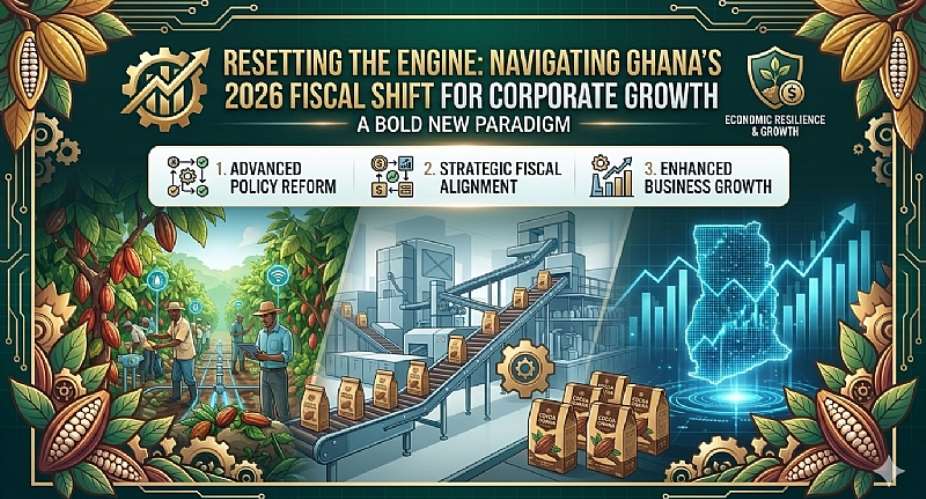
The Ghanaian economy stands at a critical crossroads. The Ghana 2026 Mid-Year Budget Review, presented by Finance Minister Dr. Cassiel Ato Forson, signals a deliberate pivot from painful stabilization to aggressive, growth-oriented restructuring. Anchored on the theme "Resetting for Growth, Jobs, and Economic Transformation," the fiscal strategy reveals striking macro victories: a stellar 6.4% GDP growth rate, a stabilized 45.0% debt-to-GDP ratio, and a formidable $11.1 billion forex buffer providing 4.8 months of import cover. Yet, beneath these roaring headlines lies a stark operational reality that businesses must navigate: a severe 41.9% contraction in capital expenditure execution and a strict commitment to fiscal discipline that slows public infrastructure rollouts. For corporate planners, this budget demands a tactical shift from crisis management to strategic, calculated expansion.
To translate these macro trends into actionable corporate planning, this blueprint analyzes the intersection of material sourcing, logistical dependencies, and credit timelines to equip Ghanaian enterprises for the remainder of 2026 and beyond.
1. Corporate Strategy Framework: Material Sourcing & Forex Exposure
The budget's macroeconomic architecture directly dictates corporate margins based on your import-to-domestic raw material ratio.
- High Import Ratio Businesses (e.g., 70% Import / 30% Domestic): Strong gold exports generating over $12 billion have built an $11.1 billion sovereign forex shield, keeping the Cedi highly stable. Corporate planners should lock in long-term forward contracts with commercial banks immediately. The stable exchange rate offers a predictable window to stock up on foreign inventory before seasonal Q4 demand pressures the currency. However, do not mistake short-term stability for permanent relief. Use this predictable fiscal window to aggressively source local alternatives, hedging against future shifts in global commodity prices.
- Balanced or Local Sourcing Businesses (e.g., 30% Import / 70% Domestic): The holding of the Bank of Ghana’s benchmark lending rate at 14.0% checks imported inflation, while public sector wage adjustments boost local purchasing power. Enterprises should reinvest capital into local supply chain integration. With zero new taxes introduced in this review, redirect saved tax capital to build robust out-grower schemes or local supplier networks. Since local demand is rising, ensure your domestic supply contracts include strict delivery SLA guarantees to handle transport bottlenecks faced by local partners.
2. Industry-Specific Tax and Policy Advantages
Choosing the Light Manufacturing & Industrial Agro-Processing sector offers optimal synergy with the 2026 budget frameworks. The specific tax advantages and regulatory mechanics under the 2026 VAT Amendment Act (Act 1151) include:
- Recoupling Input Tax Deductions: The 2026 reform fully recoupled the National Health Insurance Levy (NHIL, 2.5%) and the GETFund Levy (2.5%) into the standard VAT base. Manufacturing entities can now claim these levies back as input tax credits instead of absorbing them as structural operational costs, improving cash flow by roughly 4% to 5% on local raw material purchases.
- Abolition of Compounding Levies: The 1% COVID-19 Health Recovery Levy has been completely abolished. This removes the previous compounding "tax-on-tax" distortion, directly lowering factory gate production math. [4]
- Zero-Rated Thresholds: If your production line includes locally manufactured textiles, the 0% VAT rate remains locked in until December 31, 2028.
- Digital Enforcement Protections: The Ghana Revenue Authority (GRA) is actively rolling out mandatory Fiscal Electronic Devices (FEDs) to monitor supply chains in real time. Transitioning early shields your distribution network from unexpected audit penalties and simplifies digital cross-border VAT reconciliation.
3. Supply Chain Optimization: Navigating the Logistics Deficit
The 41.9% slump in capital expenditure means that public infrastructure expansion is heavily delayed. Businesses must optimize their supply chains based on their primary logistical footprint.
- Inter-Regional Highway Reliance: The government’s flagship GH¢30 billion "Big Push" infrastructure programme is tightly constrained, delaying key highway expansions and secondary grid connections. Companies must optimize fleet utilization and expect longer transit times between regions. Shift long-haul transport schedules to off-peak hours to reduce wear-and-tear and fuel burn on uncompleted corridors. Strategically, establish regional micro-warehouses in major hubs (e.g., Kumasi, Tamale, Takoradi) to hold buffer stock, ensuring retail markets remain supplied even when highway logistics stall.
- Localized Urban Network Reliance: Urban centers are seeing immediate demand injections from public sector pay bumps, but localized congestion remains unaddressed due to capital spending cuts. Businesses should pivot aggressively toward night-time operations by aligning with the government's 24-Hour Economy policy. Transition urban delivery fleets to automated route-optimization software. Shifting deliveries to late-evening or early-morning windows bypasses gridlock, slashes fuel costs, and fully exploits municipal night-shift security frameworks.
4. Industry and Labor Feedback: AGI and TUC Perspectives
To balance corporate plans with external pressures, managers must incorporate the latest reactions from Ghana’s primary industrial and labor bodies, which offer critical field insights on these policy directions.
- Association of Ghana Industries (AGI): The AGI has welcomed the abolition of the 1% COVID-19 Levy and the unbundling of GETFund/NHIL levies, noting that it will immediately free up corporate liquidity. However, leadership expresses strong reservations regarding the 41.9% drop in infrastructure spending, warning that raw material distribution will suffer if major highways remain stalled. AGI urges the state to channel parts of the incoming DDE liquidity specifically into an industrial credit pool to offset the rigid 14.0% policy rate.
- Trades Union Congress (TUC): The TUC strongly commends the expansion of the 24-Hour Economy framework, viewing the "1-3-3" shift model as a direct solution to the national youth employment deficit. However, labor leaders emphasize that night-shift expansions must be accompanied by strict enforcement of worker safety, fair nighttime wage premiums, and reliable municipal transport security. TUC signals that its support is conditional on businesses maintaining transparent collective bargaining arrangements during this transition.
5. Policy Evolution: 1D1F vs. The 24H+ System
To access government support effectively, corporate planners must understand how the industrial policy landscape has fundamentally changed. The previous district-bound model has evolved into a time-optimized production framework.
- Geographic Scope: The old One District, One Factory (1D1F) model was bound strictly to rural and district borders to distribute new factory footprints. In contrast, the current 24H+ Framework applies to existing and new industrial hubs nationwide, matching market density and removing restrictive location limits to allow operations inside optimal industrial zones.
- Operational Hours: 1D1F operated under standard single or double shifts (8 to 16 hours daily). The 24H+ system drives continuous output via a "1-3-3" shift model (3 distinct 8-hour shifts daily), maximizing asset utilization and tripling potential daily plant productivity.
- Energy Support: Under 1D1F, factories depended on standard grid connections with basic industrial tariffs. The 24H+ framework introduces subsidized night-shift power tariffs and priority access to green projects to lower off-peak operational energy costs.
- Port & Logistical Priority: Moving away from the standard import clearing timeframes of the previous model, the 24H+ system secures accelerated 24/7 service loops and dedicated customs fast-tracks, eliminating port demurrage fees.
- Tax Incentives: Where 1D1F utilized location-dependent income tax holidays, 24H+ focuses on duty waivers for specialized manufacturing machinery plus deep VAT credit recouping to provide immediate cash flow relief.
6. Deploying 24-Hour Economy Incentives
The Ministry of Trade, Agribusiness, and Industry has formally replaced the previous 1D1F model with the 24-Hour Economy Initiative. Your production line can register for the following specific operational incentives:
- Import Duty Exemptions: Production lines receive complete import duty waivers on approved industrial machinery, plant equipment, and critical raw materials not natively available in Ghana.
- Energy Tariff Subsidies: Registered factories shifting to the "1-3-3" shift model qualify for preferential, lower-tier electricity tariffs during the night cycle surge (10:00 PM to 6:00 AM) to offset running costs.
- Strategic Infrastructure Matching: Operating under this framework gives your company prioritized access to dedicated power setups, such as the upcoming $1.45 billion Buipe solar and battery project. This structural buffer protects against regional electricity grid lags caused by the mid-year capital spending cuts.
- Accelerated Port Logistics: The Ghana Ports and Harbours Authority (GPHA) has instituted matching 24-hour service loops. Registered manufacturers receive accelerated customs clearance processing, drastically reducing port container demurrage fees.
7. 5-Step Application Checklist for the 24H+ Secretariat
Transitioning your plant to the 24-Hour Economy requires direct endorsement from the national secretariat. Follow this sequential operational path to secure your status and incentives:
- Step 1: Conduct a Shift-Capacity Audit: Document your current labor numbers, electrical consumption metrics, and factory output capacities. Draft an explicit layout showing how your production line will transition from its current schedule into the continuous "1-3-3" shift structure.
- Step 2: Complete the Official Business Formalization: Ensure your business is in full tax compliance with the Ghana Revenue Authority (GRA) and has integrated with the mandatory Fiscal Electronic Devices (FEDs). Secure an up-to-date Tax Clearance Certificate to submit alongside your main application.
- Step 3: Submit the Technical Proposal to the Secretariat: Forward your comprehensive capacity audit and expansion plan directly to the 24H+ Secretariat under the Ministry of Trade and Industry. Detail your expected job creation numbers and specify the machinery or raw materials requiring import duty exemptions.
- Step 4: Facilitate the Secretariat Verification Visit: Host the assigned technical inspectors at your plant facility. They will cross-verify your operational setups, energy infrastructure dependencies, and localized safety measures to ensure your plant can support night-shift volumes.
- Step 5: Execute SLA Accords with Utility Providers: Upon receiving your official 24H+ endorsement letter, sign the formalized Service Level Agreements with the Electricity Company of Ghana (ECG) or GRIDCo to lock in your discounted off-peak night tariffs and secure your port customs fast-track profile.
8. Financial Blueprint: Capital Deployment & Credit Timelines
Navigating the local credit market requires precise timing, balancing the Bank of Ghana's 14.0% policy rate with massive domestic liquidity movements. While the central bank policy anchor sits at 14.0%, commercial banks are currently pricing corporate loans at an average of 16.0% to 20.0%, depending on the borrower's risk tier and credit history.
- August 2026 (The Liquidity Surge): On August 18, 2026, the state will disburse a massive GH¢10.8 billion domestic debt exchange (DDE) coupon. Commercial banks will experience a sudden surge in liquidity. Firms should initiate formal credit applications in early August to be first in line when banks look to deploy this fresh capital into less risky corporate loans. Highly creditworthy manufacturing entities should aggressively negotiate for a target commercial lending rate of 16.5% to 17.5%, avoiding standard credit risk premiums.
- September – October 2026 (The Optimal Credit Window): Banks will actively compete to lend out their excess DDE liquidity, keeping commercial borrowing rates close to the 14% policy anchor. This is your window to secure credit for asset financing, factory upgrades, or digital infrastructure. Negotiate aggressively for flexible repayment terms, citing the high liquidity in the banking sector.
- November – December 2026 (The Seasonal Squeeze): Standard Q4 commercial demand will pick up, tightening bank liquidity and increasing competition for capital. Corporate planners must freeze new credit applications. Avoid seeking local bank credit during this period, as short-term rates traditionally harden as the fiscal year closes.
9. Recommendations for Strategic Execution
- For Industries and Large Corporate Entities: Apply for state incentives under the 24-Hour Economy framework to offset energy costs and scale up extra shifts safely. Install modular, decentralized renewable energy backups (like commercial solar) to shield production lines from delayed public grid expansions. Use the current stable foreign exchange environment to clear old foreign-currency-denominated debts, protecting the business from future volatility.
- For Ghanaian Citizens and Small Businesses (MSMEs): Use this stable tax environment to formalize your business, register for digital VAT administrative systems, and access cheaper formal credit. Anticipate delays in municipal road fixes and utility rollouts; invest collectively as business associations in localized, minor infrastructure maintenance. Finally, align product offerings with the expanding purchasing power of public sector workers by introducing competitive, locally sourced consumer goods.
Seizing the Reset
The 2026 Mid-Year Budget Review offers a clear roadmap: the macroeconomic fundamentals are robust and stable, but the state is conserving its cash, leaving businesses to drive physical growth. This means the burden of infrastructure efficiency has shifted directly onto corporate operations. Success in the second half of 2026 will not belong to companies that simply wait for lower interest rates or new public roads. It will belong to agile enterprises that use today’s Cedi stability to lock in raw materials, leverage the August banking liquidity surge to secure smart credit, and re-engineer their supply chains around the 24-Hour Economy. The state has reset the macro framework—it is now up to the private sector to power the engine of economic transformation.
✍️ Retired Senior Citizen
For and on behalf of all Senior Citizens of the Republic of Ghana 🇬🇭
Teshie-Nungua
[email protected]


 Women's Development Bank has taken too long to be implemented — GUTA Vice Presid...
 'GoldBod's success story will outlive the hate-driven campaign' — Sammy Gyamfi
 Ato Forson dismisses claims of tension with Agric Minister Eric Opoku over GH¢1....
 Ghana's economy will take off after we stabilise it within two years through unr...
 President Mahama raises South Africa xenophobic attacks with Ramaphosa’s Special...
 Google Maps scam: This is why after online payment your food never comes
 GoldBod generated additional $15 billion in foreign exchange inflows — Ato Forso...
 Govt secures US$3.5 billion investment to revive upstream oil and gas sector — F...
 'Free Wontumi and all political prisoners now; we will hold your feet to account...
 NPP disqualifies Oti Regional Youth Organiser aspirant for criticising Bawumia o...

