




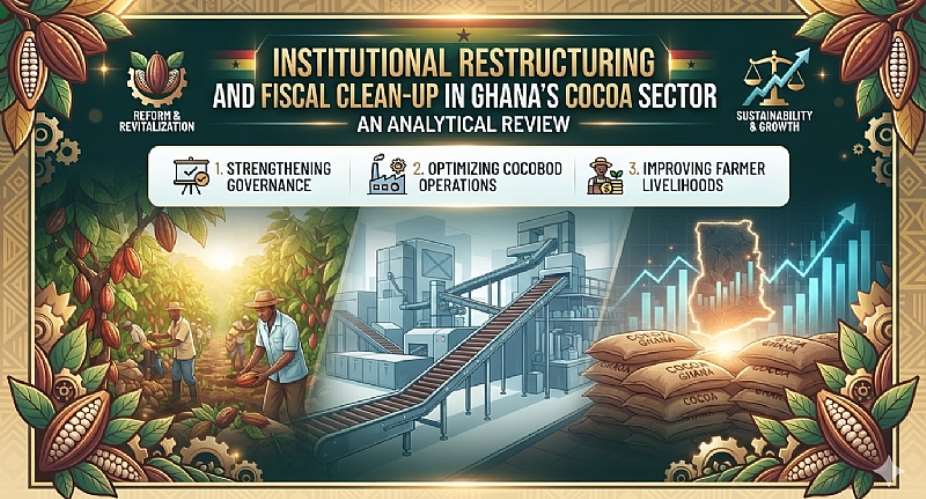
The structural and financial health of the cocoa industry dominates macroeconomic discourse following the presentation of the 2026 Mid-Year Budget Review by Finance Minister Dr. Cassiel Ato Forson. Minority Leader Alexander Afenyo-Markin criticized the omission of explicit policy announcements for the cocoa sector within the mid-year statement. However, this critique overlooks an essential fiscal reality: the current administration is heavily engaged in an intensive financial clean-up operation. This intervention is designed to untangle GH¢32 billion in accumulated legacy liabilities and operational deficits inherited from the previous New Patriotic Party (NPP) administration's eight-year tenure.
Before sustainable sector expansion can occur, systemic fiscal damage must be corrected. This analysis provides an objective assessment of current global market dynamics, the Ghana-Ivory Coast pricing intersection, and the structural reforms driving the recovery of the Ghana Cocoa Board (COCOBOD).
Macro-Fiscal Realities vs. Mid-Year Budget Omissions
- The Scope of Mid-Year Reviews: The mid-year budget review is a standard macro-fiscal tracking mechanism used to evaluate broad economic aggregates, inflation targets, and revenue performance. It is not the legally mandated venue for seasonal farmgate pricing reviews.
- Prioritizing Stabilization: Rather than introducing new ad-hoc fiscal strain, the Ministry of Finance focused the review on broad economic stabilization. This provides the fiscal space required to fund pre-existing state commitments without widening the national budget deficit.
- The Counter-Argument: The opposition's assertion that a lack of an immediate policy mention equals sector abandonment is functionally inaccurate. State efforts are currently focused on systemic debt restructuring and maintaining market liquidity over political rhetoric.
The Transnational Cocoa Pricing Framework
The sub-regional pricing dynamic between Ghana and Côte d'Ivoire reveals the intricate challenges of state-regulated agricultural markets under extreme international volatility.
[ SUB-REGIONAL PRICE INTERSECTION ] GHANA (Light Crop Farmgate Price) ➡️ GH¢2,587 per 64kg bag (approx. $3,580/tonne Equivalent) ============================================================== CÔTE D'IVOIRE (Mid-Crop Farmgate Price) ➡️ 1,200 CFA francs per bag (approx. GH¢1,216/bag Equivalent)
- The Sub-Regional Price Premium: Following a strategic price stabilization adjustments, Ghana maintained its light crop farmgate price at GH¢2,587 per 64kg bag. Conversely, a sharp dip in international futures forced Côte d'Ivoire to compress its mid-crop price down to 1,200 CFA francs (approximately GH¢1,216 per bag). This adjustment means Ghana's state-guaranteed producer price is more than double the Ivorian farmgate equivalent.
- The Forward Sales Asset Trap: International cocoa futures currently fluctuate between $5,300 and $5,700 per metric tonne. However, historical forward sales contracts executed under the previous administration locked a substantial volume of Ghana's premium yield into lower historical prices. This dynamic creates a structural deficit where current spot market windfalls cannot be fully realized by the state.
Financial Clean-up and Institutional Restructuring at COCOBOD
The contemporary financial strain at COCOBOD is the direct macroeconomic outcome of legacy liabilities, sub-optimal borrowing structures, and quasi-fiscal expenditures inherited from the prior regime.
- Resolving Restructured Cocoa Bills: Demonstrating structural integrity, the government recently cleared GH¢162 million in outstanding obligations to individual holders of cocoa bills who chose to opt out of the 2023 Domestic Debt Exchange Programme (DDEP). These individual obligations had been frozen due to systemic cash-flow constraints originating from past fiscal choices.
- A New Financing Paradigm: To lower the cost of capital and reduce vulnerability to external currency adjustments, COCOBOD is phasing out its decades-long reliance on expensive offshore syndicated loans. The board is shifting toward a tranche-based commercial paper and domestic cocoa bond architecture to borrow entirely from local commercial banks for upcoming crop seasons.
- Mitigating Cross-Border Market Distortion: Because Ghana's guaranteed producer price is double that of Côte d'Ivoire, certain Licensed Buying Companies (LBCs) have engaged in arbitrage. These entities use domestic cash allocations to purchase cheaper smuggled Ivorian beans rather than buying directly from domestic farmers.
Policy Recommendations for Structural Sustainability
- Codify the Automatic Pricing and Legal Protections: Parliament should expedite the proposed cocoa sector bill that establishes an automatic farmgate price adjustment mechanism to protect against global market dips. This framework must be paired with strict legislative enforcement, including a mandatory 10-year prison sentence for cross-border smuggling networks.
- Optimize Forward-Sales Portfolios: COCOBOD must shift away from long-term, rigid forward contract regimes. Implementing a flexible, spot-aligned hybrid marketing model will allow the state to capture unexpected price spikes on the global commodity exchanges.
- Institutionalize Domestic Value-Addition: To isolate the domestic economy from international raw commodity volatility, the Cabinet's policy directive requiring a minimum of 50% of cocoa beans to be processed locally must be aggressively funded and sustained.
- Sustain Targeted Liquidity Injections: The central government should maintain its strategy of targeted liquidity support, building on the recent GH¢2.6 billion cash injection to LBCs. This ensures that domestic farmers receive immediate cash payments, neutralizing localized credit crunches.
A Strategic Note for the Minority Caucus
The structural and financial challenges within the cocoa sector are not evidence of contemporary policy failure. Rather, they represent the complex, resource-heavy process of cleaning up an industry that faced systemic insolvency. True macro-fiscal transparency requires acknowledging that the current executive branch is methodically resolving a GH¢32 billion liability stack and settling delayed payments to local bill holders.
Minority Leader Alexander Afenyo-Markin and the opposition caucus must look past short-term political posturing regarding the mid-year budget. Sound economic stewardship requires admitting that structural rot must be cleared out before a resilient, self-financing, and locally driven cocoa economy can take its place.
Frequently Asked Questions (FAQ)
Why was the cocoa sector omitted from the 2026 Mid-Year Budget Review?
The mid-year budget review is a macro-fiscal tool used to adjust broad national targets, revenue projections, and expenditure balances. It is not the legal or operational framework for establishing seasonal cocoa producer prices. Adjustments to sector prices are handled separately by the Producer Price Review Committee (PPRC) closer to the start of the primary crop season.
What is the source of COCOBOD's current financial distress?
The financial challenges stem from an inherited GH¢32 billion debt burden, which includes a GH¢9.7 billion rollover stack of short-term Cocoa Bills from the previous administration. This structural deficit was worsened by historical quasi-fiscal expenditures (such as unbudgeted cocoa roads) and rigid forward contracts that locked Ghana into lower export prices.
Why is Ghana paying higher producer prices than Ivory Coast despite a global price correction?
Ghana adjusted its light crop producer price to GH¢2,587 per bag to insulate local farmers from inflation. Conversely, Côte d'Ivoire reacted to sharp international futures volatility by reducing its mid-crop farmgate price to approximately GH¢1,216 per bag. This policy mismatch means Ghana currently pays more than double the Ivorian rate, creating a unique market premium for Ghanaian producers.
How does the shift to a domestic cocoa bond structure benefit the economy?
By replacing offshore syndicated loans with a domestic tranche-based funding model, COCOBOD reduces its exposure to foreign currency exchange risks and minimizes external interest costs. This shift keeps financial returns within the local banking sector and encourages domestic capital development.
What steps are being taken to resolve delayed payments to domestic cocoa farmers?
The government recently injected GH¢2.6 billion into the cocoa sector, directing GH¢1.4 billion specifically to clear outstanding debts owed to farmers through Licensed Buying Companies (LBCs). This intervention is designed to ensure immediate cash distribution at the farmgate and stop illicit cross-border credit sales.
✍️ Retired Senior Citizen
For and on behalf of all Senior Citizens of the Republic of Ghana 🇬🇭
Teshie-Nungua
[email protected]

 Women's Development Bank has taken too long to be implemented — GUTA Vice Presid...
 'GoldBod's success story will outlive the hate-driven campaign' — Sammy Gyamfi
 Ato Forson dismisses claims of tension with Agric Minister Eric Opoku over GH¢1....
 Ghana's economy will take off after we stabilise it within two years through unr...
 President Mahama raises South Africa xenophobic attacks with Ramaphosa’s Special...
 Google Maps scam: This is why after online payment your food never comes
 GoldBod generated additional $15 billion in foreign exchange inflows — Ato Forso...
 Govt secures US$3.5 billion investment to revive upstream oil and gas sector — F...
 'Free Wontumi and all political prisoners now; we will hold your feet to account...
 NPP disqualifies Oti Regional Youth Organiser aspirant for criticising Bawumia o...

