




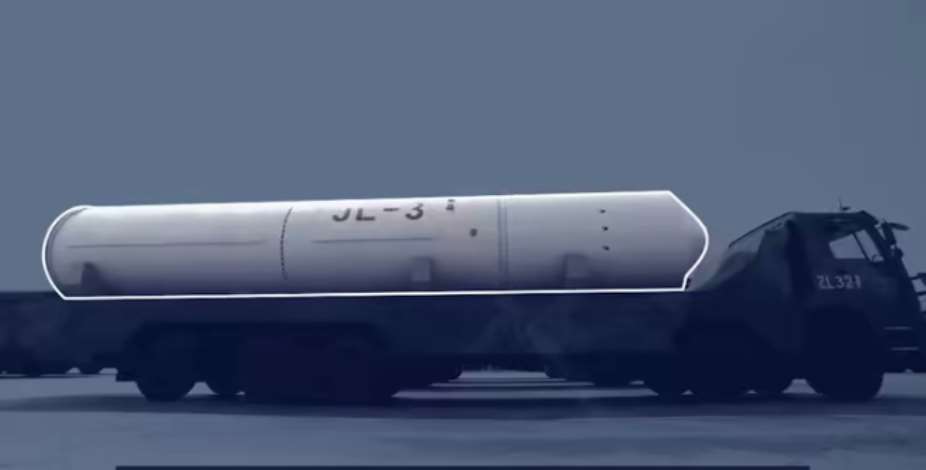
On the morning of July 6, 2026, a submerged Chinese submarine somewhere between the South China Sea and the open Pacific fired a missile that had never before left Chinese-controlled waters in this manner. It was not an act of war. It carried no live warhead. But it was, in every meaningful sense, a message one aimed less at any single adversary than at the world's understanding of where China now stands as a nuclear power.
A first for the open Pacific
The missile, believed to be either a JL-2 or the newer JL-3 submarine-launched ballistic missile (SLBM), was launched from a People's Liberation Army Navy submarine and travelled into international waters before landing, according to Xinhua, "precisely within the designated waters." Beijing described the launch as routine annual training, not directed at any country or target. It was the first time China had ever launched an SLBM into international open waters and the first public demonstration, in the Indo-Pacific specifically, that its submarine fleet can carry out a full strategic nuclear strike.
That distinction matters. China has tested land-based intercontinental ballistic missiles before, most notably a DF-31 fired into the Pacific in September 2024 itself the first such test since 1980. But a missile fired from underwater is a different proposition entirely. As one retired U.S. Navy officer observed in the aftermath, a submerged ballistic missile submarine is far harder to locate and track than a road-mobile launcher or a fixed silo. In the language of strategic deterrence, this is what analysts call "assured second-strike capability" the ability to absorb a first strike and still retaliate. Six Jin-class nuclear submarines are believed to carry these missiles for the PLA today.
The technology behind the headline
The JL-3, the more advanced of the two candidate missiles, is understood to share the same staging and general profile as its predecessor the JL-2, differing mainly in dimensions and range. Chinese state media released images of the launch, but deliberately or not none contained reference points that would allow outside analysts to confirm precisely which missile was tested. That ambiguity is itself part of the message: uncertainty about capability is, for Beijing, a form of deterrence.
What is not in dispute is the trajectory of China's broader arsenal. The Pentagon's most recent public assessment found that China had completed construction on more than 300 ICBM silos and held over 500 operational nuclear warheads, with that number projected to surpass 1,000 by the end of the decade. Washington has also released intelligence alleging a covert Chinese nuclear test at the Lop Nur site in 2020, detected through a faint seismic signature rather than any public announcement a reminder of how much of this buildup unfolds outside the reach of independent verification.
A region recalibrating
The reaction beyond China's shores was immediate. The U.S. State Department, monitoring the launch, condemned what it called Beijing's "rapid and opaque nuclear weapons buildup" as a matter of concern "to the region and the world." Australia, Japan and New Zealand also objected Wellington noting pointedly that the missile had been fired into the South Pacific Nuclear Free Zone, a zone established precisely to keep such tests out of the region. Analysts expect the test to accelerate defense cooperation among Pacific states wary of Beijing's reach, even as China insists it notified relevant governments in advance and complied with international practice.
Why this matters beyond the Pacific
For readers following Africa's own entanglement with great-power competition from Russia's Africa Corps to China's continental infrastructure and resource diplomacy this test is a useful data point. It confirms that Beijing's military modernization is not confined to land forces or regional posturing around Taiwan; it now extends to a credible, harder-to-detect sea-based nuclear deterrent.
As global power increasingly expresses itself through capability rather than declaration, African states navigating relationships with Washington, Moscow and Beijing alike will need to read these signals carefully. A submarine surfacing quietly in the Pacific says as much about the shape of the next decade as any diplomatic communiqué.
China, for its part, maintains that its nuclear posture remains at "the minimum level required for national security" and that it has no interest in an arms race. Whether the rest of the world reads the JL-3's wake in the same terms is, for now, an open question.
Mustapha Bature Sallama.
Medical/ Science Communicator,
Private Investigator, Criminal investigation and Intelligence Analysis.
International Conflict Management and Peace Building.USIP
[email protected]
+233-555-275-880
Sources
CSIS, "China's SLBM Test Underscores the Importance of a Ballistic Missile Launch Notification Agreement," July 2026 https://www.csis.org/analysis/chinas-slbm-test-underscores-importance-ballistic-missile-launch-notification-agreement
U.S. Department of State, "China Launches Nuclear Capable Ballistic Missile into Pacific Ocean," Press Statement, July 6, 2026 https://www.state.gov/releases/office-of-the-spokesperson/2026/07/china-launches-nuclear-capable-ballistic-missile-into-pacific-ocean/
The Washington Post, "What to know about China's rare ballistic missile test and why it raises concerns," July 7, 2026 https://www.washingtonpost.com/world/2026/07/07/china-missile-test-pacific-what-to-know/c5e44064-79df-11f1-b194-f872dd4ec5aa_story.html
The Washington Post, "China test fires long-range missile into Pacific, rattling U.S. allies," July 6, 2026 https://www.washingtonpost.com/national-security/2026/07/06/china-test-fires-long-range-missile-into-pacific-rattling-us-allies/
The Washington Times, "Chinese nuclear missile test flight passed near Guam," July 8, 2026 https://www.washingtontimes.com/news/2026/jul/8/inside-ring-chinese-nuclear-missile-test-flight-passed-near-guam/
CNBC, "China's rare missile test will push wary Asia-Pacific countries to close ranks, analysts say," July 8, 2026 https://www.cnbc.com/2026/07/08/china-nuclear-missile-launch-test-pacific-weapons-military-defense-alliance-australia-.html
NPR, "China test-launches a ballistic missile in the South Pacific and raises regional concerns," July 7, 2026 https://www.npr.org/2026/07/07/nx-s1-5884537/china-ballistic-missile-south-pacific
NPR, "U.S. releases new details on alleged secret Chinese nuclear test," February 17, 2026 https://npr.org/2026/02/17/nx-s1-5716046/u-s-releases-new-details-on-alleged-secret-chinese-nuclear-test
GlobalSecurity.org / Radio Free Asia, "China confirms 'successful' intercontinental ballistic missile test," September 25, 2024 https://www.globalsecurity.org/wmd/library/news/china/2024/09/china-240925-rfa03.htm


 Women's Development Bank has taken too long to be implemented — GUTA Vice Presid...
 'GoldBod's success story will outlive the hate-driven campaign' — Sammy Gyamfi
 Ato Forson dismisses claims of tension with Agric Minister Eric Opoku over GH¢1....
 Ghana's economy will take off after we stabilise it within two years through unr...
 President Mahama raises South Africa xenophobic attacks with Ramaphosa’s Special...
 Google Maps scam: This is why after online payment your food never comes
 GoldBod generated additional $15 billion in foreign exchange inflows — Ato Forso...
 Govt secures US$3.5 billion investment to revive upstream oil and gas sector — F...
 'Free Wontumi and all political prisoners now; we will hold your feet to account...
 NPP disqualifies Oti Regional Youth Organiser aspirant for criticising Bawumia o...

