





The Nandom Traditional Authority in the Upper West Region has declared its full support for the Media Coalition Against Open Defecation (M-CODe)'s one-week accountability campaign aimed at assessing the performance of Metropolitan, Municipal and District Chief Executives (MMDCEs) on sanitation following government's decision to make it a Key Performance Indicator (KPI).
The Paramount Chief of the Nandom Traditional Area, Naa Professor Edmund Delle Chiir VIII, said traditional authorities must go beyond their ceremonial responsibilities and play a more active role in monitoring public service delivery, particularly in water, sanitation and hygiene (WASH).
Speaking in an interview at Nandom, Naa Prof. Delle Chiir VIII described sanitation as a critical public health, dignity and development issue that requires the collective involvement of government, traditional leaders and citizens.
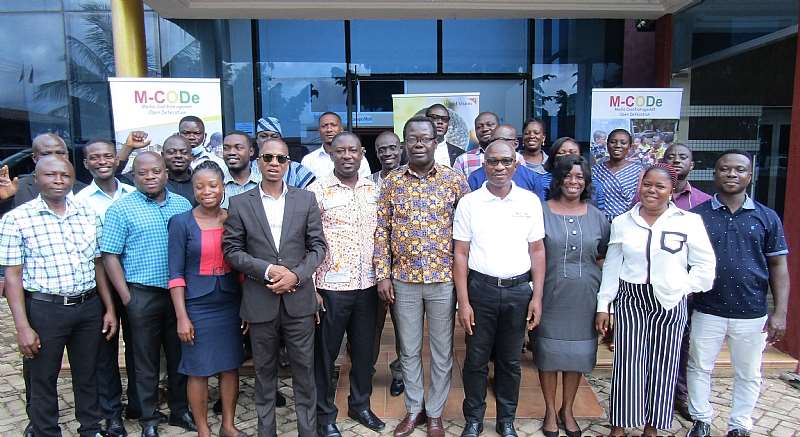
The Media Coalition Against Open Defecation (M-CODe), with support from World Vision Ghana, is rolling out a nationwide accountability exercise from Monday, July 20 to Saturday, July 25, to assess how MMDCEs are implementing the government's directive that makes sanitation a Key Performance Indicator.
Under the theme, "Institutionalizing Sanitation Performance," the campaign marks the first phase of M-CODe's national revitalisation agenda and seeks to position the media as an accountability bridge between government, traditional authorities, local assemblies and citizens in the fight against open defecation and poor sanitation.
The first phase of the exercise will be conducted in the Upper East, Upper West, Northern, Ashanti, Western and Greater Accra regions, with the remaining regions to be covered during the second phase.
Naa Prof. Delle Chiir VIII stressed that chiefs have a responsibility to demand accountability on sanitation issues because they are often the first point of contact when disease outbreaks occur within their communities.
"As chiefs, we are the custodians of the land and the first point of call when disease breaks out in our communities. If our towns are choked with refuse, if our drains are blocked, if our people lack decent toilets, then we must ask questions, and we must demand answers from those entrusted with power," he said.
The Paramount Chief, who is a dermatologist with more than 40 years of medical practice and Founder and President of Rabito Clinics, linked poor sanitation directly to preventable diseases such as cholera, typhoid, diarrhoea and malaria.
“From a medical perspective, prevention is cheaper than cure. A clean environment is the first clinic. That is why this M-CODe accountability week is timely and necessary,” he stated.
He called on divisional chiefs, queen mothers and opinion leaders across the Nandom Traditional Area and the country to mobilise their communities to participate actively in sanitation monitoring, clean-up exercises and engagement sessions with district authorities.
Naa Prof. Delle Chiir VIII further aligned the campaign with the United Nations Sustainable Development Goals, particularly SDG 6 on Clean Water and Sanitation and SDG 11 on Sustainable Cities and Communities.
“Ghana committed to SDG 6: to ensure availability and sustainable management of water and sanitation for all by 2030. We cannot meet that target if our districts are not accountable every year, every quarter, every week,” he said.
He noted that traditional authorities possess both constitutional and cultural legitimacy, making them key partners in implementing sanitation policies at the community level.
According to him, chiefs play vital roles in providing land for landfill sites, influencing behavioural change on open defecation and supporting the enforcement of sanitation by-laws.
“Development without the chief is like a body without a head. Government brings the policy. The assembly brings the budget. The chief brings the people. All three must work,” he added.
The Paramount Chief appealed to MMDCEs, assembly members, civil society organisations, schools, religious bodies, community members and the media to fully support the M-CODe initiative.
“I am calling for massive support for this project. Let every house sweep its compound. Let every market sweep its stalls. Let every assembly fix its drains. And let every MMDCE account for what they have done with sanitation funds,” he urged.
The National Convenor of M-CODe, Mr Francis Ameyibor, said the campaign is intended to promote transparency and accountability rather than target public officials.
“When citizens and traditional leaders track performance together, MMDCEs are more likely to deliver,” he said.
Mr Ameyibor encouraged traditional councils nationwide to establish Sanitation Monitoring Committees that would meet regularly with their respective assemblies to review sanitation performance and develop practical solutions to local sanitation challenges.
He explained that the campaign seeks to strengthen collaboration between the media, traditional authorities, local assemblies and citizens to eliminate open defecation and improve environmental sanitation across the country.
Mr Ameyibor noted that the President's decision to make sanitation a Key Performance Indicator for MMDCEs has shifted sanitation from being a policy aspiration to a measurable governance obligation.
He said the media would monitor whether sanitation budgets are utilised effectively, by-laws are enforced and district leaders fulfil their responsibilities.
He further appealed to development partners, government institutions, traditional and religious leaders, environmental service providers, media organisations and the general public to provide financial and logistical support to ensure the success of the initiative.
Also speaking on the project, the WASH Technical Specialist at World Vision Ghana, Mr Yaw Attah Arhin, described the campaign as a significant step toward improving accountability in the sanitation sector.
“Sanitation as a KPI is a bold step. This media-led accountability week ensures that commitments translate into measurable results for the most vulnerable communities,” he said.
Mr Attah Arhin added that the campaign is expected to increase public awareness that sanitation is now a measurable performance indicator for MMDCEs rather than a discretionary responsibility.

 'EOCO attempted arrest of Baffour Awuah was unprofessional' — James Agalga
 'Building a congregation of 20,000 will kill you' – Duncan-Williams tells young ...
 September 29: Cedi finishes day selling at GHS12.20 on forex market, GHS11.67 on...
 ‘We’ll explore another constitutional option for narcotics probe’ – Minority on ...
 Speaker Bagbin adjourns Parliament indefinitely after rejecting narcotics probe ...
 Food Buffer Stock seeks stronger liquidity buffer despite record GH¢91.7 million...
 Ex NAFCO Boss trial: Court adjourns trial to hear application for return of seiz...
 Bagbin backs Mahama’s call for national dialogue on social media insults


