




Nearly a month after Washington and Tehran signed an interim peace deal designed to put an end to the US-Israeli war against Iran, drones and missiles are once again hurtling back and forth across the Persian Gulf.
Incensed by the US attempt to undercut Iran's de facto control of the crucial Strait of Hormuz by urging container ships to take an alternative route along the Omani coast, Tehran has renewed its attacks on freighters crossing the narrow waterway through what it describes as “unauthorised” routes.
The US, in turn, has launched deadly air strikes against military infrastructure across Iran's southeast coast, prompting Tehran to once again target Gulf states hosting US military assets.
Read more Middle East live: US military conducts '90-minute wave' of strikes on Iran
Washington on Tuesday reimposed a naval blockade on Iran's ports, and US President Donald Trump has threatened to target civilian infrastructure – including bridges and power plants, in possible contravention of international law – if Tehran doesn't come back to the negotiating table.
So far, unfortunately, so familiar.
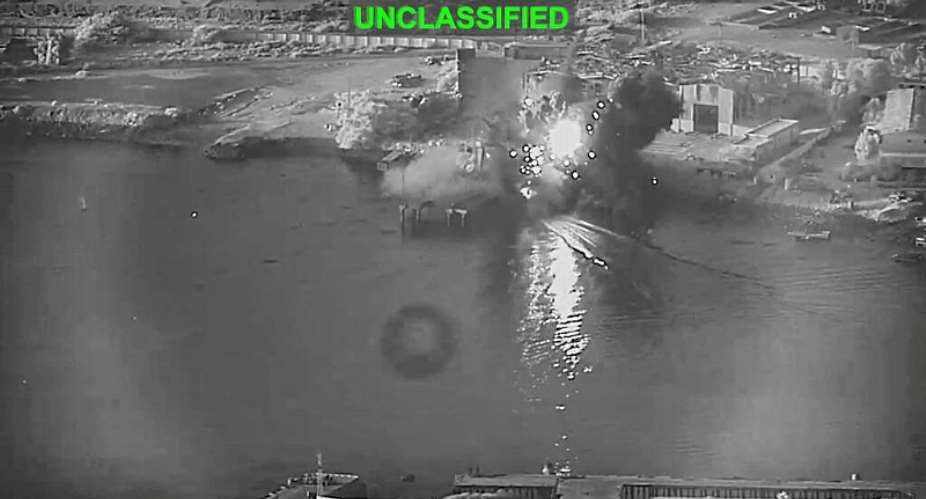
But on Sunday night, the US unleashed a new weapon in its vast arsenal. Black-and-white footage posted on social media by US Central Command (CENTCOM) shows three unmanned boats surging through the water towards what the US military alleged was a submarine and ship maintenance facility in the port city of Bandar Abbas.
The footage lurches to a first-person view, taking us behind a drone's lifeless eye, and colour returns to the world.
A moment before impact, the footage returns to a grainy aerial shot and the pier is lost in black smoke and white fire. It was the first time that the US has deployed naval drones in combat.
Yesterday, using multiple one-way attack surface drones, CENTCOM forces successfully struck a submarine and ship maintenance facility in Iran. Three Corsair unmanned surface vessels hit the port at Bandar Abbas Naval Base, marking the first time American forces have employed sea… pic.twitter.com/bOM2kmgRxz — U.S. Central Command (@CENTCOM) July 13, 2026
Bandar Abbas has been hit hard by the war. The city of more than half a million people, home to the country's largest container terminal and responsible for more than half its maritime traffic, has been battered by US air strikes since the end of February as Washington sought to break the Islamic Republic's naval power.
Data pulled together by the Armed Conflict Location and Event Data Project reported at least 96 separate US strikes in and around the city between the outbreak of the war and the announcement of a ceasefire. A third of these are thought to have targeted military infrastructure, including missile sites and naval infrastructure.
One such strike killed Revolutionary Guards naval commander Alireza Tangsiri, bringing half an apartment building down with him.
Home to both Iran's Navy and the naval arm of the Revolutionary Guards, the port city holds a peerless strategic position on the northern shore of the Strait of Hormuz, the narrow waterway that in peacetime saw more than a fifth of the world's oil and liquefied natural gas exports flow through it.
Blocked by Tehran following the outbreak of the US-Israeli war on Iran, control of the critical crossing has become the Islamic Republic's most effective deterrent – and a potential source of much-needed income should Tehran emerge from the war with licence to levy fees on ships transiting the strait.
Read more US-Iran ceasefire: Why Tehran wants to charge ships for crossing the Strait of Hormuz
Land-based defence
The Memorandum of Understanding signed by the two countries in June declared that Tehran would dedicate its “best efforts” to allowing commercial vessels to safely transit the strait for 60 days. In the meantime, Iran and Oman – which sits on the other side of the waterway – would agree on the “future administration” of the strait.
Tehran maintains the interim deal acknowledges its right to manage traffic through the waterway, a key point the US disputes.
This disagreement now threatens to plunge the region back into war and the global economy back into chaos. Last week, the US military carried out a series of strikes to “further degrade Iran's ability to attack commercial shipping”, taking out what it said were radars, air-defence systems and more than 60 small boats used by the Revolutionary Guards.
Bilal Saab, senior managing director of the TRENDS US research centre and a former Pentagon official during the first Trump administration, said that Bandar Abbas continues to serve as the backbone of the Islamic Republic's maritime logistics.
“You can't talk about Iranian coastal defence without talking about Bandar Abbas,” he said. “It's the hub for maritime logistics. You take that out, you cripple Iran's maritime capabilities.” Three boys play in the shallow waters of the Strait of Hormuz, as a plume of smoke rises from an explosion in the background, off Bandar Abbas, Iran, Monday, July 13, 2026.
The shock US-Israeli assault that began in February devastated Iran's conventional navy, destroying or disabling more than 155 warships as of the start of April – effectively sinking the Islamic Republic's fleet before its warships could leave port. But the loss of this naval power has done little to stop Iran from cutting off freight traffic through the Hormuz Strait at will.
“Iran's defence of the Strait of Hormuz is largely land-based,” according to a Jamestown analysis released in June. “Iran mainly defends the strait by aerial drones and a variety of land-based missiles and sea drones launched from hardened positions rather than using conventional naval vessels. With the addition of mines dropped from small speedboats, passage through the strait becomes a precarious enterprise, even for powerful naval vessels.”
The decentralised command structure of the Revolutionary Guards' naval branch – a legacy from the grim years of the Iran-Iraq war – has made it well-suited to the kind of asymmetric warfare that Iran has used to withstand the US-Israeli onslaught.
Nonetheless, analysts believe that much of the Islamic Republic's maritime command-and-control facilities remain concentrated in and around Bandar Abbas – as does a great deal of its coastal surveillance and drone infrastructure.
Saab said the US strikes appear to be part of a long-term strategy to deal real lasting damage to Iran's ability to challenge Washington's unrivalled naval dominance.
“CENTCOM is deliberately destroying infrastructure in Bandar Abbas, not just ships,” he said. “Infrastructure is long term. Ships are easily replaceable. Dry docks, repair yards and all of the maintenance that's needed to sustain Iranian naval power are not.”

 NPP protests over Miracles Aboagye's arrest misplaced — Akwatia MP
 I did not go to Kumasi to apologize on behalf of Okatakyie Afrifa — Jerry Ahmed ...
 BoG Governor's appearance: Minority, Majority clash over media coverage
 COCOBOD settles GH¢162 million owed to non-DDEP cocoa bill holders
 NPP annuls constituency elections in Adansi Asokwa, Bantama and Afigya Sekyere E...
 Mahama heads to Volta Region on Thursday for 'Resetting Ghana Tour'
 GoldBod honours NACOC with GH¢12.65m reward for anti-gold smuggling operation
 Miracles Aboagye's GH¢50 million bail conditions weren't impossible to meet — Kw...
 No forest reserve has been lost to illegal mining under Mahama government — Land...

