




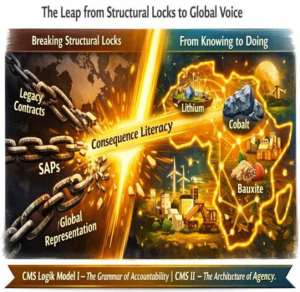
“In Africa, our forefathers’ fight was for the Liberation of our Lands and self‑rule. Today, our fight is for the Liberation of our minds.” — Albert K. Owusu
Beyond External Dependency
Dependency is not only external; it is also internal — embedded in curricula, governance, and the shaping of African mindsets. Afrobarometer’s 2025 flagship survey across 43 African countries found that while voting is widespread, citizen participation in protests, forums, and policy advocacy remains minimal, constrained by fear and weak accountability. The World Bank’s 2025 Worldwide Governance Indicators similarly show Africa scoring below 40/100 on Voice & Accountability and below 35/100 on Government Effectiveness, underscoring persistent weaknesses in institutional independence and civic engagement. These are not merely economic locks but structural ones, shaping how Africans perceive agency and stewardship
CMS argues that Africa must dismantle inherited frameworks and rebuild governance on consequence, not comfort. The CMS Trilogy translates this critique into practical tools for curricula, institutions, corporations, nation‑states, RECs, AfCFTA, and the AU. It is not abstract theory; it is a grammar of accountability, an architecture of agency, and a covenant of stewardship.
Football as a Mirror of Governance
At the 2026 FIFA World Cup, Morocco reached the quarter‑finals but fell to France; other African teams exited earlier. This outcome is not evidence of governance failure, but it illustrates familiar patterns: inflated honorariums, interference in management, and weak transparency. Transparency International’s 2025 Corruption Perceptions Index ranks Sub‑Saharan Africa as the lowest-performing region globally, with an average score of 32/100 and only four countries scoring above 50. UNDP’s 2025 governance review similarly finds that accountability mechanisms remain fragile and citizen participation limited, underscoring the institutional weaknesses CMS seeks to address.
Cabo Verde’s disciplined professionalism offers a counterexample. Their collective stewardship earned admiration and boosted tourism — showing how custodianship and competence can translate into tangible outcomes.
Business and Industry: Extraction Without Transfer
In many African commercial centres, foreign firms dominate key sectors. Reports by the African Development Bank (African Economic Outlook 2025) note that while foreign investment brings capital, weak enforcement of knowledge transfer and regulatory oversight often limits local capacity building. The report estimates that Africa loses over $275 billion annually through profit shifting and base erosion, alongside $90–148 billion in illicit financial flows and corruption. These leakages underscore the need for consequence‑driven governance to ensure investment translates into retained value and citizen benefit.” This is dependency in practice: regulatory gaps and patronage politics incentivize decisions that prioritize short‑term or personal interests over collective stewardship.
“The liberation of our minds is not a slogan. It is the foundation for every reform, every policy, every act of stewardship that will define Africa’s next chapter.” — Albert K. Owusu
Structural Governance and Imported Hierarchies
Institutions such as AfCFTA and the AU often rely on external funding, shaping mandates in ways that reflect donor priorities. Research by the OECD (Africa’s Development Dynamics 2025) and UNCTAD (2025) shows that external subsidies and debt‑linked financing often distort institutional independence, aligning governance reforms with donor priorities rather than African strategic visions. UNCTAD estimates that least‑developed countries spend over 22% of government revenue on external debt service, diverting resources from education and health. These findings underscore
CMS’s call for consequence‑driven governance grounded in Africa’s epistemic foundations. Breaking these locks requires capable, professionally trained Africans to design & implement reforms. Yet proximity governance — where closeness to power matters more than competence — remains entrenched. Patronage, party card membership, and plagiarism dominate, undermining custodianship and consequence.
Civic Participation and Global Perceptions
Afrobarometer’s 2025 survey across 43 African countries found that while voting is widespread, citizen participation in protests, forums, and policy advocacy remains minimal. Fear of political persecution and weak accountability mechanisms constrain engagement, with trust in parliaments and political parties consistently below 40%. These findings underscore CMS’s call for consequence‑driven governance grounded in custodianship and accountability. The consequences extend globally: Africa’s low ranking on human development indices reinforces perceptions of instability and dependency.
This is not accidental — it is the outcome of leadership that prioritizes patronage over competence. When governance fails to embody vision and custodianship, consequences ripple outward: Africans everywhere are judged through the lens of dependency rather than dignity.
CMS in Practice
CMS proposes Consequence Metrics (CCM) as a corrective lens that complements GDP and ESG. The CCM grid captures what it measures — making visible dimensions of value retention, knowledge transfer, custodianship, and consequence literacy that conventional frameworks overlook.
- Custodianship, not entitlement: Leadership as stewardship, elevating collective dignity.
- Outcome thinking: Legitimacy measured by results, not optics.
- Consequence‑driven leadership: Decisions judged by impact, not intentions.
- Mindset awareness: Citizens ask, “Who benefited from my leadership?”
Proposed CMS Consequence Metrics (CCM): A New Grammar of Accountability
- CMS calls for a shift from GDP and FDI as the dominant measures of progress to Consequence Metrics (CCM) — a framework that embeds retention, custodianship, and consequence into measurement. The CCM grid captures what it measures, making visible dimensions of governance and citizen welfare that GDP and FDI overlook
| Existing Metric | CMS Consequence Metric | What It Captures |
| GDP (Gross Domestic Product) | Value Retention Index (VRI) | How much of GDP remains after profit repatriation |
| FDI Inflows | Knowledge Transfer Score (KTS) | Whether foreign firms build local capacity and whether it benefits the nation |
| Leadership Optics | Custodianship Quotient (CQ) | Decisions judged by collective benefit, not personal gain |
| Policy Announcements | Consequence Literacy Index (CLI) | Anticipation of ripple effects on citizens and ecosystems |
| Elections | Civic Agency Metric (CAM) | Citizen participation beyond voting — audits, accountability, transparency |
Closing Invocation
Dependency Theory has long explained Africa’s position in the global economy. Recent scholarship confirms its relevance: Yende (2025) shows how IMF and World Bank reforms perpetuate Africa’s underdevelopment; Kapoor & Vasishta (2026) highlight aid dependency and great‑power competition as structural locks; and Okeke & Iroro (2026) argue that even under multipolarity, Africa’s global engagement remains shaped by dependency dynamics.
These findings underscore CMS’s call for consequence‑driven governance as a corrective lens.
NB.
CMS Consequence Metrics (CCM) is proposed as an African‑authored governance framework. The CCM grid captures what it measures — making visible dimensions of value retention, knowledge transfer, custodianship, and consequence literacy that GDP and ESG overlook. Unlike purely academic models, CMS is informed by lived realities of governance implementation at senior levels across corporations and institutions in Europe and Africa.
Author Bio
Albert K. Owusu is the founder and architect of the Consequential Management System (CMS), an African epistemic governance framework authored and codified across three volumes. A global strategist, financier, and policy architect, he draws on lived experience of governance implementation, integrating consequence‑based measurement with institutional reform.


 Highly influential people sponsoring Ghana Jollof TikTok activities – CID
 'Ghana Jollof' case: Bawumia's condemnation of nurse's arrest is hypocritical – ...
 Ahafo Ano South West MP involved in road accident
 Constitutional Review alone will not solve Ghana’s problems – Kwesi Pratt Jnr.
 East Legon Football Academy applauds NPA Boss for supporting youth football
 Gov't didn't show NPP enough respect in constitutional review process – Martin K...
 September 18: Cedi sells at GHS12.15 on forex market, GHS11.53 on BoG interbank
 Lawyer challenges two-week remand of Salomey over connection to wanted 'Ghana Jo...
 Minority calls for NSA boss Ampofo Ankrah, others to be dismissed over alleged 2...
 ‘You gave us GH¢60,000 to run 66 offices nationwide and expect us to function?’ ...


