




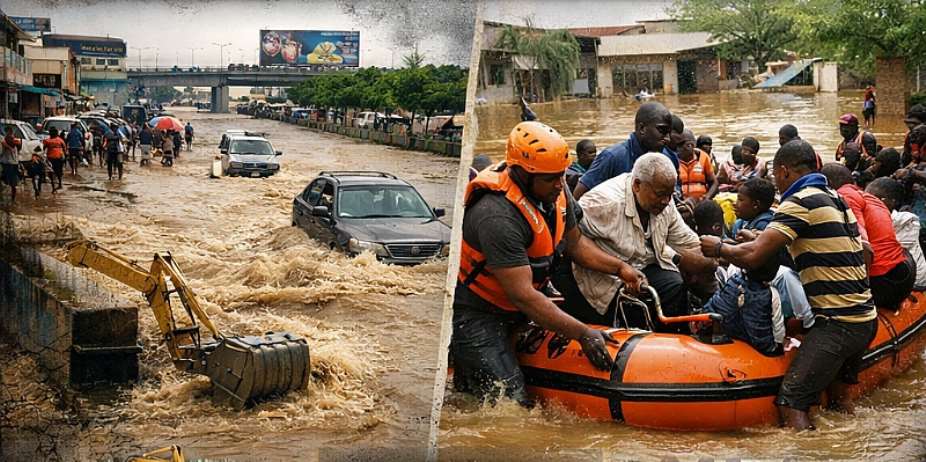
Since 1935, Ghana has recorded flooding incidents every year. What began as an urban challenge in Accra has grown into a nationwide crisis, with cities including Kumasi and Takoradi regularly submerged during the rainy season. Flood events routinely affect at least 110,813 households nationwide. In May 2025, a single three-hour downpour killed four people and displaced more than 3,000 in Accra. On June 29, 2026, floods struck Accra again, killing at least 12 people. When citizens cannot walk safely through their neighborhoods or protect their homes and livelihoods from rising water, their fundamental rights to life and adequate housing are threatened. Ghana can protect its citizens only if the government enforces land-use regulations, modernizes drainage infrastructure, and builds an early warning system that gets flood information to people before disaster strikes.
Ghana's recurring floods destroy homes, displace families, and set back economic progress. National flood data compiled from 1935 to 2023 records more than 3,000 flood-related deaths and over 700,000 people displaced in less than a century. Choked drains, buildings constructed on waterways, and neglected infrastructure turn every rainfall into a preventable disaster. Flooding is also a failure of civic responsibility. Citizens who dump waste into drains and tolerate illegal construction on waterways are as much a part of the crisis as governments that have failed to act.
Weak enforcement of land-use regulations is one of the most cited drivers of flooding across Ghana's cities. Buildings are erected on wetlands, floodplains, and designated watercourses, blocking natural drainage corridors. With waterways obstructed, even well-designed drainage systems cannot function. Therefore, addressing this challenge requires enforcement of existing land-use regulations. The Town and Country Planning Department should immediately halt approvals for developments on floodplains and enforce existing zoning laws without exception. The Lands Commission must digitize land records and stop the sale of wetlands to developers. Metropolitan, Municipal, and District Assemblies need to conduct regular inspections and demolish non-compliant structures with consistent political backing. Citizens, too, have a role to play by reporting illegal construction through community platforms instead of quietly tolerating it. Rwanda offers a model of what this can look like at a national scale. The country treats flood prevention as a long-term planning priority rather than a seasonal response, and has embedded land-use compliance into its development strategy and built nature-based flood defenses across Kigali's most exposed neighborhoods. Consistent enforcement, such as that in Kigali, protects communities before the rains arrive.
However, land-use enforcement alone cannot protect Ghana's cities if the infrastructure meant to move water safely is itself broken. Ghana's drainage systems were designed decades ago for cities with a fraction of their current population. Many drains across the country are too narrow, poorly connected, or structurally incapable of handling intense rainfall runoff. The Greater Accra Resilient and Integrated Development (GARID) project by the World Bank committed $350 million toward drainage improvements. As of early 2026, only about 40 percent had been disbursed, funding delays have stalled critical works, and the closing date has been pushed back to 2027. Funding exists, but without consistent execution and political will, Ghana's drainage crisis will persist long after the project closes.
The Ministry of Roads and Highways should mandate that every new road include a functional drain as a condition of approval. The Ghana Hydrological Authority may need to conduct a nationwide audit of undersized and broken culverts and publish a prioritized repair schedule. Public-private partnerships offer a route to unlock corporate investment in drainage infrastructure through tax incentives. Citizens, for their part, must keep drains in their immediate communities clear of waste and debris. Clean drains alone can prevent some of the most localized and recurring flood incidents across Ghana's neighborhoods.
In addition to enforcing regulations and modernizing infrastructure, Ghana must prepare for the floods that still get through. What separates a flood from a national disaster is how early the government sees it coming and how fast that warning reaches the people at risk. Ghana already collects rainfall data from the Ghana Meteorological Agency and river data from the Ghana Hydrological Authority, but neither feeds into a single system that can issue timely, local warnings.
A National Flood Intelligence and Early Warning System would connect these data sources into a single platform, similar to how health information systems turn scattered patient data into one shared dashboard. The Meteorological Agency and Hydrological Authority can run the technical side, while the National Disaster Management Organization (NADMO) can turn the data into SMS alerts and community warnings that name specific at-risk streets, not just regions. Local volunteers serve as the last link, reaching households before water rises. Bangladesh demonstrates what early warning systems can achieve. Cyclone Gorky in 1991 claimed 147,000 lives in the country. By 2007, investment in warning and evacuation systems reduced the death toll from a comparable cyclone to 4,500 lives.
A country that floods annually without building resilience is not fighting nature; it is fighting itself. Ghana has the laws, the resources, and the knowledge to protect its cities. Enforcing land-use regulations, modernizing drainage systems, and building an early warning system can turn the situation around permanently. If governments continue treating floods as weather events rather than human rights failures, the losses will compound. More lives, more livelihoods, and more cities are unable to function when it rains. The solutions exist, and the choice now belongs to those in office and the citizens who put them there.
Gideon Danso is a writing fellow at African Liberty.

 How IGP Yohuno led Police team to rescue victim, arrest four kidnappers in Assin...
 Akufo-Addo would have used Accra-Kumasi expressway for galamsey – Mahdi Gibrill
 Nigeria's Dangote refinery launches continent's biggest IPO
 Accra-Kumasi Expressway to cut travel time to 2hours, drive 120km per hour — Mah...
 'Our own money $2billion ready, we have not gone to borrow money from anywhere' ...
 Founder’s Day September 21 declared public holiday
 Council of State was not qualified to determine prima facie case against Torkorn...
 'Grounds for removal of Chief Justice and justice of superior court shallow, eph...
 Don't be a Bar that flips on principles but a Bar that is consistent — AG tells ...
 Prostate cancer may show no symptoms until advanced stage – Urologist warns


