




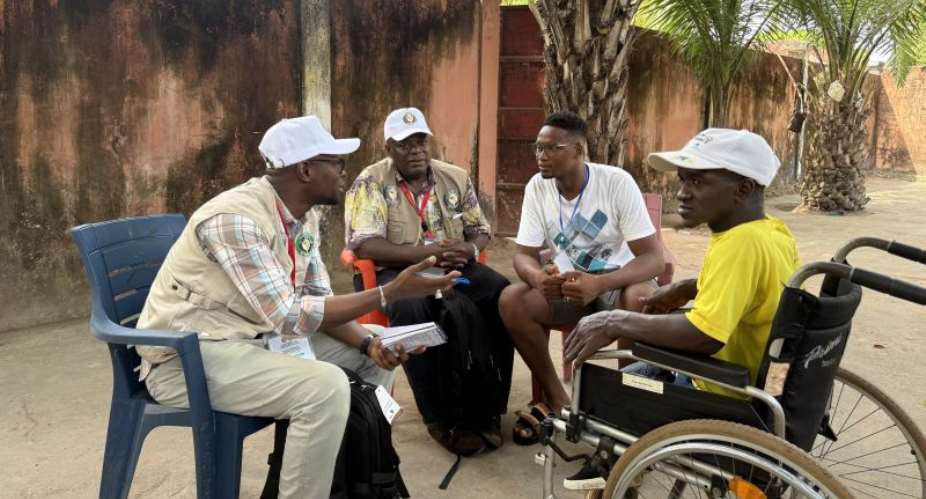
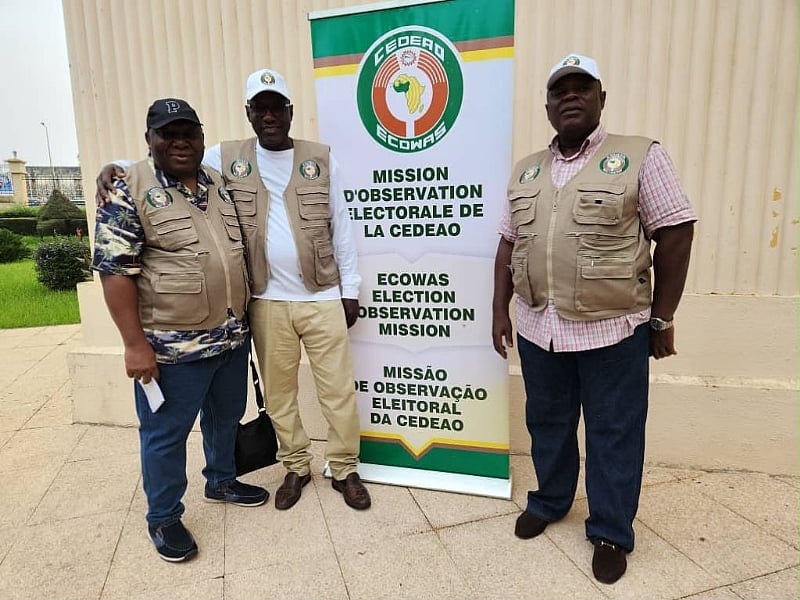
I write this article as a, Ghanaian, Patriot, Nationalist, God-fearing Nation Builder, and an ECOWAS International Elections Observer, who is deeply (rightly so), worried about a sustained attempt by some persons to destroy Ghana’s democracy – instead of having a mindset transformation for positive growth, nurturing a negative mindset transformation that would only reset Mother Ghana in the wrong direction.
Constitutions are Not Rags to Wipe Feet On
A constitution earns its authority from the fact that it means roughly the same thing on a good day as it does on a bad one — that its words cannot be stretched, on demand, to fit whatever a person in power (with his/her paid/rented assigns) happens to want at a particular point in time to suit a very selfish and parochial megalomaniac interest.
The moment Ghana starts treating Article 66(2) — "a person shall not be elected to hold the office of President for more than two terms" — as a puzzle to be solved in someone's favor rather than a limit to be honored, it has stepped onto thin ice and sitting on very dangerous explosives, and all well-meaning Ghanaians have every reason to watch that ice and explosives closely.
What Is Actually on the Table Right Now?
Two live developments deserve to be named plainly, because vague alarm helps no one, and precise vigilance helps everyone.
First, a Constitutional Review Committee (CRC), chaired by law professor Henry Kwasi Prempeh (HKP), delivered a 127-page report in December 2025 recommending — among many other things — that presidential and parliamentary terms move from four years to five.
Crucially, the Committee paired that proposal with an explicit reaffirmation of the two-term cap, and HKP told the nation there was no demand for lifting term limits "even from the incumbent president," adding that the limit is precisely what has let Ghanaian democracy mature.
That is not, on its face, a life-presidency scheme; it is a debate about term “length”, running alongside a menu of other reforms (capping ministers, taxing the president's salary, opening former presidents to civil and criminal suits after they leave office).
Second, and separately, two private citizens have filed separate Supreme Court writs in July 2026 asking the Apex Court to interpret whether Article 66(2)'s two-term cap applies to two *consecutive* terms only, or whether it bars anyone who has served two terms — even with a gap in between — from running again.
Those who are seeking interpretation are not telling us exactly what they seek to benefit from having an individual serve more than two terms, but we do not have to be clairvoyants to know for a fact what the driving force behind their intentions are.
It is trite philosophical deduction that “behind every reason, is the real reason”. So, behind the reason for the interpretation is the real reason of someone or some people wanting to benefit from the interpretation they are seeking.
Why the Underlying Risk Is Not Paranoia
The reason this subject deserves such careful handling is that the continent's recent history gives this fear real weight, even where no “wrongdoing” has been proven.
Uganda: Yoweri Museveni's government removed presidential age limits in 2017 and had already scrapped term limits in 2005, clearing the path for a rule that has now stretched close to four decades.
Burundi: Pierre Nkurunziza's pursuit of a third term in 2015, on a contested reading of the constitution, triggered a coup attempt, mass unrest, and a wave of refugees before he died in office in 2020.
Guinea: Alpha Condé pushed through a new constitution in 2020 that reset his term clock, won a widely disputed third term, and was overthrown in a military coup within a year.
Côte d'Ivoire: Alassane Ouattara argued a 2016 constitutional rewrite reset his term count, enabling a third term in 2020 amid deadly protests.
Togo: The Gnassingbé family has held the presidency continuously since 1967, aided by constitutional and electoral-system changes along the way.
Republic of Congo: Denis Sassou Nguesso has used constitutional amendments across decades to remain in office since 1997 (and earlier, from 1979).
Benin: In 2025, Benin, one of the most stable democracies in Africa, got badly jolted with a near-successful junta take-over because the constitution had been amended to allow for the incumbent, Patrice Tallon, to literally plant his preferred successor on the nation and also plant himself in a newly created Upper Chamber that allows him to “sit on top” of his “puppet”.
The pattern across these cases is not that a leader simply announced, "I am staying." It is almost always narrower and more procedural than that: a constitutional commission, a technical argument about non-consecutive terms, an age-limit tweak, a "reset" theory following a new constitution.
The mechanism is legalistic before it is dramatic. That is exactly why the current Ghanaian debate — however innocent its stated intentions — deserves sustained public attention rather than a shrug.
Sunlight and scrutiny are cheap insurance against a pattern that has been expensive everywhere it has taken hold.
Systems That Have Kept Ghana Different So Far
Ghana's Fourth Republic has a real record to be proud of: eight consecutive credible elections since 1992, four peaceful transfers of power between the two major parties, and unbroken presidential adherence to the two-term limit.
Ghana is one of the few West African states where every single president since the rule applied has stepped down on schedule.
On, January 7, 2021, when I saw President Jerry John Rawlings handing over to newly-elected, President John Agyekum Kufuor, I knew that Ghana’s democracy had come to stay.
These positive happenings are not an accident. It reflects an electoral process that cannot be easily manipulated by either the incumbent nor the opposition, a judiciary willing to rule against sitting governments, a press and civil society willing to hit the right decibels publicly, and a citizenry that treats the ballot box as a non-negotiable weapon which must be used to punish those who abuse their mandate.
The entrenchment provisions in Ghana's constitution are also a genuine structural safeguard.
Amending core provisions, including, notably, the amendment procedure itself - requires not just a two-thirds parliamentary supermajority but a national referendum with 40% turnout and 75% approval.
This is a high bar, deliberately so, and it is one reason Ghana has resisted the kind of one-party constitutional railroading seen elsewhere.
What Vigilance Actually Looks Like
Being "on guard" is not the same as assuming bad faith. Useful vigilance must wear these helmets of steel:
1. Citizens keeping a close eye on the Supreme Court's eventual ruling on the non-consecutive-terms question closely, and judging it on legal reasoning, not on who benefits.
2. Distinguishing genuine governance reforms (five-year terms, spending caps, post-office accountability for former presidents) from anything that would touch the two-term cap itself — and treating any move toward the latter as a five-alarm issue regardless of which party proposes it.
3. Insisting that any constitutional amendment affecting presidential tenure go through the full referendum process the constitution requires, with no shortcuts.
4. Demanding transparency and time for public debate — Ghana's own constitution requires Gazette publication and waiting periods for exactly this reason, so the public is not asked to ratify what it has not had time to understand.
5. Applying this standard consistently, to every party and every leader, rather than only when it is politically convenient.
Let Us Not Look for Trouble Where There Is No Trouble
Ghana does not need to import anyone else's crisis to take this seriously.
The country's own history of resisting military rule when it does happen, and building a durable multi-party system is reason enough.
The lesson from Kampala, Bujumbura, Conakry, Abidjan, Lomé, and Brazzaville, Cotonou, is not that Ghana is destined to repeat it — it is that the guardrails that have held so far (the courts, the press, an engaged public, the referendum requirement, etc.,) are precisely what has made the difference, and they only work if people keep using them.
A constitution interpreted honestly protects everyone – majority and minority (as has been witnessed consistently, the majority today, easily becomes the minority tomorrow).
A constitution interpreted to fit one person's convenience protects no one, including, eventually, that person.
Ghana's four-decade record of getting this right is worth defending on the facts — not through claims the facts don't yet support, but through the same vigilance, transparent process, and stubborn insistence on term limits that built that record in the first place.
Let us hold on steadfastly to the covenant words of our National Anthem and “… resist oppressors’ rule with all our will and might forevermore”.
Amen!!!
Samuel Koku Anyidoho
(Founder & CEO, MILLS Institute for Public Policy Advocacy and Transformational Leadership Development).
Email: [email protected]

 Ms. Emelia Affi Agbenyo must honourably resign as new EC Deputy Chairperson to p...
 Why have US-Ukraine relations soured ahead of the midterms?
 Govt to meet Free Zones Authority, Trade Ministry over Customs Act concerns
 Kojo Bamba was never my driver or bodyguard — Nana B
 Ekow Assafuah petitions OSP to probe alleged World Cup visa facilitation irregul...
 Africa attracting wrong waste management solutions – GAIA report
 Summon Kofi Adams, GTA boss over 2026 World Cup visa scandal — NPP tells Parliam...
 Obuasi SHS headmaster accused of sexual abuse is NDC constituency secretary – Ma...
 Family demands answers over death of 14-year-old student at Abomosu STEM SHS
 Osahen Afenyo-Markin reflects on loneliness of public service, says survival is ...


