




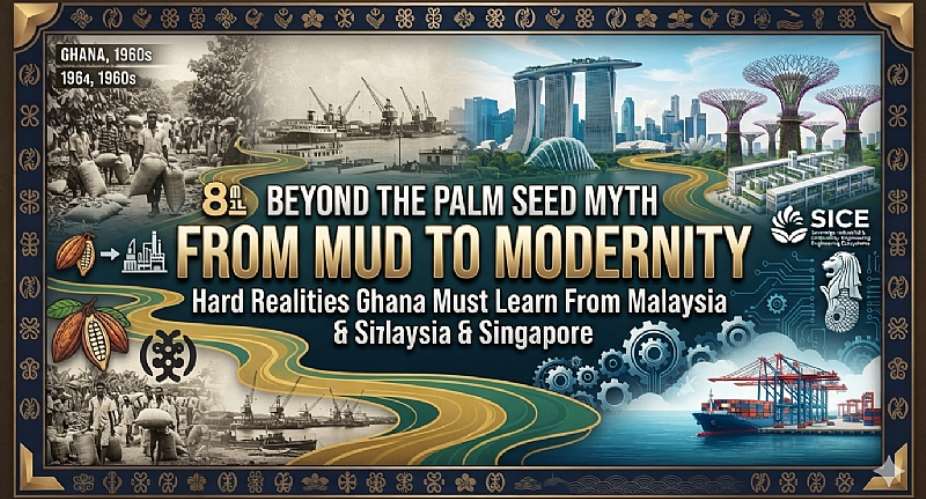
The Dangerous Comfort of a Social Media Fiction
For years, a comforting narrative has circulated within Ghanaian intellectual and social media spaces: the myth that Singapore took oil palm seeds from Ghana and used them to build its modern utopian skyline. As patriotic as this story sounds, it is an absolute fiction. Singapore does not have palm plantations; its wealth was built on cold engineering, high-tech manufacturing, and structural discipline. The nation that actually took West African hybrid seeds in the 1960s was Malaysia, transforming them into a multi-billion-dollar agricultural empire while our own local industry stagnated.
The historical baseline makes for painful reading. In 1960, a newly independent Ghana was economically ahead of both Malaysia and Singapore. We possessed premier cocoa, abundant gold, timber, and a GDP per capita of roughly $180—compared to Singapore’s $428 and Malaysia’s $235. According to official International Monetary Fund (IMF World Economic Outlook) figures, the gap has grown into an abyss. Singapore’s nominal GDP per capita has crossed a breathtaking $99,000, cementing its place in the world's top ten wealthiest nations. Malaysia stands firmly as an advanced industrial economy at approximately $14,700. Meanwhile, Ghana's nominal GDP per capita hovers at a fragile $3,310. [1, 2, 3, 4]
Our problem was never a lack of resources; it was a lack of execution. To move forward, Ghana must look beyond the myth of the palm seed and study the literal groundwork of the Asian Tigers: specifically, how Singapore took a crocodile-infested, muddy mangrove swamp and turned it into the beating heart of global manufacturing.
THE HISTORICAL DIAGNOSIS: Why Ghana’s Industrial Engines Stalled
To understand our present stagnation, we must candidly evaluate the policy decisions of our past:
- The Failure of State-Led Industrialization: Following independence, the First Republic under Dr. Kwame Nkrumah established impressive state-backed projects through the Ghana Industrial Holding Corporation (GIHOC) [from-swamp-to-singapore.html]. From the Kade Match Factory to the Asutsuare Sugar Factory, the infrastructure was there. However, these entities were treated as political reward systems rather than commercial enterprises. Crippled by over-staffing, lack of raw material integration, and gross mismanagement, they collapsed, forcing Ghana back into a low-value economy that merely extracts and exports raw materials.
- The "Political Yo-Yo" and Project Abandonment: Since the inception of the Fourth Republic, Ghana has suffered from a lack of institutional continuity. A change in political administration—from NDC to NPP or vice-versa—frequently results in the immediate abandonment of major national initiatives. Multimillion-dollar factories, roads, and agricultural programs are routinely left to rot simply because a rival party initiated them, destroying long-term policy predictability.
- Treating Agriculture as Subsistence, Not Science: While Ghana treated farming as a social welfare tool for rural survival, Malaysia approached it as an industrial science. Our agricultural sector has remained crippled by fragmented land tenure systems, low-yielding crop varieties, and a total absence of downstream refinery linkages. Consequently, while Malaysia exports billions in refined palm products annually, Ghana spends over $200 million every single year importing vegetable and palm oil to meet its domestic deficit.
THE JURONG INSIGHT: Engineering a Swamp into an Economic Superpower
When Singapore gained independence in 1965, the situation was catastrophic: 12% unemployment, zero natural resources, explosive labor strikes, and an island largely composed of tidal mudflats and mangrove swamps.
The centerpiece of their transformation was the development of the Jurong Industrial Estate [jurong-industrial-estate-development]. At the time, critics mocked the project as "Goh’s Folly"—named after Finance Minister Dr. Goh Keng Swee—believing it was impossible to build heavy infrastructure on a swamp. Here is the exact step-by-step engineering and economic blueprint they used:
[Swamp Clearance & Levelling] ➔ [Deepwater Port Dredging] ➔ [Pre-Built Standard Factories] ➔ [The EDB One-Stop Shop]
- Step 1: Mechanical Reclamation and Topographical Leveling: Singapore did not try to build on top of mud. Between 1961 and 1965, the government mobilized heavy machinery to systematically blast down the inland hills of Jurong. Millions of tons of clay and stone from these hills were used to fill, compact, and dry the mangrove swamps and prawn ponds, transforming unstable mud into high-load-bearing bedrock.
- Step 2: Dual-Purpose Dredging: As they filled the swamps, engineers simultaneously dredged the adjacent coastal waters to create Jurong Port [jurong-port]. The earth scraped from the seabed was used as additional infill for the land, while the deepwater channels were cleared to allow large international cargo ships to dock directly adjacent to the newly created factory zones.
- Step 3: The "Speculative Factory" Strategy: Knowing that foreign companies hated waiting for construction, the Jurong Town Corporation (JTC) took a massive financial gamble. They built standardized, fully wired, and plumbed concrete factory shells before they had any tenants. When multinational corporations visited, Singapore’s pitch was immediate: "Sign the lease today, install your machinery tomorrow. The power lines and deepwater berths are already waiting."
- Step 4: Institutional Consolidation (The EDB): To eliminate bureaucratic friction, Singapore created the Economic Development Board (EDB) [1959-1965]. The EDB acted as a supreme corporate concierge. A foreign investor did not have to visit ten different ministries for immigration, taxes, land allocation, and environmental permits. The EDB handled every single permit internally, bypassing red tape completely.
THE REFORM BLUEPRINT: Transitioning from Slogans to SICE
Ghana is not short of good intentions; it is short of the rigid, uninterrupted execution seen in the East. To scale from localized programs to nationwide industrial dominance, our policymakers must abandon political labels and completely overhaul our economic architecture around a new model: SICE (Sovereign Industrial & Commodity-Engineering Ecosystems).
SICE Strategy: [Sovereign Continuity] + [Industrial Infrastructure] + [Commodity-Engineering Refineries] + [Integrated Land Banks]
- Abolish 1D1F and Transition to SICE (Sovereign Industrial & Commodity-Engineering Ecosystems): The One District One Factory (1D1F) initiative is a noble concept, but its execution remains highly fragmented and weary of political optics. Many 1D1F facilities operate as isolated entities struggling with erratic power supplies, poor road access, and unstable raw material streams. Ghana must immediately transition to SICE. Instead of scattering small factories randomly across districts to win votes, the state must engineer centralized, plug-and-play industrial ecosystems. These SICE zones must be built near key transit corridors, fueled by subsidized high-voltage power grids, and linked directly to dedicated agricultural land banks—completely mimicking Singapore's Jurong project.
- Depoliticize and Legislate the GIPC into an Absolute Authority: The Ghana Investment Promotion Centre (GIPC) must be legally transformed from an advisory investment agency into a supreme, non-partisan corporate concierge modeled after Singapore’s EDB. A foreign or local investor looking to build a processing plant should not spend months navigating the environmental protection agency, local assemblies, grid companies, and the Ghana Revenue Authority. The GIPC must be given the executive power to clear all regulatory hurdles under a single roof within 72 hours.
- Overhaul the Land Tenure Act for Mega-Farming Land Banks: The Ministry of Food and Agriculture’s Planting for Food and Jobs (PFJ) Market and the Red Gold Initiative (distributing 1.5 million oil palm seedlings) are step-one fixes. Step two requires land. Ghana's current land tenure system is plagued by endless litigation and boundary disputes that terrify commercial investors. The state must partner with the National House of Chiefs to establish litigation-free, long-lease corporate land banks specifically designated for agricultural out-grower schemes, mirroring Malaysia’s FELDA model to securely scale crop yields.
A Call to Action for Ghanaian Leadership
The divergence between Ghana and the Asian Tigers is not a story of resource disparity; it is a clinical demonstration of the power of institutional execution. While Ghana rested on the laurels of its natural bounty, Singapore transformed uninhabitable mud into sovereign industrial capital.
Our leaders must heed the timeless biblical proverb: "Go to the ant, thou sluggard; consider her ways, and be wise." The ant does not possess a vast empire or a royal decree, yet it prepares its food in the summer and gathers its provision in the harvest through flawless, unprompted organization. Malaysia and Singapore acted like the ant—quietly engineering, storing value, and building systems for the future while we consumed our raw harvests in a single season.
The persistent myth of the Ghanaian palm seed must no longer be used as historical trivia to comfort our national pride. Instead, it must serve as a glaring warning of what happens when a country relies purely on raw potential without the institutional will to refine it. Our path to economic liberation is not located underground in our gold or oil; it is found in our ability to build an efficient, predictable, and industrialized value chain. The blueprint has been proven in the East—it is time for Ghana to finally execute it.
✍️ Retired Senior Citizen
For and on behalf of all Senior Citizens of the Republic of Ghana 🇬🇭
Teshie-Nungua
[email protected]


 Education Ministry condemns shooting incident at Yendi primary school
 Over 10,000 businesses register for govt support under 24-hour economy – Rashid...
 Shops, businesses must close for national clean-up exercise — Ga Mantse orders
 Mahama commissions Ghana Medical Trust Fund Cardiac Catheterization Laboratory a...
 Former Deputy Upper West Regional Minister raises concerns over mode of fertiliz...
 Mahama orders demolition of old Korle Bu maternity block, describes facility as ...
 Wildfire kills 12 in southern Spain as victims found in vehicles
 Otumfuo announces Nana Ama Bonsu as new Asantehemaa to Kumasi Traditional Counci...
 GNACOPS urges private schools to participate in National Sanitation Day exercise
 Gun shots shut down Zohe E.P. School in Yendi as headteacher assaulted

