




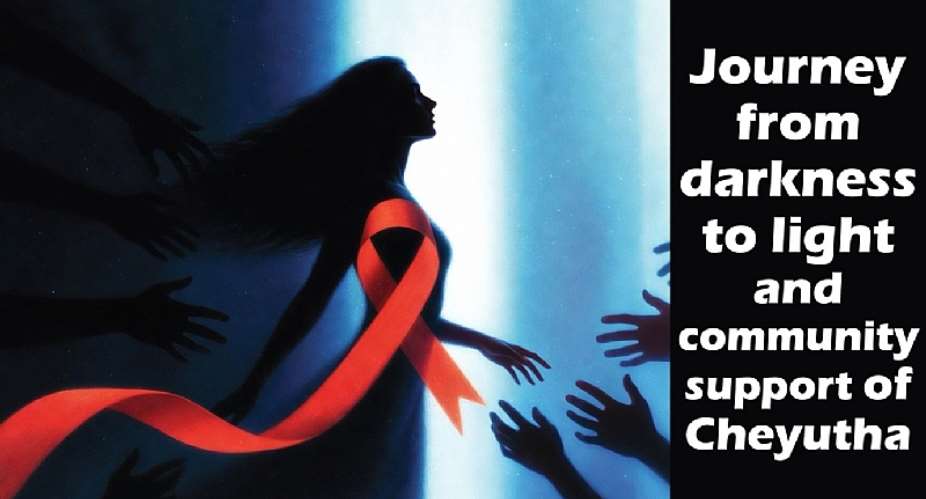
To this day 23 years-old Sneha (name changed to respect confidentiality) does not know with certainty how she got infected with the human immunodeficiency virus (HIV). No one else in her family carries the virus. The only plausible explanation she offers is that she got it through an infected injection needle in some healthcare setting.
Since her infancy Sneha had a hole in her left eardrum which would discharge pus. So she was put on medication for a long time which included injectables. Eventually she had to undergo an ear surgery in 2015 when she was 12 years old.
During the general investigations and tests done prior to the surgery, she was found to be HIV positive.
Sneha was in a state of shock.
“My mother refused to believe the test results and she got my test done again in three different laboratories. But every time the result was the same. My mother and elder brother also got tested and both were HIV negative. And we strongly believe that my deceased father was negative as he had undergone multiple heart surgeries and all general investigations were done then, with no sign of HIV," shared Sneha with CNS ahead of world's largest AIDS conference later this month (26th International AIDS Conference or AIDS 2026 on the theme: #RethinkRebuildRise).
Diagnosed with HIV at 12 years of age
Thus at the tender age of 12, Sneha was diagnosed with HIV. She was directed to government-run Niloufer Hospital in Hyderabad which has a prominent, designated paediatric ART Centre for HIV management in children and adolescents.
A year later Sneha got registered for her medical check-ups at Blue Peter Public Health and Research Centre (BPHRC) of LEPRA Society which also focuses on comprehensive HIV care, support, prevention, and treatment. Through BPHRC she came in contact with Cheyutha (Cheyutha is a Telugu language word meaning ‘helping hand’). Cheyutha is a women’s community initiative to empower women living with HIV, through mutual support and collective action. The organisation was started in 2005 by an HIV survivor Laxmi Priya Kagitha, with support from the LEPRA Society in Hyderabad. To date, Cheyutha’s Board of Directors is composed entirely of women living with HIV.
“When Priya madam heard about my plight and our financial crisis, she started supporting me for my nutrition as well as my education. I was studying in Class 9 then," said Sneha.
Cheyutha’s helping hand
Sneha, who recently completed her post-graduation in Social Work, got an opportunity to work with Cheyutha as a field level worker for Adolescent Friendly Health Clinics in 2021. These clinics are specialised healthcare centres designed to meet the unique physical, mental, and reproductive health needs of young people. Sneha shared that: "The aim was to work for adolescents living with HIV in the age group of 10 to 19 years, focusing on their regular medication and overall wellbeing."
"The children for whom I worked, reminded me of my earlier days when I was newly diagnosed with HIV. At that time, I did not know much about the disease and neither did my mother. I just took my pills regularly because my mother asked me to do so. It was only when I was 17-18 years old that I understood the gravity of my illness and gradually accepted to live with it," she said.
She faced several challenges including discrimination from her relatives. "But my mother always stood by me and took good care of me. So compared to other children living with HIV, I was in a much better position," she reflected.
"Around150 adolescents living with HIV with whom I have been working, come from very difficult family backgrounds and faced far greater challenges than I had. Almost 70% of them were semi-orphans, who depended on single parents or elderly grandparents. So due to lack of proper care, they would often miss their medication. Some of them had been adopted without anyone knowing about their positive status. It was only when their health deteriorated and they visited hospitals that they were tested and were diagnosed for HIV. They also had to deal with a lot of stigma within their family," said Sneha.
"I was determined to help these children living with HIV - project or no project - and started building my rapport with them. They had got infected unknowingly and had to be prepared to deal with their situation in the best possible manner," she said.
A day of hope: Free check-ups, supplements & life skills for adolescents living with HIV
"Through Adolescent Friendly Health Clinics, we hold a day long camp once every month on a Sunday, so that the participants do not have to miss their school. A medical check-up of all the children living with HIV is done to monitor their health parameters. They are also given multivitamin, calcium, iron, and protein tablets free of charge. We also counsel them on why they should not miss their daily medication, which is essential for our survival," shared Sneha.
Sneha shared that these health camps provide a safe space for the adolescents to express and share their thoughts without any discrimination and stigma, which many of them have to face in their families. They look forward to these camps and literally wait for that one day in the month to enjoy their day with other similar participants with no strings attached.
"Adolescence is the age when they undergo physical changes and they also need some career guidance. So, we call some resource person every month to guide them about their studies and help them in life skills development." Sneha worked for three and a half years in this project before it ended in March 2025 due to funding cuts. Now she works as a peer counsellor in Cheyutha, doing similar work.
"But we still continue holding these health camps with the help of some local donors. I enjoy spending time with the youngsters so that they feel safe and reassured that whenever they have a problem, they can discuss it with us and arrive at a solution by themselves with our help."
Sneha is happy that 92% of these 150 children are virally suppressed. When the project started less than 55% had viral load suppression. But within 3 years the figure rose to 92%. According to the World Health Organization (WHO), if a person with HIV is virally suppressed, then not only the person lives healthy and normal, there is zero risk of any further HIV transmission too - that is why, Undetectable equals Untransmittable or UequalsU (or treatment is prevention).
From open ostracism to discrimination – The unfinished battle against HIV stigma
From her personal lived experiences, Sneha laments that even today stigma and discrimination is very much there, despite India having an HIV and AIDS (Prevention and Control) Act, 2017, which provides comprehensive legal rights, and prohibits discrimination across education, healthcare, and housing.
“In the 1990s, people expressed it openly and ostracised those living with HIV. Things have improved now but stigma is still rampant. I see it in the hospitals. Hospital staff behave very differently once they come to know of our HIV status. Till they do not know our status we are treated like any other patient. But once we disclose our status for any follow up medical procedures to be safer, their attitude changes instantly and they fear even to touch us or even come near to us," said Sneha.
Sneha’s fears are corroborated by the HIV Stigma Index 2.0 Report from 25 countries (including India). It shows that 13% of people living with HIV experienced stigma and discrimination when seeking HIV-related care in the past 12 months, and 25% reported such experiences when seeking non-HIV-related healthcare, including 12% who reported being denied non-HIV-related healthcare completely.
High prevalence of self-stigma
“Most of our community also have self-stigma. They do not want to come forward and share their problems because of self-stigma. Even I have that fear that people will not understand and would treat you like a black spot if they come to know of your status. None of my friends know that I am living with HIV. I have already faced discrimination from my relatives and I fear that if I share my HIV status with my friends, I would get the same reaction from them," said Sneha.
Mirroring trends across the Asia-Pacific region, the HIV Stigma Index 2.0 data from India reveals that internalised stigma (feelings of shame, guilt, or self-blame) is significantly high. This psychological barrier often acts as a major roadblock, causing individuals to isolate themselves or completely drop out of local health services. The index also demonstrates a strong correlation between individuals experiencing community discrimination and those who interrupted their treatment.
“We have to change the way of thinking of hospital staff and healthcare personnel through advocacy. Despite knowing the causes of HIV transmission, yet they fear to treat us. We also need to continuously maintain a link with our stakeholders and share with them our challenges that we are facing at ground level," said Sneha.
For Sneha, creating awareness in the community, as well as in the general public plays a key role in reducing stigma. Moreover, if people have more knowledge about this infection, they will protect themselves from getting infected. There should also be some method for the community to share the challenges they are facing in their daily lives with policy makers.
As per Government of India's Sankalak Report 2025, 1,894 children got infected with HIV due to vertical transmission (parent/mother to child during pregnancy or breastfeeding) in 2024. Around 80,000 children living with HIV were receiving the lifesaving antiretroviral therapy by March 2025. Rate of vertical transmission is still high at 10.75%. This is unacceptable because we can do better. No child needs to be born with HIV.
We have to #Rise to #Rethink and #Rebuild to #PutPeopleFirst in HIV responses and strive for a world in which HIV no longer remains a public health threat.
Shobha Shukla – CNS (Citizen News Service)
(Shobha Shukla is a feminist, health and development justice advocate, and an award-winning founding Managing Editor and Executive Director of CNS (Citizen News Service). She serves as Chairperson of Global AMR Media Alliance (GAMA), Host and Coordinator of SHE & Rights (Sexual Health with Equity & Rights), President of Asia Pacific Media Alliance for Health, Gender and Development Justice (APCAT Media), and founder leader of DJOP (Development Justice for Older Persons) initiative. She was also the Lead Discussant for SDG-3 at United Nations inter-governmental High Level Political Forum 2025. GAMA , led by her, received the AMR One Health Emerging Leaders and Outstanding Talents Award at UN High Level Ministerial Conference on AMR 2024. Follow her on X @shobha1shukla or read her writings here www.bit.ly/ShobhaShukla)

 Eritrea, Ethiopia trade barbs as Tigray rebels retreat
 OccupyGhana warns EOCO, BNI against using investigations as punishment
 Mahama visits Ahafo Region to inspect development projects
 CSA rejects claims of FBI command over Operation Blackout in Ghana
 Entertainment presenter Andy Dosty denies obtaining US visa through GTA
 “I will be on buses and lorries to preach, let them arrest me!” — Prophet Nigel ...
 October 9: Cedi sells at GHS12.30 on forex market, GHS11.79 on BoG interbank
 New York mayor to ask Trump for ICE withdrawal after agents shoot man in car wit...
 Ukraine takes Russia fight to 'scorching sands' of Sahel
 Clashes lead South Africa to withdraw asylum processing order


