




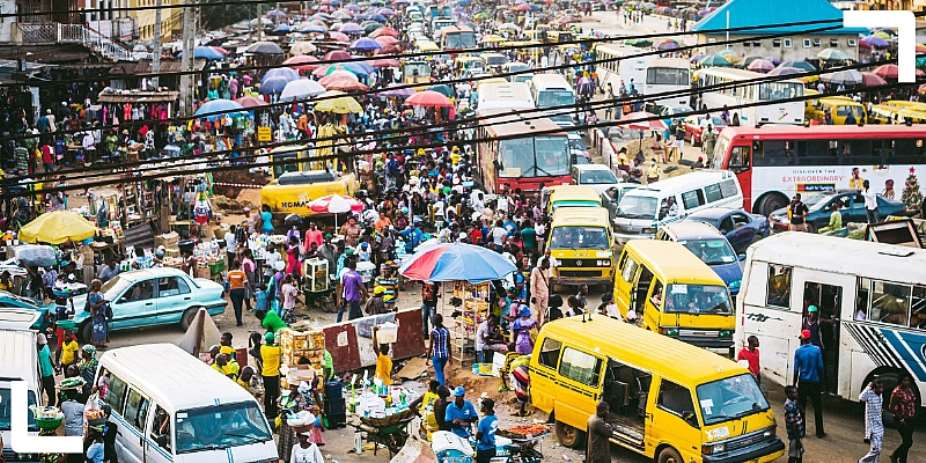
Lagos is one of the fastest-growing cities in the world, with a population estimated at around 20 million. Its rapid urbanization contributes to a way of life where survival relies on improvisation and ingenuity.
Nigerian musician Fela Kuti summed up the chronic difficulties of this megalopolis with the term " impossibilism ." Yet Lagos is also renowned for offering numerous opportunities .
My research as an anthropologist specializing in religion shows that many Lagosians turn to religion in the hope of transforming the impossible into the possible. Religion is not only a spiritual matter, but also a practical means of solving problems.
To improve their daily lives in Lagos, residents must overcome numerous challenges: economic uncertainty, failing infrastructure, governance issues, inequality, and crime. To maximize their chances of success, a growing number are combining elements from different religious traditions. "Chrislam," which emerged in Lagos in the 1970s, is a prime example. It blends Christian and Muslim beliefs and practices.
Although relatively modest compared to the Pentecostal churches and reformist Muslim organizations that have proliferated in Lagos over the past few decades, Chrislam must be understood as part of a broader religious transformation.
This transformation is difficult to grasp. Religious scholars tend to emphasize the fixed boundaries between religions, rather than the improvised practices of believers.
In the media , relations between religions are often reduced to conflict and violence.
Chrislam may seem like a marginal phenomenon, but understanding it offers a new perspective. It sheds light on how urban Christians and Muslims live their religion and interact with each other, beyond the stereotypical images often associated with Nigeria.
Religious Zapping
"Welcome to Lagos; here, anything is possible," was the word my research collaborator, Mustapha Bello , used to greet me when I arrived in this megacity in 2010. I quickly understood the significance of this phrase when I met the founder of Chrislam .
Nigeria has a distinct religious landscape, with a Muslim majority in the north and a Christian majority in the south, despite significant areas of interfaith mixing. Relations between Muslims and Christians are particularly intense in the southwest, centered around Lagos.
In this region, Muslims and Christians have long lived side by side, often in close interaction with followers of Yoruba religious traditions. The latter believe that the material world is shaped by invisible powers, notably the òrìṣàs (deities of the Yoruba pantheon) to whom good fortune is attributed. It is this unique religious coexistence that created the conditions conducive to the emergence of Chrislam.
There are two main Chrislam movements . Ifeoluwa (“The Love Of God Mission”) has a small congregation of about 50 followers. Oke Tude (“Mountain of Losing Bondage”) now has more than 1,000 followers.
In addition to their Yoruba names, they use the term "Christlam" to describe their faith. These two movements share some practices. They draw inspiration from both the Bible and the Quran and invoke Jesus and the Prophet Muhammad in their prayers. However, they differ in several ways. The founder of Ifeoluwa , Tela Tella, leads a secluded life in a densely populated suburb of Lagos. The founder of Oke Tude , Prophet Dr. Samsindeen Saka, uses modern media to spread his message of unity between Christians and Muslims.
This mixing and combining is referred to locally as "religious shopping" or "religious zapping." Over the past 15 years, I have interviewed hundreds of people who describe themselves as "religious shoppers ." For them, when seeking health and wealth, one cannot afford to be picky when choosing between religions.
The "followers of Chrislam ," for example, explained that their faith allowed them to "thin their odds" by "combining the powers of Christianity and Islam," thus doubling their chances of achieving a "good life." And the imam of Oke Tude confided in me that he prayed eight times a day—five times according to Muslim tradition and three times according to Chrislam tradition —in order to benefit from the cumulative power of prayer.
The Christian-Islamic prayer consists of circling a replica of the Ka'bah – Islam's holiest place – seven times while shouting "Hallelujah" and "Allahu Akbar" (God is great).
In this context, it is both pragmatic and strategic to build on the perceived potential of both Christianity and Islam.
Debunking stereotypes
The "Christlam" challenges the perception of Nigeria as a country defined by clashes between Muslims and Christians. While religious violence is certainly a major concern in the country, my research shows that relations between Christians and Muslims cannot be reduced to a logic of conflict.
The "Christlam" is far from being an isolated case. In African societies (and beyond) where several religions coexist, there are movements that draw from different religious traditions. They defy any clear classification.
This is particularly true of the Afrikania Mission , which emerged in Ghana in the 1980s. It blends elements of Christianity with what is known as traditional African religion. Crossing religious boundaries is now an integral part of religious life in Africa.
This does not mean that religious differences are unimportant. They are important, but religious differences do not automatically lead to violence or polarization. They can just as easily serve as a basis for imitation, competition, and mutual exchange .
Indeed, followers of Chrislam consider Christianity and Islam to be complementary rather than contradictory. For example, a devout follower of Chrislam answered my question about whether he venerated Jesus as the son of God (as in Christianity) or as a prophet (as in Islam) by saying, "He is both."
The founder of Ifeoluwa , Tela Tella, preached:
Jesus Christ is on my right, the Prophet Muhammad is on my left; they are both my best friends.
Why is this important?
In my opinion, it is time to rethink how we study religion in Africa. Western approaches, inherited from Christianity, often present religious traditions as fixed and clearly defined entities. An Afrocentric perspective, on the other hand, starts from African forms of knowledge, practice, and meaning. It seeks to understand how African practitioners live and blend different traditions to create meaning for themselves.
Viewed from this angle, Africa does not appear as a passive recipient of so-called world religions, but as a true breeding ground for religious creativity and innovation.
The “Christlam” is therefore no longer a curiosity or a contradiction, but a political resource in a context where religious identities are often used as weapons.
He offers us a lesson that today's fractured world needs more than ever. Religious boundaries do not necessarily have to serve as front lines. They can also serve as meeting points .
Marloes Janson received a research grant from the Federal Ministry of Education and Research (BMBF) in Bonn, Germany, and from the Forum Transregionale Studien in Berlin, Germany.
By Marloes Janson, Professor of West African Anthropology, SOAS, University of London
 'Our conscience will not allow us to lie' — South Africa evacuees accuse NPP of...
 Second batch of GAF recruits begins six-month basic military training
 'We can only win together' – Kojo Bamba rallies NPP members for 2028
 ‘Congratulations!’: World leaders hail Lula’s election victory in Brazil
 'Stop overthinking, Sammy Gyamfi spoke simple language not PhD thesis' — Frankli...
 IMF broadens engagements as first review of Ghana’s PCI enters second week
 Government rejects GH¢873.94m in Treasury bill bids despite strong investor dema...
 President Mahama woos British investors, urges global debt reforms
 Ashanti Regional Minister impressed with progress of 24-Hour Economy model marke...
 GTA issue: Sanction whoever leaked Abeiku Santana’s letter to Tourism Minister –...


