




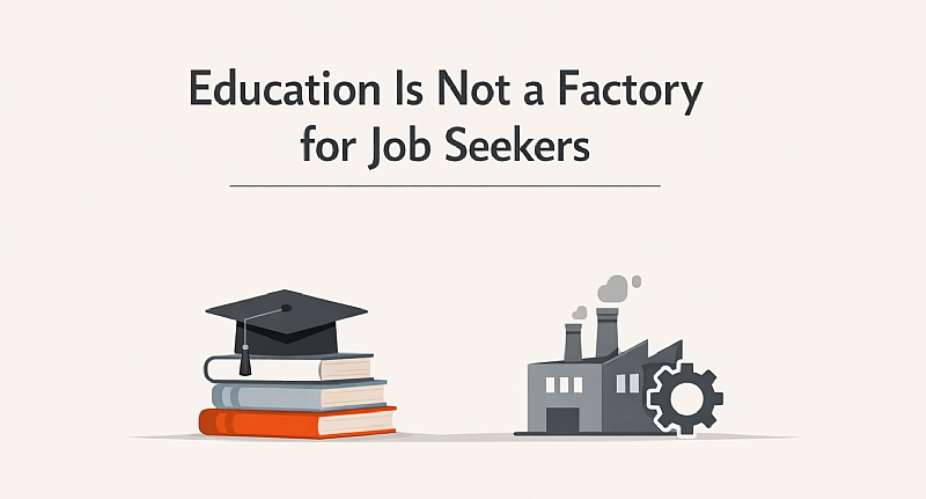
The recent remarks by the former Minister of Education on the relevance of certain University programmes have sparked an important national conversation. Let me weigh in on the discussion. While concerns about rising graduate unemployment and its consequent ramifications deserve serious attention, it is deeply troubling when the debate is framed around the assumption that the sole purpose of higher education is to produce graduates for existing jobs. That is very disappointing.
It is a fundamentally flawed assumption to think of higher education as a means to getting employed; the purpose of education transcends job hunting!
Education has never been intended merely to prepare people for employment. Its first responsibility is to develop the human mind, to cultivate critical thinking, creativity, ethical reasoning, innovation, leadership, and the ability to solve society’s most pressing problems. Employment is an important outcome of education, no doubts about that, but it is not its sole purpose, nor should it become its defining yardstick.
In the thoughts of Aristotle, education must achieve eudaimonia: virtues. What virtues, and how? Education must focus on developing both moral virtues and rational intellect through lifelong learning; individuals are empowered to live good, happy lives while becoming responsible, active citizens who contribute to a stable, and just society. Whether or not a programme leads to a direct employment in existing firms should not be the pivotal mindset behind any programme at the University. It should be about the graduates’ ability to THINK through problems, solve the problems, CREATE something new from the knowledge acquired. If graduates focus their mind in this direction, the menace of unemployment would cease to exist long before we start this discussion.
The former minister was quoted as saying: “They have courses called Development Education. It doesn’t qualify the student to teach, and I don’t know what industry, what company is going to employ students who have done Development Education.”
This statement raises a more worrying question: Was the programme itself understood before it was criticised?
Every accredited university programme is built around a carefully developed curriculum comprising numerous courses designed to equip students with specialised knowledge and transferable skills. Often involving multidisciplinary engagements with other departments and courses. By the time one graduates, you have studied more than just that course or Programme. It is therefore intellectually risky to dismiss an entire discipline without first examining what it teaches and the competencies it develops. Very risky.
Development Education, for instance, is far more than its title may suggest. It equips students with knowledge in community development, social policy, sustainable development, governance, advocacy, project management, research, conflict resolution, and civic engagement. These are not abstract ideas. They are practical competencies required by governmental and non-governmental institutions, local authorities, civil society organisations, international development agencies, research institutions, and private organisations committed to sustainable development. The narrow thinking, boxing education into just job-hunting tools, is very heartbreaking!
More importantly, such programmes challenge students to identify societal problems and design innovative solutions. That is precisely the kind of education a developing nation should celebrate.
Equally concerning is the suggestion that educational programmes are relevant only to those intending to become classroom teachers. Such a view reduces the rich and diverse field of education to classroom instruction alone. Contemporary education encompasses educational leadership, policy formulation, curriculum studies, educational technology, assessment, administration, counselling, adult education, and organisational learning. Professionals from various disciplines contribute immensely to these fields. It is very relevant, even for cleaners, and pan bearers, security personnel and all other non-teaching staff to be introduced to formal educational psychology and pedagogical knowledge as they deal directly with the students in one way or the other.
If our national conversation is genuinely about aligning higher education with the needs of the economy, then let us have that conversation honestly. Universities should continuously review their curricula. Emerging fields such as artificial intelligence, data science, climate resilience, digital entrepreneurship, renewable energy, and the creative economy may deserve greater attention but to infer from that that all other programmes should be discarded because they do not have direct employability is a misnomer. Curriculum reform should be driven by research, consultation, and evidence, not by public ridicule of existing programmes. Don’t do that.
Public officials, especially those who have had the privilege of leading the nation’s education sector, bear a special responsibility. Their words shape public perception. When they dismiss legitimate academic disciplines without adequate nuance, they unintentionally undermine public confidence in higher education and devalue the achievements of thousands of graduates. This can be very disappointing, demotivating, demoralising, and saddening. Let’s avoid it.
The bigger challenge facing Ghana is not that Universities are producing graduates in the wrong disciplines. It is that our economy has not expanded sufficiently to absorb the talents it produces. The answer is not to belittle academic programmes but to build an economy that rewards innovation, entrepreneurship, research, and creativity. These should attract attention rather than putting down what others invest years of hard work into.
The future belongs to graduates who can think independently, adapt to change, collaborate across disciplines, and create opportunities where none exist. That is exactly what Universities should be nurturing.
Education should not manufacture job hunters; It should develop nation builders.
A University degree should not merely answer the question, “Who will employ me?” It should also inspire the far more transformative question, “What can I REATE? Whose life can I IMPROVE? What PROBLEM can I SOLVE?”
When education begins to answer those questions, society advances. When it is judged only by the availability of existing jobs, both education and national development are diminished.
Perhaps it is time we stopped measuring the value of knowledge solely by the vacancy announcements in today’s newspapers and started measuring it by its capacity to transform tomorrow’s Ghana through critical thinking.
The author is an academic at the University, prior, with ten years of Professional experience as a Senior High School teacher (ten years as WAEC Examiner(literature), more than five years pre-SHS teaching experience.
E. Yao Agbenyo
Accra
[email protected]
 'Floods are not natural disasters alone; they are planning failures' — Koans Est...
 Hanan Abdul‑Wahab’s Lawyers Drag A‑G, Deputy A‑G and BNI to Court Over ‘Illegal’...
 ‘No Discipline, No Solution’: Vanderpuye Blasts Weak Enforcement Behind Accra’s ...
 ‘Useless Degrees’? Prof. Kwaku Azar Pushes Back, Calls Adutwum’s Remarks Mislead...
 Ghana–US Friendship ‘Enduring and Unshakeable’ — Mahama Celebrates America’s 250...
 Former NAFCO Boss Hanan Aludiba Arrested at Airport Over Alleged Attempt to Acce...
 Trump blasts 'communists', celebrates the United States in 250th anniversary spe...
 Ounahi stars as Morocco outclass Canada to advance to last eight at World Cup
 Hezbollah, Hamas and Houthi officials attend funeral ceremonies for Iran's Khame...
 World Cup 2026: Ounahi fires Morocco to quarter-finals with decisive brace
