




"The measure of government is not how much money it announces during a crisis, but how faithfully that money restores the lives of those who need it most."
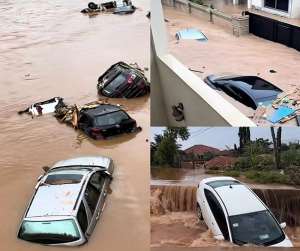
The floodwaters that submerged parts of Accra have begun to recede, but another tide is only beginning to rise—the tide of public expectation.
For countless families, the recent floods were not merely another rainy season inconvenience. Homes were destroyed, businesses were washed away, vehicles submerged, and livelihoods built over many years disappeared within a few hours. Behind every flooded street was a mother wondering where her children would sleep, a trader calculating losses that may never be recovered and a young entrepreneur watching years of sacrifice disappear beneath muddy waters.
Against this backdrop, Government's decision to release GH¢350 million from the Contingency Fund to support flood relief and mitigation efforts deserves commendation. In moments of national emergency, swift action is both necessary and reassuring. It reflects government's recognition of the urgency of the situation and its responsibility to support affected citizens.
However, the announcement of funds should never be the end of the conversation.
It should be the beginning of accountability.
In my previous article, When the Rain Brought Accra to Its Knees: Must We Always Learn the Hard Way? argued that Ghana's recurring floods are not simply natural disasters but the consequences of years of poor urban planning, inadequate drainage infrastructure, weak enforcement of building regulations and ineffective waste management. While emergency funding addresses the immediate consequences of these longstanding challenges, it also presents government with an opportunity to demonstrate that public resources can be managed with transparency, fairness and measurable impact.
The real success of this intervention will therefore not be measured by the GH¢350 million announced, but by the lives restored.
The first question must be straightforward: Who qualifies as a flood victim?
In every emergency, there is understandable pressure to provide immediate assistance. Yet urgency should never replace fairness. Every household that lost its home, every trader whose capital was swept away and every family displaced by the floods deserves a transparent process that is guided by evidence rather than influence.
Transparency is equally important.
Citizens deserve more than assurances that funds have been released. They deserve to know how beneficiaries are identified, how resources are allocated, which communities have received assistance and what mechanisms exist to ensure that relief reaches those for whom it was intended.
These are not questions of distrust.
They are the foundation of responsible governance.
Year after year, Ghanaians watch parliamentary oversight committees, the Public Accounts Committee and other accountability institutions scrutinise the management of public funds. While such proceedings do not automatically establish wrongdoing, they consistently remind us that accountability cannot begin after money has been spent. It must accompany every stage of implementation. The surest way to protect both public resources and public confidence is through transparency, timely reporting and open communication.
Ghana has demonstrated the value of such communication before. During the COVID-19 pandemic, government regularly addressed the nation, updating citizens on emerging developments, interventions and measures being implemented to protect lives. Those briefings did more than communicate information; they reassured Ghanaians that government was present, responsive and accountable during one of the country's most uncertain periods.
The current flood emergency presents a similar opportunity.
Imagine regular public briefings informing citizens about the number of households supported, businesses assisted, communities reached, drainage projects undertaken and mitigation measures completed. Imagine visual evidence showing completed interventions and families whose lives have been restored. Such communication would not only strengthen public confidence but also demonstrate that accountability is an ongoing commitment rather than an afterthought.
The allocation itself also deserves careful attention. While GH¢200 million has been earmarked for immediate relief, GH¢150 million has been dedicated to flood mitigation.
The distinction is significant.
Relief addresses today's suffering.
Mitigation determines whether tomorrow's suffering can be prevented.
If these mitigation resources result in improved drainage infrastructure, sustained desilting exercises, better waste management, stronger enforcement of planning regulations and resilient urban development, this investment will represent far more than emergency expenditure. It will become an investment in Ghana's future resilience.
Another story from the floods deserves equal attention.
Across affected communities, many ordinary Ghanaians risked their own lives alongside officers of NADMO, the Ghana National Fire Service and other emergency responders to rescue stranded residents. They acted without formal training, protective equipment or expectation of reward. They simply recognised that every second could mean the difference between life and death.
Their courage should not disappear once the floodwaters do.
Government should consider establishing a National Community Emergency Volunteer Programme under NADMO to identify, train and certify such volunteers in disaster response, first aid and emergency rescue. Outstanding volunteers could receive recognised certification and structured pathways into institutions such as the Ghana National Fire Service, the National Ambulance Service, NADMO and other emergency management agencies. A nation that invests in citizens who have already demonstrated courage and selfless service is investing in its own resilience.
Ultimately, the victims of this disaster are not asking for sympathy alone.
They are asking for fairness.
They are asking for institutions that work.
They are asking for confidence that public resources will genuinely become public good.
The people of Ghana have consistently demonstrated remarkable trust in their government during times of national difficulty. That trust is a national asset that must be protected. Every transparent update, every completed mitigation project, every family assisted, and every cedi properly accounted for strengthens that trust. Every failure to communicate or demonstrate results weakens it.
The rain has stopped.
The floodwaters are receding.
Now begins the greater test—not of our drainage systems, but of our institutions.
Years from now, Ghanaians are unlikely to remember the day GH¢350 million was announced. They will remember whether families rebuilt their homes, whether businesses reopened, whether vulnerable communities became safer and whether government proved that accountability is strongest when citizens can see it in action.
Because, in the end, public trust is the most valuable investment any nation can make, and history will judge this intervention not by what was promised, but by what was faithfully delivered.
Email: [email protected]
Contact: (233) 507457889
The author is a governance and public policy commentator whose writings explore accountability, leadership, institutional reform and sustainable national development in Ghana.

 July 3: Cedi sells at GHS12.25 on forex market, GHS11.40 on BoG interbank
 'Resign if you still don't understand double track' — Kwasi Kwarteng tells Educa...
 'We're building an electronic warfare centre to strengthen security surveillance...
 'June 29 floods were not caused by YEA-Zoomlion contract cancellation' — Manasse...
 Don't consume any food or product retrieved from June 29 flood waters — FDA caut...
 AMA begins week-long clean-up to clear debris of June 29 floods
 NADMO, Zoomlion Intensify Drain‑Clearing Blitz Under “No Do No Do” Campaign Afte...
 High Court Orders Extradition of ‘Abu Trica’ to U.S. in Alleged $8m Romance Scam...
 NHIA Announces Free NHIS Registration for Accra Flood Victims Amid Cholera, Diar...
 COCOBOD Releases GH¢2.6bn to LBCs to Clear Outstanding Payments to Cocoa Farmers
