




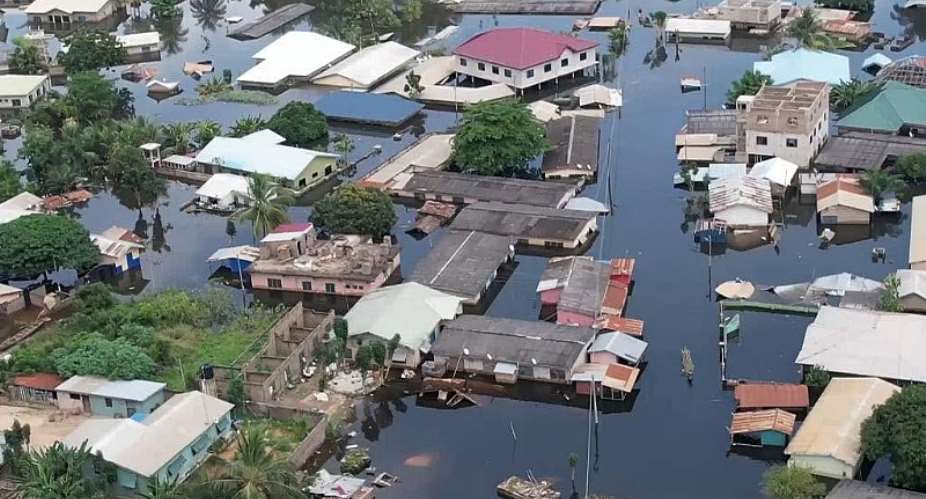
The sky above Accra on any late-May evening is deceptive. The air turns thick, carrying dust and the salty scent of the Atlantic Ocean. To a stranger, the dark clouds bring welcome relief from the tropical heat. But to the people of Ghana’s capital, that shifting sky triggers instant anxiety.
It is the prelude to June.
For over a decade, June has been more than just a month in Accra. It has become a seasonal crisis—a predictable, relentless force that arrives with the monsoon winds, testing human resilience, infrastructure, and governance. Between 2016 and 2026, June transformed from a regular rainy season into a ten-year cycle of structural failure and survival.
This is the retrospective of a decade underwater. It is the story of how a city of over five million people learns to fear the gathering clouds.
1. The Anatomy of a Crisis: Why June Terrifies Accra
To understand why June brings terror, one must understand how the city becomes a trap. Accra is built on low ground that slopes gently toward the Gulf of Guinea. A network of small rivers, streams, and lagoons—most notably the Odaw River and the Korle Lagoon—naturally channels rainwater safely into the ocean.
But this natural blueprint has been heavily disrupted. Over the last ten years, Accra’s floods have shifted from natural disasters into predictable structural failures. The elements remain the same, but the damage grows worse each year.
Intense Storm Dynamics
The West African Monsoon brings moist air from the Atlantic Ocean over the warm landmass of West Africa. When this air rises rapidly, it forms massive storm systems. In the past, these storms distributed rainfall over weeks. Today, driven by climate shifts, they dump millions of gallons of water over concrete surfaces in just three to six hours.
Blocked Drainage Systems
If rivers are the veins of Accra, the storm drains are its life-support system. However, a walk along any major drain in Alajo, Circle, or Kaneshie in late May reveals a visible problem: thousands of tons of discarded single-use plastics, silt, and uncollected trash. When heavy rains hit, these drains cannot channel water; they act as dams, forcing the water back up into the streets.
The Concrete Trap
As Accra has grown into a busy economic hub, soil has been replaced by concrete. Rapid, unregulated real estate developments have paved over wetlands and natural drainage areas. Because the water cannot soak into the ground, it runs rapidly across concrete surfaces and floods the lowest points of the city.
2. Chronology of the Deluge: The Ten-Year Ledger (2016–2026)
The history of Accra’s relationship with June is written in the scars left behind by each passing year. Data from disaster management files, weather logs, and news reports track a decade of escalating crises.
The Baseline: 2016 to 2020
The decade began under the shadow of the June 3, 2015 twin disaster, when a catastrophic flood and filling station explosion at Kwame Nkrumah Circle killed over 150 people. The years immediately following were marked by high alert, yet structural issues remained unchanged.
2016 (The Violent Reminder): Between June 9 and June 12, Accra was battered by consecutive storms that dumped between 140 mm and 190 mm of rain. In less than six hours, major transport hubs like Kwame Nkrumah Circle, Teshie, and Achimota turned into lakes. At least 10 people died, swept away by currents or trapped in submerged vehicles.
2017 (The Creeping Gridlock): While rainfall volumes were slightly lower, early June storms exposed the city's expanding vulnerability. Commuters in Kaneshie and South Shiashie were stranded on top of commercial buses as intersections flooded within forty-five minutes.
2018 (The Dawn Assault): On June 19, a torrential downpour struck while the city slept. Residents of Dome Kwabenya, Madina, and Adenta woke up to water breaching their beds. The structural damage was so severe that the Ministry of the Interior used aerial teams to locate stranded communities along the Kasoa-Accra corridor.
2019 (The Overflowing Basin): A 24-hour deluge from May 30 to June 4 dropped 78 mm of water on an already saturated city. The Odaw River overflowed its banks, flooding the Central Business District and claiming three lives.
2020 (The Pandemic Deluge): Amid COVID-19 lockdowns, June 10 to 19 brought multiple heavy downpours. The informal trading sectors in Odawna and Lapaz suffered a double economic blow: first hit by pandemic restrictions, then washed out by muddy floods that destroyed millions of Cedis worth of goods.
The Modern Escalation: 2021 to 2026
As the city entered the mid-2020s, the intervals between storms shortened and water volumes increased, culminating in the extreme weather anomalies of the current year.
2021 (The Multi-Day Flood): In mid-June, Accra experienced continuous, relentless multi-day rainfall. With no sunlight to evaporate the water and no time for drains to clear, low-lying communities like Adabraka remained waist-deep in water for nearly 72 hours.
2022 (The Conflict of Concrete): June 5 brought intense, localized storms that paralyzed the Kwame Nkrumah Circle interchange and the N1 highway at Fiesta Royale. The severity of the damage prompted executive orders to demolish illegal structures built over watercourses, which faced immediate resistance from landowners.
2023 (The Kasoa Corridor Crisis): On June 21 and 22, violent storms hit the western edges of the city. Runoff from the Akwapim hills cascaded down toward Ga South and Kasoa, turning highways into rapids and trapping commuters in their vehicles past midnight.
2024 (The Intermission): A brief anomaly in the decade, June 2024 recorded a low monthly rainfall of just 85 mm. Flash floods were short-lived and limited to traditional hotspots like the Spintex Road underpass and Tetteh Quarshie. It was a deceptive calm.
2025 (The Resurgence): In mid-June 2025, the monsoon returned, dropping 172 mm of rain over the month. Makola Market and Kaneshie suffered massive disruptions, with traders wading through chest-high water to salvage their goods.
2026 (The Historic Peak): June 2026 broke all previous records. A severe climate anomaly caused rain on 22 days of the month, yielding an unprecedented total of 333 mm. The peak arrived on June 29, when 140 mm of rain fell in a single 24-hour window. The result was catastrophic: 12 confirmed dead, 7 missing, and 38,802 people affected. Electricity substations were shut down to prevent mass electrocution, plunging the flooded city into darkness.
3. The Human Dimension: Stories of Survival and Loss
Behind the numbers lie the daily realities of Accra’s residents. For those living in low-lying areas, June is a seasonal battle for survival.
Consider a trader at the Odawna market near Circle. For ten years, her business strategy has included a simple rule: Never stock goods on the floor in May.
In areas like Alajo and Adabraka, families stay awake when it rains at night. When a downpour begins at 2:00 AM, parents stand on chairs, holding sleeping children, and watching the water line creep up their living room walls. They know that if the Odaw River breaks its banks, they have less than fifteen minutes to escape.
The economic toll creates a cycle of poverty. Every June, families lose refrigerators, mattresses, school books, and commercial stock. Money that should go toward education, healthcare, or business growth is spent replacing what the water destroyed. It is a harsh tax levied by nature on the city's most vulnerable people.
4. The Engineering Deficit: Why Demolitions and Dredging Fail
Every year, after the floodwaters recede, a familiar ritual occurs. Government delegations inspect the damage, heavy excavators dredge the Odaw channel, and engineers point out illegal buildings blocking the water.
Yet, twelve months later, the exact same headlines return.
The reality is that Accra’s engineering problem cannot be solved just by cleaning gutters. The city has outgrown its structural design. Much of the primary drainage network in central Accra was designed decades ago for a fraction of today's population. Since then, the population has grown past five million. Millions of individual decisions—building a house, paving a yard, or dropping a plastic bottle into a gutter—combine to create a massive disaster.
Furthermore, interventions are mostly reactive. Dredging the Korle Lagoon removes the silt from last year’s flood, but it does nothing to stop new water from rushing down from the developing hills of Aburi and McCarthy Hill. Without upstream retention basins to hold back the water and slow its descent, the low-lying urban core will always be overwhelmed.
5. Blueprint for the Future: Turning the Tide by 2036
As Accra reflects on the devastating records of June 2026, it is clear that the city can no longer treat these floods as temporary emergencies. They are certainties. To survive the next decade, urban planning must change completely.
Transitioning to a "Sponge City"
Accra must stop trying to force all water into concrete channels as fast as possible. Instead, it should adopt the modern "Sponge City" concept. This means requiring permeable pavements in new commercial developments, restoring degraded urban wetlands around the Sakumono and Korle areas, and creating public parks designed to safely flood during extreme weather to protect residential areas.
Upstream Retention Systems
The water that drowns Circle and Kaneshie starts miles away in the elevated zones surrounding the city. A series of engineered dry-dams and artificial retention lakes should be built along the foothills of the Akwapim ridge. These basins would capture the initial, violent rush of water during a storm, releasing it slowly and safely into the urban drainage system over 24 to 48 hours.
A Circular Plastic Economy
The fight against clogged drains cannot be won by occasional clean-up campaigns. It requires an economic solution. Ghana must implement a strict plastic economy, using cash incentives for waste buy-back programs. This turns empty water sachets and plastic bottles into valuable raw materials for construction and manufacturing. If plastic waste has direct value, it will not end up in the gutters.
Digital Early-Warning Infrastructure
While structural engineering takes time, technology can save lives immediately. Using the Ghana Meteorological Agency's radar arrays, the city must set up automated early-warning alerts tied to national mobile networks. When a severe storm moves toward the city, residents in high-risk zones should receive targeted SMS warnings, giving them a critical 45-minute window to move their families and valuables to higher ground.
Conclusion: The Choice Before the Capital
The story of June in Accra is not a story of helplessness; it is a story of delayed choices. The data from 2016 to 2026 shows a predictable threat that grows more dangerous every year.
As the floodwaters of June 2026 finally recede, leaving behind broken roads, muddy markets, and grieving families, the city stands at a crossroads. Accra can continue its pattern of temporary cleanups, waiting in fear for the next storm cloud. Or, it can use the painful lessons of this past decade to redesign its landscape, clean its waterways, and ensure that when the next dark clouds gather, they bring nothing more than a welcome rain.
References & Data Acknowledgments
Ghana Meteorological Agency (GMeT). (2016–2026). Monthly Meteorological Bulletins and Seasonal Rainfall Performance Reports for the Greater Accra Region. Meteorological Services Department, Aviation-Accra.
National Disaster Management Organisation (NADMO). (2016–2026). Flood Situation Reports, Impact Assessment Ledgers, and Humanitarian Response Logs. Ministry of the Interior, Republic of Ghana.
Ministry of the Interior, Ghana. (2018). Executive Briefing on Aerial Disaster Assessments and Infrastructural Encroachment along the Kasoa-Accra Highway Corridor.
Ghana News Agency (GNA), Graphic Communications Group, and Multimedia Group Ghana. (2016–2026). Compiled News Reports, Editorial Analysis, and Real-Time Field Dispatches on the June Seasonal Monsoon Inundations in the Accra Metropolitan Area.
Written by Seyram Kofi Amekudzi, A contemporary Ghanaian Writer.
 NADMO, Zoomlion Intensify Drain‑Clearing Blitz Under “No Do No Do” Campaign Afte...
 High Court Orders Extradition of ‘Abu Trica’ to U.S. in Alleged $8m Romance Scam...
 NHIA Announces Free NHIS Registration for Accra Flood Victims Amid Cholera, Diar...
 “Don’t Call Me When Demolitions Start” — Odawna Assembly Member Warns Residents ...
 Ex‑Minister Slams NDC’s “Lazy” Approach to Accra Floods, Says Only NPP Has a Rea...
 Deputy Defence Minister Pushes GAFCSC to Become West Africa’s Frontline Think‑Ta...
 COCOBOD Releases GH¢2.6bn to LBCs to Clear Outstanding Payments to Cocoa Farmers
 Former G4S guard sentenced over £117,200 Santander Bank fraud in London after fl...
 Algerians vote for new parliament, turnout projects record low
 Nigeria pushing anti-jihadist collaboration with Benin, Niger: defence minister
