




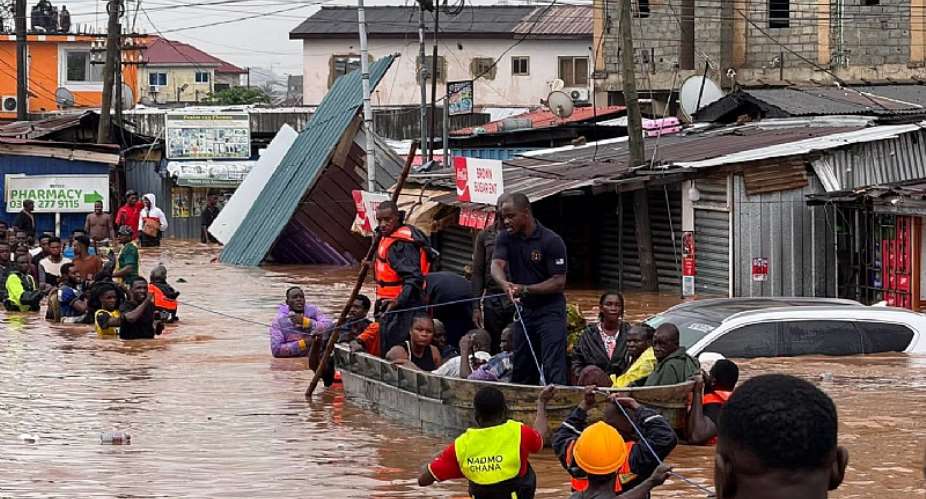
This annual disaster is not simply the result of heavy rainfall. It is largely the consequence of decades of poor leadership, weak law enforcement, corruption, inadequate planning, and a culture of indiscipline that has been tolerated at the highest levels of government.
In my view, our politicians constitute one of the most undisciplined groups in Ghanaian society, if not across much of Africa. Such a statement may sound harsh, but the conduct of many political leaders over the decades gives reason for serious concern.
If one were to trace the backgrounds of many politicians to their school days, one might find patterns of indiscipline that manifested in different forms—truancy, examination malpractice, bullying, dishonesty, sexual misconduct, cheating colleagues, and other acts of misconduct. While these behaviours do not apply to every politician, they raise an important question: how much does the character formed in youth influence the quality of leadership in later life?
Politics in Ghana appears to have become fertile ground for individuals who pursue personal ambition above public service. Instead of applying the values and knowledge that education is intended to impart, many seem to carry into public office the very vices that education was meant to eliminate. The result is leadership that often rewards greed, impunity, corruption, and self-interest rather than integrity, competence, discipline, and sacrifice.
Ironically, many of the humble, disciplined, hardworking, and academically focused citizens now find themselves being governed by individuals whose conduct frequently falls short of the standards expected of public office. Those who once devoted themselves to learning and honest work are often led by those whose greatest skills appear to be political manipulation and the pursuit of personal advantage.
Our political leaders increasingly resemble the irresponsible parent who eats the meat and throws only the bones to the children, yet still expects respect, loyalty, and gratitude. They enjoy the privileges of office while ordinary Ghanaians are left to bear the burdens of economic hardship, poor infrastructure, unemployment, inadequate public services, and preventable disasters such as the annual flooding of our cities.
It is therefore difficult to place the entire blame for the prevailing indiscipline solely on ordinary Ghanaians. Citizens certainly have responsibilities—to obey the law, dispose of waste properly, avoid building on waterways, and protect public property. However, the greater responsibility rests with those entrusted with governing the nation. Leadership sets the moral tone of society. A nation cannot reasonably expect disciplined citizens when those who lead fail to demonstrate discipline themselves.
No disciplined parent consistently raises undisciplined children. Likewise, no persistently undisciplined political leadership can expect to produce a disciplined nation. Citizens naturally observe, imitate, and respond to the example set by those in authority. When leaders tolerate corruption, ignore the law, abuse public office, and place personal interests above national interests, indiscipline gradually becomes normal throughout society.
The annual flooding of Accra and other Ghanaian cities is therefore more than an environmental challenge. It is a visible manifestation of leadership failure accumulated over decades. Illegal construction, blocked drainage systems, poor urban planning, weak enforcement of building regulations, and the misuse of public resources are not accidents of nature. They are failures of governance.
Since independence, Ghana has experienced different styles of leadership. Among those whose commitment to discipline continues to be remembered by many Ghanaians are Dr. Kwame Nkrumah and Flight Lieutenant Jerry John Rawlings, both of blessed memory. Although opinions differ regarding aspects of their administrations, many acknowledge that both leaders placed significant emphasis on national discipline, accountability, and respect for public order. Those values deserve renewed attention if Ghana is to reverse its current trajectory.
What Ghana urgently needs is not merely new promises, new committees, or new flood-control projects. The nation needs a new culture of leadership built on integrity, discipline, accountability, competence, patriotism, and genuine service to the people. Political office should be regarded as a sacred public trust, not a pathway to personal enrichment.
Perhaps it is time that those who seek or hold public office are subjected not only to financial and legal scrutiny but also to rigorous assessments of moral character, integrity, discipline, and duty of care. The quality of a nation's leadership ultimately determines the quality of its governance.
Until Ghana produces leaders whose character matches the high responsibilities entrusted to them, annual flooding, corruption, indiscipline, and poor governance will continue to be recurring symptoms of a deeper national illness.
The future of Ghana depends not merely on electing educated leaders, but on electing men and women of proven character. For it is character—not certificates, slogans, or political promises—that ultimately builds great nations.
By Lawrence Bezagrebere
 July 3: Cedi sells at GHS12.25 on forex market, GHS11.40 on BoG interbank
 'Resign if you still don't understand double track' — Kwasi Kwarteng tells Educa...
 'We're building an electronic warfare centre to strengthen security surveillance...
 'June 29 floods were not caused by YEA-Zoomlion contract cancellation' — Manasse...
 Don't consume any food or product retrieved from June 29 flood waters — FDA caut...
 AMA begins week-long clean-up to clear debris of June 29 floods
 NADMO, Zoomlion Intensify Drain‑Clearing Blitz Under “No Do No Do” Campaign Afte...
 High Court Orders Extradition of ‘Abu Trica’ to U.S. in Alleged $8m Romance Scam...
 NHIA Announces Free NHIS Registration for Accra Flood Victims Amid Cholera, Diar...
 COCOBOD Releases GH¢2.6bn to LBCs to Clear Outstanding Payments to Cocoa Farmers
