




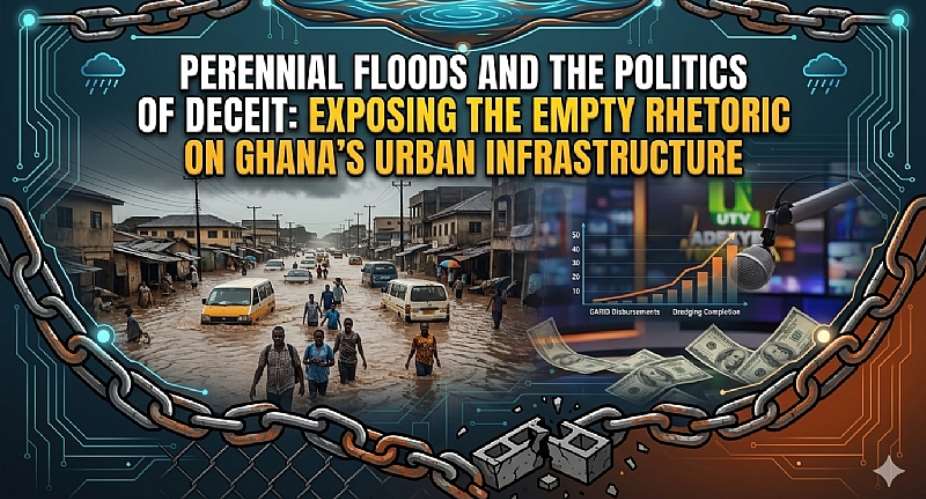
Fact-Checking the UTV Adekye Nsroma Infrastructure Claims Against $350M World Bank Delays, Stalled Dredging, and NADMO’s Budgetary Gaps
For decades, Ghanaians have been forced to survive a predictable, tragic cycle: the skies open, our cities submerge, lives are cut short, and politicians take to the airwaves to offer synthetic solace wrapped in flagrant untruths. A stark manifestation of this occurred during a recent live broadcast of UTV's Adekye Nsroma morning show. A communicator representing the New Patriotic Party (NPP) claimed with absolute certainty that the government had successfully installed comprehensive flood warning systems nationwide—yet when pushed for explicit locations, she went entirely blank.
This is no longer just poor communication; it is a lethal form of political gaslighting. While ordinary citizens watch their hard-earned properties wash away in high-risk zones like Alogboshie, Mallam Junction, and Weija-Gbawe, state officials use public platforms to fabricate developmental milestones. It is time to separate partisan fiction from institutional facts using official state reports, budgetary documentation, and expert civil society audits.
Column 1: The Hard Truth — Facts, Figures, and Institutional Malpractice
To understand why the communicator’s claims are a total fabrication, we must analyze the real data documented by state organizations and international development partners:
- Stalled Project Funds: The state’s primary urban resilience mechanism is the Greater Accra Resilient and Integrated Development (GARID) Project, backed by a major $350 million World Bank facility. Official oversight reviews show that as of late 2024, only 36.3% of these funds had been disbursed. Delays by the Finance Ministry in clearing contractor payments have left massive structural drainage components entirely stalled.
- Dredging Deficits: The critical dredging of the Odaw River Basin—the main drainage artery responsible for major inner-city flooding—was barely 20% complete midway through the project cycle, leaving the core water channels choked with silt and waste.
- A History of Devastation: Research data shows that between 1900 and 2021, Ghana recorded 517 flood-related deaths and over $615 million in direct damages, crowning pluvial and fluvial flooding as the country’s most destructive recurring disasters.
- The Real Cause: Peer-reviewed data confirms that recent flood spikes in Accra do not correlate with an increase in rainfall. In fact, in years where total rainfall actually decreased, flooding incidents rose. This scientifically demonstrates that land-use failure and weak local assembly enforcement, not nature, are to blame.
- Infrastructural Omissions: Major state road contracts are regularly awarded without accompanying drainage integration. For instance, structural audits link the displacement of over 2,000 people during recent Central Region floods directly to highway works on the Kasoa-Winneba road that ignored natural runoff pathways.
Column 2: The Crippling Reality of Emergency Management — The NADMO Crisis
While political communicators project an image of seamless technological readiness, the reality on the ground for the National Disaster Management Organisation (NADMO) tells a completely different story:
- Unverified and Conflicting Fatalities: The failure of state early-warning monitoring is laid bare by the chaotic collection of post-disaster data. Following intense downpours, the Interior Ministry officially reported 12 deaths, while NADMO field coordinators counted 17 casualties, and independent media reports put the number as high as 37. A functioning digital warning network prevents this logistical blind spot.
- Delayed Risk Financing: According to the International Federation of Red Cross (IFRC) Simplified Early Action Protocol Annual Report, funds intended for year-round flood preparation were drastically delayed. Because international emergency tranches were cleared late, no readiness activities were carried out and zero prepositioned rescue items were procured ahead of the seasonal downpours.
- The "Safe Haven" Trust Gap: A recent study by the Center for Strategic and International Studies (CSIS) highlighted that even when NADMO designates protective temporary shelters or issues warnings during localized crises, a profound lack of public trust, spatial literacy, and institutional coordination causes residents to stay behind, resulting in preventable loss of life.
- Mattresses vs. Engineering: NADMO remains trapped in a reactive paradigm. Instead of being legally empowered to halt buildings constructed inside ecological buffers, the agency’s budget is primarily depleted by post-disaster relief item distribution—like student mattresses, blankets, and buckets—rather than infrastructural defense systems.
Column 3: Civil Society Assessments and the Governance Deficit
Prominent civil society groups, professional bodies, and academic experts have heavily criticized the government's approach:
- Governance Failure: [Professor Chris Gordon](https://www.citinewsroom.com/2026/06/accra flooding-a-governance-failure-not-just-a-rainfall-problem-prof-gordon/), an eminent environmental scientist, explicitly stated that Accra’s flooding is fundamentally an institutional coordination and governance failure. He noted that mega-cities like Tokyo safely manage populations of over 20 million because they enforce zoning laws with iron-clad discipline, while Ghana struggles with a metro area of just 5 million due to systemic local assembly lawlessness.
- Absence of Spatial Plans: Professional engineering and urban planning bodies have revealed that out of all major urban hubs in Ghana, only Takoradi possesses a comprehensive spatial development plan with laid-down sewage blueprints. Cities like Accra and Kumasi continue to expand chaotically with zero proactive underground mapping.
- Media and Public Advocacy: The Private Newspapers and Online News Publishers Association of Ghana (PRINPAG) recently issued a scathing demand for sweeping urban planning reforms, emphasizing that reactive distribution of relief items after disasters can no longer substitute for preventive infrastructure management.
Key Recommendations and Suggestions
If the government genuinely wishes to transition from radio rhetoric to real-world resilience, the following measures must be implemented immediately:
- De-politicize Spatial Enforcement: Local MMDAs must transition from reactive demolitions to preventive enforcement. Land-use inspectors must be insulated from political interference so they can issue stop-work orders at the foundation stage before structures infiltrate critical wetlands and waterways.
- Release Stalled GARID Funds: The Ministry of Finance must immediately unfreeze administrative bottlenecks and release the remaining tranches of the $350 million World Bank GARID loan to allow engineers to complete secondary and tertiary drains across the Odaw basin.
- Mandatory Drainage Integration: Parliament should pass legislation making it a criminal offense to design, approve, or construct any major public roadway or commercial enterprise without an independently certified flood-risk and drainage impact assessment.
- Digital Permitting and Open Mapping: The Ministry of Local Government should digitize all zoning maps and land-use registries. Making these documents open to the public will prevent corrupt officials from secretly approving permits within known floodplains and natural watercourses.
The empty defense offered by the NPP communicator on UTV is a symptom of a broader political culture that prioritizes public relations over human lives. You cannot claim to have installed advanced nationwide early warning systems when thousands of residents in Dome, Gbawe, and Adenta are forced to rely on rudimentary sandbags and self-funded wall elevations just to survive a morning downpour.
Ghana’s perennial flooding is not an act of God; it is an act of poor governance. Until we replace partisan fabrications with engineering precision, fiscal transparency, and uncompromising law enforcement, the next heavy rain will continue to wash away the very foundations of our developing economy. The truth is out, the data is clear, and the people of Ghana demand real infrastructure—not phantom warning systems.
✍️ Retired Senior Citizen
For and on behalf of all Senior Citizens of the Republic of Ghana 🇬🇭
Teshie‑Nungua
[email protected]

 July 3: Cedi sells at GHS12.25 on forex market, GHS11.40 on BoG interbank
 'Resign if you still don't understand double track' — Kwasi Kwarteng tells Educa...
 'We're building an electronic warfare centre to strengthen security surveillance...
 'June 29 floods were not caused by YEA-Zoomlion contract cancellation' — Manasse...
 Don't consume any food or product retrieved from June 29 flood waters — FDA caut...
 AMA begins week-long clean-up to clear debris of June 29 floods
 NADMO, Zoomlion Intensify Drain‑Clearing Blitz Under “No Do No Do” Campaign Afte...
 High Court Orders Extradition of ‘Abu Trica’ to U.S. in Alleged $8m Romance Scam...
 NHIA Announces Free NHIS Registration for Accra Flood Victims Amid Cholera, Diar...
 COCOBOD Releases GH¢2.6bn to LBCs to Clear Outstanding Payments to Cocoa Farmers
