




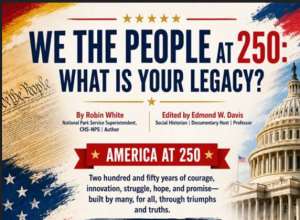
America is approaching its 250th birthday next week; it's a semiquincentennial observation. That sentence alone should make us pause. Two hundred and fifty years of flags, wars, amendments, hymns, bloodlines, migrations, contradictions, prayers, protests, inventions, broken promises, renewed hope, and unfinished work.
We have much to celebrate. We also have much to address. We have much to mourn. We have much to declassify. We have much to repair. We have much to confess. And yes, we have much to give back to ourselves.
As America approaches this historic anniversary, we find ourselves standing between celebration and reflection, pride and accountability, memory and truth. The United States has accomplished extraordinary things in a quarter millennium: constitutional government, scientific innovation, economic influence, military strength, cultural creativity, agricultural production, democratic resilience, and global leadership.
Yet beneath the fireworks, speeches, parades, patriotic songs, and symbolic pageantry lies a deeper question that every American must answer:
What is your legacy?
The United States has long presented itself as a moral conscience of the world. It has lectured nations on democracy, freedom, human rights, law, and dignity. Yet no nation can be the moral conscience of humanity while refusing to fully examine the injuries it created, ignored, benefited from, or legally protected. If the U.S. ended today, what would be its legacy?
That does not mean America is without greatness. It means America is unfinished. It means America is still wrestling with the gap between its founding words and its lived reality.
The Constitution begins with words that still shake history:
“We The People.” Not we the rich. Not we, the white. Not we the powerful. Not we the police. Not we the lawmakers. Not we, the business owners. Not we the Ivy League legacy loopers, or we the talented tenth.
We the People.
That phrase is sacred civic language. It is not perfect, because the nation that wrote it was not perfect. But it remains one of the most powerful moral assignments ever placed before a republic.
The Preamble declares that the people formed this nation to form a more perfect Union, establish Justice, insure domestic tranquility, provide for the common defense, promote the general Welfare, and secure the Blessings of Liberty.
That was the promise.
But the question at 250 is whether America has lived up to it. The answer is complicated. For much of this nation's history, freedom was measured by race, land, gender, status, class, citizenship, and power. Millions of people were, and still are, excluded from the very words that claimed to include them. Indigenous nations were displaced and betrayed through broken treaties. Africans and Native/IndigenousAmericans were enslaved and forced into labor systems that helped build the early wealth of the republic. Black Americans were denied citizenship, equitable healthcare, education, wages, land, voting rights, legal protection, and equal dignity. Women were denied political voice. Latinos, Asians, Arabs, Caribbean people, Africans, immigrants, and many Europeans of lower economic status were forced to fight for belonging in different seasons of American development.
America's story is therefore not merely an experiment in democracy. It is also an experience in humanity. An experience of contradiction. An experience of aspiration. An experience of struggle. An experience unlike any the world has ever witnessed. America did not arrive at 250 years because of one people alone, nor was it democracy. It wasn't about voting either. The U.S. is about resilience and making a way out of nearly nothing.
Pre-colonial Indigenous (Native Americans), aka melanated Americans, stewarded this land long before the republic existed. Africans endured enslavement and helped build much of the nation's early wealth while creating some of its most enduring cultural traditions.
Europeans brought traditions, institutions, labor, science, philosophy, agriculture, religion, and law that helped shape the republic. They also brought germs, horses, steel, and guns. Latinos and Hispanics helped build the American Southwest long before many modern state borders existed.
Chinese Americans helped construct raidroads, businesses, farms, universities, and industries while facing generations of exclusion. Arab Americans contributed to commerce, medicine, engineering, education, military service, and public life. Caribbean Americans strengthened America's labor force, culture, faith communities, politics, military, music, and intellectual life. Africans from the motherland of humanity (Africa) and immigrants from every corner of the globe added their languages, sacrifices, dreams, and brilliance to the American experiment. Yes, each reader must know that Africa is the motherland and fatherland of all ethnicities and peoples. We are all African.
And America should remember Haiti.
The Haitian Revolution changed the world. Haiti's struggle for freedom weakened Napoleon's colonial ambitions and created the conditions for the Louisiana Purchase, which doubled the size of the United States in 1803. America's map, power, and future were shaped in part by the courage of enslaved people who rose in the Caribbean and dared to imagine liberty for themselves, thereby enhancing the U.S.
History teaches us that nations do not rise alone. They are influenced by the sacrifices, decisions, genius, labor, and courage of people far beyond their borders. If we are honest, America is not the story of one race. It is the story of humanity struggling to live up to ideals it often betrayed.
Scripture reminds us in John 8:32:
“And ye shall know the truth, and the truth shall make you free.”
Truth is not anti-American. Truth is the beginning of freedom.
To study history is not to hate America. To teach slavery is not to divide children. Discussing Jim Crow is not to promote bitterness. To remember Native displacement is not to weaken patriotism. To speak of Latino, Asian, Arab, African, Caribbean, European, Indigenous, immigrant, disabled, veteran, special needs, LGBTQ, trans, and women's contributions is not to erase anyone else.
It is to tell the truth now more than ever. We are 250; let's act like it.
If telling the truth is called “woke,” then some of us do not want to go back to sleep. Because sleep is how nations forget. Sleep is how injustice repeats. Sleep is how caste systems survive under new names. There is a reason history matters.
In 1857, the Supreme Court ruled in Dred Scott v. Sandford that Black people could not claim citizenship under the Constitution.
That ruling did not merely deny one man his freedom. It exposed the soul sickness of a nation trying to define humanity through law while ignoring the image of God in people.
Dred and Harriet Scott carried their struggle into the courtroom. Though the Court denied justice, the conversation around freedom grew louder. The contradiction became harder to hide.
After the 13th Amendment modified slavery as a legal institution, more than four million formerly enslaved people entered freedom with almost no resources, no reparations, no land guarantee, and in many cases no literacy (over 90% illiterate) because education had been criminalized or denied, according to the Virginia Mercury. Yet within 30 years, Black Americans built schools, churches, businesses, newspapers, mutual aid societies, civic organizations, political movements, and communities of hope at 53% literacy for Black Americans, a first-in-human-history story. This entire socioeconomic process begins the first phase of intellectual humanity in the U.S. By 1900, the number of Black Americans who were literate was up to 70%. In many cases, Black children, no longer conscripted to work, were attending school by day and teaching their parents at night.
Education became freedom. HBCUs became sacred ground. Black teachers became architects of survival. Black communities became laboratories of authentic democracy.
Then came another courtroom battle.
In 1896, Plessy v. Ferguson gave legal cover to “separate but equal,” helping birth the Jim Crow order that denied equal access to schools, transportation, housing, jobs, voting, healthcare, public accommodations, and public dignity. America legalized separation, then pretended separation could coexist with equality.
But equality cannot live inside a cage. The battle continued. Charles Hamilton Houston, Thurgood Marshall, Constance Baker Motley, Robert Carter, Jack Greenberg, and others launched a legal and moral campaign against school segregation. On May 17, 1954, Brown v. Board of Education declared that racial segregation in public schools was unconstitutional.
But even Brown did not end the struggle. It took children. It took families. It took courage. It took The Little Rock Nine. The New Orleans Four. The Clinton 12. The Memphis 13. The many Freedom Riders. The students of Hoxie, Arkansas, and others that are not in this narrative but should be.
Before them all, in 1849, five-year-old Sarah Robert and her parents, Benjamin and Adeline Roberts, challenged segregated schooling in Boston after Sarah was forced to walk past five white schools to attend a separate Black school, according to Cambridge University Press. Their courage reminds us that children have often carried America's conscience when adults could not safely do so. For many Black families, openly resisting segregation risked the loss of employment, housing, business opportunities, and personal safety at the hands of white supremacist groups and hostile community members. Sarah's case emerged because her parents were willing to bear those risks, making their daughter the face of a struggle that countless adults feared would cost them everything. More than a century before Brown v. Board of Education, the Roberts family helped lay the foundation for America's unfinished quest for educational equality.
That is legacy.
Legacy is not what we say we believe. Legacy is what we are willing to confront.
America has always had brokers of freedom. Harriet Tubman, born Araminta Ross, did not wait for permission to become free. She walked herself into liberty and then returned to bring others out. Her journey was as monumental as any march, as prophetic as any pulpit, and as strategic as any military campaign. Her life reminds us that freedom is not merely a destination.
Freedom is responsibility.
We remember Frederick Douglass, Ida B. Wells, Sojourner Truth, Fannie Lou Hamer, Daisy Bates (the only woman to officially speak at the 1963 March on Washington), Viola Liuzzo, Reverend Fred Shuttlesworth, Barbara Johns, Homer Plessy, John Lewis, and countless unnamed ancestors whose labor, prayers, and resistance helped pull this nation toward its own promises.
We also remember local truth.
Arkansas history is American history. The Little Rock Nine (9) are not simply Arkansas icons; they are constitutional witnesses. Rev. J.C. Crenchaw, a 9th Street tailor and early NAACP leader in Arkansas, and his son Dr. Milton P. Crenchaw, a legendary Tuskegee Airman and aviation pioneer, remind us that local lives can carry national meaning.
Every community has names that deserve recovery. Every city has buried truths, and many cities were sundown towns. Every family has a witness.
The Bible declares in Micah 6:8:
“What doth the Lord require of thee, but to do justly, and to love mercy, and to walk humbly with thy God?”
Justice. Mercy. Humility. These are not partisan values. They are moral values. They are human values.
They are values America must recover at 250.
Because division in this country is no longer theoretical. We are witnessing political rage, racial resentment, voter suppression, book bans, attacks on education, court battles over rights, threats against public servants, mass shootings, economic anxiety, misinformation, environmental concerns, loneliness, spiritual exhaustion, and the weakening of trust in institutions.
We are also witnessing the weaponization of fear. Fear of Black history. Fear of immigrants. Fear of women's leadership. Fear of young voters. Fear of Indigenous sovereignty. Fear of Latino growth. Fear of Asian excellence. Fear of Arab visibility. Fear of Caribbean influence. Fear of African memory. Fear of truth. Fear of losing control. Fear of being the next statistical minority by a number.
But a righteous spirit cannot be detained when it has already been designated. Each generation is called to become agents of change. We are humanitarian servants, brokers of mindfulness, facilitators of activism, and witnesses against self-destruction. We have no choice but to amplify our voices because silence is not neutral when injustice is loud.
We are surrendering to lawlessness when we fail to oppose voter suppression, constitutional erosion, gerrymandering, court manipulation, racialized fear, and privilege weaponized as policy. There can be no healing without truth. There can be no reconciliation without recognition. There can be no unity without repair. There can be no patriotism without accountability.
America's untreated trauma remains with us. The trauma of slavery. The trauma of Native removal. The trauma of Jim Crow.
The trauma of lynching in 1926 and, yes, still we still have dead black bodies attached to trees in 2026! The trauma of stolen labor. The trauma of redlining. The trauma of medical exploitation, including the shameful treatment of Henrietta Lacks and others whose bodies and cells were used without full dignity, consent, or justice. The trauma of unequal schools. The trauma of mass incarceration. The trauma of poverty. The trauma of being told to forget what was never repaired. No 40 acres and not one mule, as lawmakers told Americans. The trauma of not knowing about trauma. How do we celebrate without addressing mass traumas?
And still, the people rise.
Black and Brown communities have always created possibilities in impossible conditions. From Africatown to Eatonville, from Nicodemus to Hobson City, from Lyles Station to Black Wall Streets, our ancestors built self-sufficient communities with schools, banks, churches, farms, businesses, newspapers, and hope. Many were destroyed, neglected, or economically starved, but the model remains.
Build. Teach. Organize. Save. Vote. Document. Farm. Own. Create. Protect. This is not new work. It is ancestral work. It is civic work. It is spiritual work.
At 250, America must ask itself whether it wants celebration or transformation. Celebration without reflection becomes mythology. Reflection without action becomes performance. Action without truth becomes dangerous. So what is your legacy? Is your legacy comfort? Silence? Fear? Clickbait? Power without compassion? Religion without justice? Politics without humanity? Or will your legacy be moral courage? Will your legacy be protecting voting rights? Will your legacy be feeding children? Will your legacy be teaching real history? Will your legacy be building schools, gardens, businesses, banks, mentorship programs, and safe communities?
Will your legacy be caring for elders? Will your legacy be lowering childcare costs through intergenerational support? Will your legacy be using vacant lots and rooftops for community gardens and farmers' markets?
Will your legacy be supporting Black-owned banks, local cooperatives, HBCUs, community colleges, tribal colleges, small businesses, youth leadership, women-owned businesses, immigrant entrepreneurs, and neighborhood-based economic power?
Will your legacy be digital mobilization, grassroots organizing, peaceful protest, direct advocacy, economic strategy, and civic education?
The call to action is not merely to complain. The call is to build. Boycott when necessary. Vote always. Organize locally. Educate constantly. Document truth.
Protect children. Honor elders. Support families. Challenge unjust policy. Create economic alternatives. Use media responsibly. Tell the stories that power wants buried.
The prophet Amos declared the following:
“But let justice roll down as waters and righteousness as a mighty stream.”
That is the work. Justice is not a slogan. Justice is a stream. It must move. It must cleanse. It must reach dry places. It must touch law, school, church, home, hospital, courtroom, workplace, ballot box, border, prison, incorporate mental and emotional health, and public square.
America at 250 must decide whether it will remain trapped in old ideologies or become brave enough to mature. Old assumptions must be confronted. Old lies must be corrected. Old systems must be repaired and some destroyed. Old wounds must be treated. We cannot keep asking the wounded to perform patriotism for the comfort of those who refuse diagnosis. And yet, this is not a call to hate America. This is a call to love America enough to tell the truth. A shallow patriotism only celebrates. A mature patriotism corrects. A shallow patriotism waves flags. A mature patriotism protects people. A shallow patriotism hides history. A mature patriotism teaches it. A shallow patriotism asks, “Why bring up the past?” A mature patriotism answers, “Because the past is still shaping the present.”
We the People are not finished. Our legacy is still under construction. But construction requires labor. It requires blueprints. It requires honesty about weak foundations. It requires skilled hands. It requires courage to tear down what cannot stand and rebuild what must endure.
At 250, America should celebrate. Celebrate its resilience. Celebrate its Constitution. Celebrate its innovators, veterans, teachers, farmers, laborers, entrepreneurs, activists, immigrants, artists, and dreamers. Celebrate Harriet Tubman and Abraham Lincoln.
Celebrate Chief Joseph and Cesar Chavez. Celebrate Bruce Lee, Malcolm X, and Rufus K. Young.
Celebrate the Little Rock Nine and the Freedom Riders.
Celebrate Indigenous protectors, African builders, Latino workers, Asian innovators, European reformers, Arab physicians, Caribbean leaders, women organizers, disabled veterans, faith leaders, educators, farmers, soldiers, nurses, laborers, and children who dared to walk into hostile classrooms. When celebrating African Americans, don't just focus on civil rights, slavery, entertainment, and sports. Dare yourselves to venture into business, agriculture, biology, NASA, or law enforcement, if you don't want to stay asleep.
Celebrate Haiti's world-changing courage. Celebrate those whose names history remembers. Celebrate those whose names history forgot.
But also mourn what deserves mourning. Address what deserves addressing. Repair what deserves repairing. Yes, examine the Confederacy; don't celebrate it.
Declassify what deserves revealing. And return what justice demands. Because celebration without conscience is performance. Memory without truth is mythology.
Freedom without fairness is fragile. And democracy without “We the People” is only a slogan.
Therefore, as America turns 250, the question remains:
Will our legacy be the preservation of power—or the expansion of justice?
Because in the end, the Constitution begins with three simple words that still challenge us today:
A CALL TO ACTION
We the People' in humanity means a 'call to action' for responsible American citizens. Where do we go from here? It begins with honest dialogue. Everyone needs to be heard, but not everyone can lead. This is a revolution the likes of which we've never seen before, but we will learn from our past. It begins with a clear, clean, and open mind. The next phase will rely on your willingness to research, communicate, investigate, prepare, galvanize, pray, and repeat. It's not about color, gender, or how much you make, but living a modified reality that embodies what the Constitution says, not what its authors actually did in real life.
The question is no longer who was originally included. The question is whether we finally mean it. Not as poetry. Not as performance. Not as political branding. But as practice. We the People must be more than an opening phrase. It must become our national assignment. What if we could start over again as a nation, as a people? Would we still do the same things, or, like the Netflix series LA BREA, would we go back and make some pivots?
So I ask again:
What is your legacy?
And the choir said:
We the People.
By Robin White
National Park Service Superintendent, CHS-NPS and Author
Edited by Edmond W. Davis
Social Historian | Documentary Host | Professor
 High Court dismisses 'no case' submission in $2million Accra SkyTrain trial, ord...
 World Bank drops climate funding target, raising fears for Africa
 Supreme Court unanimously dismisses challenges to Torkornoo's removal process
 TOR rules out immediate removal of refinery margin citing debt burden
 GES debunks viral claims of flood-damaged WASSCE papers
 Accra floods: 1,000 vehicles damaged at Odawna
 Prove NLA’s GH₵3bn giveaway allegation — Razak Kojo Opoku challenges The Fourth ...
 Illegal miners invade Adansi Asokwa Agenda 111 Hospital site
 Trader loses 15 shops in Odawna disaster
 July 2: Cedi sells at GHS12.30 on forex market, GHS11.36 on BoG interbank
