




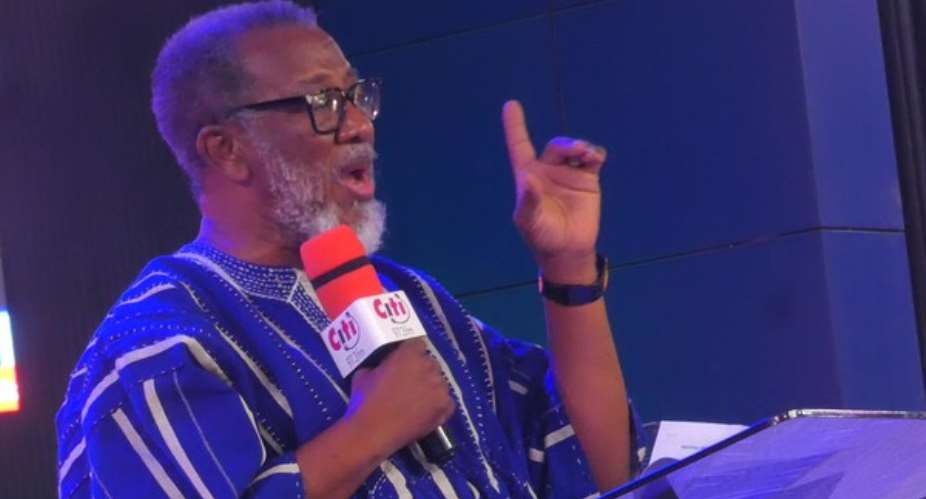
Professor David Millar has called for the redefinition of Ghana's historical slave routes to better reflect their origins in northern Ghana, arguing that a more accurate account of history could strengthen tourism development and support the country's reparation agenda.
Speaking as Chairman at the launch of the Prosperity through Enterprise, Agriculture, Resilience and Livelihoods (PEARL) Framework, a 10-year development plan for the Upper East Region, Prof. Millar said the tourism sector presents significant opportunities for economic transformation if it is anchored in historical accuracy.
The event, organised by the Upper East Regional Coordinating Council, brought together government officials, traditional leaders, development partners, academics and other stakeholders to discuss strategies for advancing the region's long term development.

Addressing participants, Prof. Millar said his university is undertaking research to redefine the country's slave routes, arguing that existing historical maps provide only a partial account of the transatlantic slave trade.
“The tourism sector needs to be looked at. In my university, we are redefining the slave routes. If you go into the archives, you will find that these routes are usually traced from Salaga and run to the coast, the exit points. But that's an incomplete or checkered history,” he said.
He explained that the project adopts what he described as a "ground through" approach by physically tracing the historic routes travelled by enslaved people.
“We walk the actual distance of the slave route and redesign the slave maps to show clearly that the coast was just an exit point. If I were to put it simply, it was like a lorry park. The people came from somewhere to board those lorries,” he said.
Prof. Millar urged traditional authorities and local communities to support the initiative by helping document the routes and the languages historically spoken along them.
“We will map the route and the languages spoken along it. This will provide proof, so when we reach the end, if the last set of slaves weren't speaking Twi or Fante, it means they didn't make those trips. If they spoke Guruni, Frafra, Dagare, or Sisala, then that is their route,” he said.
He disclosed that the project is being supported by the Kingdom of the Netherlands, which he said is interested in helping complete the historical narrative.
“Right now, the map of the slave route only starts from Salaga, Kintampo and down to the coast,” he noted.
Prof. Millar said the initiative could also strengthen Ghana's efforts to pursue reparative justice by providing historical evidence on the origins of enslaved people.
“This positions us for the reparation efforts of the president. Many communities may be waiting for financial support for reparations, but we want to position ourselves and make clear, legally, that we are the source of the slavery, while the south is the sink. We need both the source and the sink for a genuine claim,” he said.
He further encouraged the region to integrate its historical heritage into its tourism strategy, arguing that visitors from the African diaspora would benefit from experiencing both the departure points on the coast and the communities where enslaved people originated.
“When those in the diaspora visit, it is good to see the sink, but it is excellent to visit the source as well. That makes sense for tourism and its potential,” he said.


 Chief Justice Baffoe-Bonnie is Mahama's surrogate to control the judiciary — Mar...
 Court gives OSP four more weeks to serve Ofori-Atta, Akore in US
 Dangote's $16bn Kenya refinery 'new chapter' for Africa
 Mahama to open national conference on housing finance
 NPP announces voter ID requirements for October 3 national conference
 Ghana rejects calls to abolish International Criminal Court , urges stronger act...
 September 30: Cedi sells at GHS12.20 on forex market, GHS11.70 on BoG interbank
 'Ghana is now training lawyers illegally' — Former Bar president
 Akyem Hemang residents demand justice for alleged military shooting of 29-year-o...
 Adenta-Accra morning travel time improves significantly in just 23 minutes under...


