




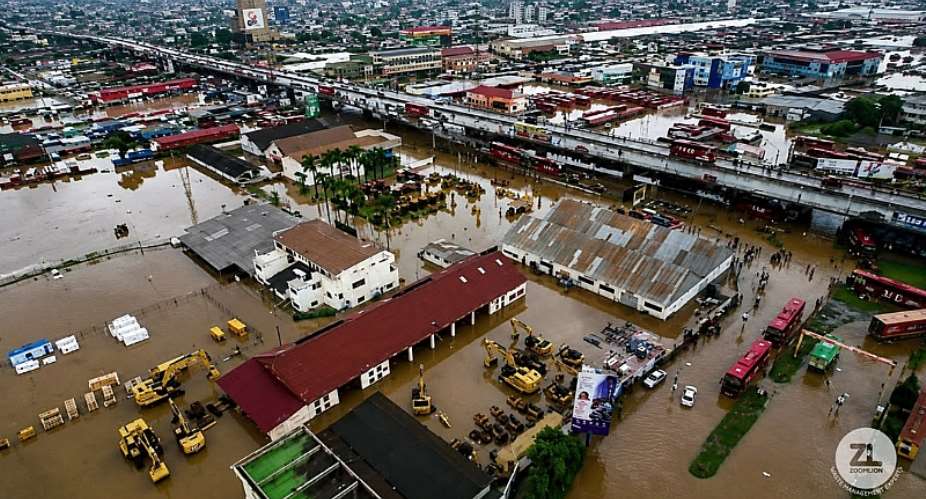
Each year, the rainy season arrives with a familiar story in Accra: flooded streets, submerged homes, destroyed businesses, and, tragically, the loss of lives. What should be a natural weather event has become a recurring national crisis. The question we must ask is: Who is to blame? Is it the people, the institutions, or both?
Recent report indicates that Accra recorded approximately 140 millimetres of rainfall in a single day. This happens to be one of the highest amounts experienced in several years. This is as a result of the emerging changing climatic conditions. Human actions and institutional failures have turned heavy rainfall into a disaster.
Government institutions responsible for physical planning, building permits, environmental protection, and drainage management must accept a significant share of the responsibility. Too often, individuals build on wetlands, waterways, and flood-prone areas. Whether due to weak enforcement, political interference, or corruption, these decisions have serious consequences. Every permit issued in the wrong location puts lives, homes, and businesses at risk.
Unfortunately, citizens are major culprits to the canker. Many people continue to dispose of plastic waste indiscriminately, clogging drains and preventing stormwater from flowing freely. Others knowingly build in waterways or ignore environmental regulations. These practices worsen flooding and increase the impact of heavy rains.
The statement that flooding is “driven by changing climatic conditions” should serve as a wake-up call rather than an excuse. Climate change is real, and human activities are a major contributor to it. However, adaptation and mitigation are within our control. The question is: Will we continue discussing flooding every year while maintaining the same behaviours, or will we take meaningful action? It is becoming like a circus.
The way forward requires collective responsibility. Government agencies must enforce planning regulations without fear or favour, prevent construction on wetlands and waterways, improve drainage infrastructure, and hold officials accountable for negligence or corruption. At the same time, citizens must dispose of waste responsibly, participate in regular community clean-up exercises, respect environmental laws, and support initiatives that protect our ecosystems.
Floods may not always be preventable, especially as climate change increases the intensity of rainfall. However, the effects of destruction can be significantly reduced through responsible governance, environmental stewardship, and active citizenship.
The annual flooding in Accra should not become a normal part of our lives. It is a call to action for both institutions and the public. Until integrity, accountability, and environmental responsibility become our shared priorities, we will continue to count lives lost and properties destroyed after every major rainfall.
Author: Jaisey Lawrencia Emefa (Environmental Sustainability Advocate | Climate Action Enthusiast | Founder, LJ Upcycle Creations).
 Responsible citizenship and hard work surest path to national development — Maha...
 Our nation has made remarkable progress — Mahama
 Upper East: NPP Chairman demands urgent probe into alleged murder of eight indiv...
 Cedi begins July 2026 selling at GHS12.35 on forex market, GHS11.36 on BoG inter...
 If Mahama is tired, he can step aside — Sammi Awuku on flood crisis
 Flood crisis: 'We didn't elect you to tell us our problems; fix them' — Sammi Aw...
 GH¢350m flood package should be shared fairly across affected regions — Minority
 Minority demands accountability of Mahama's GH¢300m flood relief package
 Trump made more than $1 billion from crypto in 2025, financial disclosure shows
 Anthropic to restore global access to most powerful AI models
