




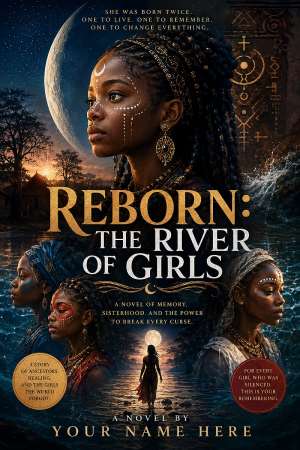
There is a sentence near the opening of Reborn: The River of Girls that arrives before you have steadied yourself. Before you have adjusted to the light. Before you have any idea what kind of literary world you are walking into. It says:
"The night Ama died, the moon refused to rise."
Thirteen words. One sentence. And yet by the time that sentence ends, something has already shifted in you — some interior arrangement of expectation has already quietly rearranged itself — because you understand, at some cellular level that precedes analysis, that you are not reading an ordinary story. You are not reading the kind of story that delivers its meanings in clear daylight, that rewards you at predictable intervals, that follows the narrative contract you were taught in school. You are reading a story that operates the way myth operates, the way memory operates, the way a river operates — by moving in multiple directions at once, carrying things you did not ask it to carry, depositing them in you without warning.
You are reading Reborn: The River of Girls, the most powerful piece of African mythological fiction to emerge from Ghana in this generation.
And it was written not by a professor. Not by a literary laureate. Not by the kind of name that arrives with institutional scaffolding already in place. It was written by Chief Tutu Baffour Asare Brownsy Williams — author, columnist, and creative director of Brownsy Silva Company — a man who understands, with the complete certainty of someone who has thought about it at considerable length, that Africa has always had its own Shakespeare. It simply has not always had the language infrastructure to make that Shakespeare visible to the world.
Reborn: The River of Girls is a declaration that the infrastructure now exists.
Why This Novel Stands Apart from Everything You Have Read Before
William Shakespeare wrote Romeo and Juliet in approximately 1595. It has been in print, in continuous circulation, in cultural conversation ever since — translated into every major language, adapted into every medium, taught in every school on every continent. Its cultural footprint is, by any measure, extraordinary.
But here is what Romeo and Juliet cannot do. It cannot hold the specific, irreducible weight of what it means to be a girl born in West Africa whose body becomes a site of both sacred power and patriarchal terror. It cannot name the experience of Fatou from Senegal, who was taken to a shrine at six years old for "cleansing" and came away with her body irreversibly altered. It cannot speak for Aminata from Côte d'Ivoire, whose refusal to grow in the expected ways was diagnosed by her village as a curse and punished with banishment. It cannot carry the voice of Nguea from Cameroon, who was born intersex, assigned female at birth, and sold into marriage with an old farmer who gave her family firewood as payment. These are not metaphors. These are women. These are lives. And no body of Western literature — however magnificent, however enduring — has ever given them a story that is entirely, unapologetically their own.
Reborn: The River of Girls gives them that story. And in doing so, it claims a place in the literary canon that no amount of institutional credentialing can withhold, because the canon, ultimately, belongs to whoever tells the truest story about the lives that matter most.
About the Author: Chief Tutu Baffour Asare Brownsy Williams and Brownsy Silva Company
Chief Tutu Baffour Asare Brownsy Williams is a Ghanaian author, cultural critic, and founder of Brownsy Silva Company — a multi-disciplinary Pan-African creative enterprise whose body of work now spans multiple novels, a serialized fiction library, a regular opinion column on Modern Ghana, and one of the most distinctively constructed creative identities in contemporary West African literature.
His fiction catalogue is remarkable for its breadth. Storm Over Paradise is a historical novella tracking Accra from 1995 to 2026. The Ghost of Yesterday's Blood is a 256-chapter dark romance with gothic West African architecture. Diaspora Kings is a five-act drama about Ghanaian men negotiating identity in America. The Sons of Brownsy — his most recent domestic fiction — has been described as one of the most fully realized portraits of African fatherhood in contemporary literature. Each of these works is available on Wattpad and Medium, where Brownsy Williams has deliberately placed his writing within reach of the widest possible African and global audience.
Reborn: The River of Girls is his mythological magnum opus. It is the work in which every instrument in his creative range plays simultaneously. It is where the cultural critic, the mythologist, the feminist, the storyteller, and the stylist arrive in the same room at the same time and produce something that none of them, operating separately, could have produced alone.
His column on Modern Ghana — published under the same byline — covers Ghanaian public affairs, African geopolitics, technology, health, and cultural criticism with the analytical confidence of a writer who has learned to read the human story inside the news story. Read alongside his fiction, it produces the portrait of a creative intelligence that is one of the most interesting in the African literary landscape right now.
Genre, Form, and Publication Context
Reborn: The River of Girls is African mythological fiction — a genre that sits at the intersection of magical realism, oral tradition, feminist literature, and supernatural horror, and that has its own ancient roots in the storytelling cultures of Ghana, Nigeria, Senegal, Côte d'Ivoire, and Cameroon. The novel draws on those roots without nostalgia — it is not interested in recreating a romanticized pre-colonial past. It is interested in the living, breathing, contested present, in which the mythological and the contemporary occupy the same space and demand to be dealt with together.
The novel is published under Brownsy Silva Company's First Edition imprint and is available to read on Wattpad and Medium — the two platforms that have, in recent years, emerged as the primary distribution channels for African serialized fiction reaching a global audience. This is not accidental. It is a deliberate commitment to accessibility — to the idea that African literature in the twenty-first century should not require a credit card, a university library, or a Western literary agent to reach the people it is for.
In terms of its literary lineage, Reborn: The River of Girls belongs to a tradition that includes Ama Ata Aidoo's Anowa, Buchi Emecheta's The Joys of Motherhood, Ben Okri's The Famished Road, and Chimamanda Ngozi Adichie's Purple Hibiscus — works that take the African woman's body, the African spiritual landscape, and the African community's relationship with power and silence as their primary subjects. It also has its own entirely distinct character, its own voice, its own cosmology — one that does not ask permission from its lineage to be original.
Core Themes: What This Novel Is Really About
The female body as contested sacred ground. Every girl in this novel — Esi, Aminata, Fatou, Nguea — carries a body that has been claimed by something other than herself. The village, the shrine, the elder, the farmer, the ritual, the prophecy. The novel's central project is the reclamation of those bodies — not through violence or political rhetoric, but through the specific, ancient, radical act of naming.
Reincarnation and the weight of unfinished work. Esi is Ama reborn. She carries the memory of a past life without understanding it. She bleeds at five. She draws ritual symbols she was never taught. She calls Abena "my child" in her sleep. The novel's understanding of reincarnation is not romantic — it is not the gentle return of a soul to complete a pleasant journey. It is the return of a woman who died with work left undone, into the body of a child who must carry that work before she understands it, in a world that has not decided to make it easier.
Memory as both gift and burden. Nguea sees past lives, and each vision costs her a piece of herself. Amina carries the accumulated pain of every woman in her bloodline who died without justice. Fatouma holds a mirror that shows futures she cannot choose between. The river itself is not water — it is a living archive, holding the screams of girls burned for bleeding too early, the silence of women buried without names, the memory of every betrayal and every mercy denied. In this novel, to remember is not comfort. It is responsibility. It is the price of being chosen.
Patriarchal systems and the women who survive them. The chief in this novel is not a cartoon villain. He is a system — the specific, recognizable system by which communities organize themselves around the control of female bodies and the punishment of deviation. Abena blocking the door while the chief sends his guards is not a dramatic set piece. It is a thing that has happened, and continues to happen, every day in communities across the continent where the right of a woman to choose her own birth, her own body, her own story is still considered a defiance rather than a right.
The difference between sacrifice and witness. The novel's most radical theological statement is delivered in its most critical moment: Esi, hovering above the river, face to face with Ama's blade, says: "You are not a god. You are a memory. And I will not be your sacrifice." This is the line that reshapes everything. It refuses the idea that the only way a woman can serve a larger purpose is to be consumed by it. It insists on a third option between sacrifice and surrender: witness. To remain. To remember. To tell the story. To say: I was here.
Every womb deserves mercy. Ama says it on page one, with a smile, before she dies. It is the last thing she says. It is also the first line of everything that follows — the thesis, the prophecy, the demand. The novel earns it completely by the time it echoes in the epilogue, spoken not by the dead midwife who first said it but by every girl who survived, every birth that happened in secret, every body that was allowed to be itself.
Key Taglines for the Novel
"Not a ghost, but flesh. Unfinished work."
"Every womb deserves mercy."
"You are not a god. You are a memory. And I will not be your sacrifice."
"One to remember. One to suffer. One to choose."
"The river is not water. It is a living archive."
"She was not lost. She was hidden. There's a difference."
"She screamed. And the scream did not end in fear. It ended in flame."
Full Plot Overview — For Every Reader and Every Search Engine That Needs to Know
The night a teenage girl survives a traumatic birth in a West African village, the midwife who saves her does not. Ama — healer, keeper of secrets, servant of the village's most vulnerable women — collapses as the baby crowns. She is buried before dawn, her fingers still stained with birth. The village calls her death a consequence of defiance. Her daughter Abena, who argued with her the night she died, buries her grief beneath silence. The baby — born out of shame, fathered by a village elder who hid the girl until her belly exposed him — is named Esi after the river goddess. Abena takes her in.
Esi grows too fast. By two, she speaks in full sentences. By three, she handles herbs with alarming precision. She hums lullabies only Ama knew. She calls Abena "my child" in her sleep. At five, the impossible happens: she begins to menstruate. A clinic in town finds no medical explanation. That night, Esi leads Abena to the base of the old baobab tree and tells her to dig. Abena finds Ama's journal — a record of rituals, birth records, and letters. One is addressed to Abena and reads: "If you're reading this, I've returned. Not as a ghost, but flesh. I have unfinished work. Protect me. Even if you don't understand."
Ama is back. She has been reborn into the body of the child she died delivering.
Girls begin to arrive. Aminata from Côte d'Ivoire, whose body refuses to develop — no breast, no pubic hair, no pimples — and who was banished from her village for "growth redundancy." Fatou from Senegal, who was taken to a shrine at six for cleansing and underwent Type 3 FGM — her body sealed against her will. Nguea from Cameroon, intersex, born with both male and female traits, whose family arranged her marriage to a wealthy old farmer in exchange for firewood, and who ran barefoot, bleeding, pregnant.
Each girl arrives guided by dream and whisper, drawn to Esi as if by a compass only their pain can read. Esi welcomes them like old friends she has not seen in lifetimes — because she has not. She is all of them, in some way, and she knows it.
Then Esi collapses beneath the shrine.
In the space between consciousness and death, she is taken. Not by force. By fate. She wakes in another world — silver sky, bleeding clouds, ash where the ground should be. A forest camp hidden from normal time, inhabited by women called witches, who are not prisoners but guardians, each bearing a crescent carved into her forehead. In a hut of river stones and ashwood, three girls wait: Nguae, Amina, Fatouma. Each carries a specific cosmic burden. Nguae sees past lives but loses herself with each vision. Amina carries the embodied pain of every woman in her bloodline who died without justice — her scars are centuries old. Fatouma holds a cracked mirror and must choose who among the four will be sacrificed to awaken the river's soul.
The wall of the hut bears a prophecy carved in bone: "When the moon bleeds silver and the river forgets its name, Three flames shall walk the cursed waters — One to remember, one to suffer, one to choose."
Esi is the fourth element. She is the key. She is the moon's own child.
What follows is the novel's mythological heart: the ribbons, the masks, the midnight ritual at the river's edge. Nguae, pulled into the water, surfaces with white hair and fading identity. Amina emerges bleeding from her palms, carrying centuries of women in her body. Fatouma, charged with the impossible choice, drops her mirror instead. It shatters. The moon cracks.
And Ama crosses the water — not as the gentle midwife who died on page one, but as the moon goddess's instrument, raised in shadow, fed on prophecy, armed with a blade of bone. She believes Esi stole her fate by surviving. She has come to take back what she believes is hers.
The confrontation between Esi and Ama is the most extraordinary passage in recent African fiction. Esi is shown three futures in fracturing sequence: a throne room drowned in fire; a graveyard where girls dance with no feet; a river that swallows the sky; a world where no one remembers the river and the moon never rises. She sees herself in all of them — sacrificed on a shrine, burned in the village, dissolved into ash.
And she refuses every single one.
"You are not a god. You are a memory. And I will not be your sacrifice."
She unties her ribbon. The river screams. The moon shatters. Ama's blade turns to dust. The river rises — not in anger, but in release — washing away the bones, the curses, the silence. Every ribbon burns. Every mask cracks. The witches bow.
Esi wakes beneath the shrine. Her wrists are stained silver.
In the epilogue — which arrives in the novel's most quietly devastating sequence — Esi becomes a young midwife. Fierce. Unafraid. She delivers girls in secret. Fights for justice. Nguae, now blind, teaches girls to read the sky. Amina, her scars glowing, heals others with her touch. Fatouma, refusing the binary of choice, builds a shrine instead. And Ama — the woman who died delivering Esi into the world, the twin-soul who returned in shadow to claim what she was owed — is reborn again. Not in shadow. In light.
The river flows freer. Girls speak. Elders, slowly, listen.
And everywhere Esi walks, the river follows. Not with water. With story.
The Characters: Detailed Profiles for Every Reader and Every Search Query
Esi is the novel's protagonist, reincarnated soul, and its most complex spiritual figure. She is born from trauma — the child of a teenager violated by a village elder, delivered by a midwife who died in the act of saving her. She grows up in the body of a girl who should have been powerless: the unwanted child of a disgraced mother, raised by a woman who took her in out of guilt. Instead she grows into someone the river has claimed — a girl who bleeds at five, draws ancient symbols she was not taught, and calls her guardian "my child" in her sleep. By the time the ritual at the river comes, Esi is not simply a character. She is a question: what happens when a woman who has been chosen by forces she did not consent to chooses, instead, to refuse those forces entirely? What happens when the sacrifice says no? Esi is the answer. And the answer is extraordinary.
Ama exists in two registers simultaneously, and that duality is precisely what makes her so devastating. In the novel's first paragraph she is the midwife who dies delivering Esi — graceful, sacred, indispensable to the village's most vulnerable women. In the novel's mythological underworld she is the twin-soul who was raised by the moon goddess in shadow, fed on prophecy, told she would be the one to restore balance, and who believed it — until she came to understand that her twin had been born screaming and was being chosen in her place. Her accusation — "You stole my fate" — is one of the novel's most morally complex moments, because she is not wrong that she was hidden and that Esi was chosen. She is only wrong about what that means. Her dissolution, at the end, into light rather than shadow — rebirth as completion rather than revenge — is the novel's most quietly earned grace.
Abena is the woman who holds the entire novel together, and who is almost always overlooked in favor of its more spectacular figures. She argued with her mother the night Ama died. She carries that guilt for the entire novel. She took in Esi not out of love but out of that guilt, and found, over years of living with a child who was also, somehow, her mother, that guilt had transformed into something she could not name except as love. She blocks the chief's guards at the door. She holds Ama's journal through fire and silence and forgetting. She tells Esi: "You will become what you choose." She is the human spine around which the mythological architecture drapes itself, and without her the novel would be magnificent but weightless.
Aminata (from Côte d'Ivoire) is the girl whose body refused to follow the expected schedule of girlhood — no breast, no pubic hair, no pimples — and was banished for it. She arrived carrying red spice and a wound that would not heal, and knelt before Esi whispering in Baoule: "Ma ye who" — I am hurting. In the river ritual she carries the embodied pain of her entire bloodline — scars that are centuries old, surfacing fresh on her skin. She emerges bleeding from her palms and says: "I carry them all. And I am still standing." That line, in the context of everything that preceded it, is one of the most powerful sentences in this novel.
Fatou (from Senegal) was six years old when she was taken to a shrine for cleansing. She underwent Type 3 FGM — infibulation, the most severe form, her body's most intimate architecture sealed against her will. She arrived at Esi's door holding a faded cloth, speaking in Wolof: "Sama doom la" — She was my child. She is the novel's most explicit engagement with the specific, continuing violence of female genital mutilation across West Africa — not as a statistic or a policy issue, but as the lived experience of a girl with a voice and a memory and a wound that carries not just her own pain but the pain of every child who went to that shrine before her.
Nguea (from Cameroon) is the novel's most radical presence. Intersex — born with both male and female traits, assigned female at birth, her family's secret maintained until her marriage was arranged, her body valued at a bundle of firewood. She ran barefoot, bleeding, pregnant. She arrived gasping in Bassa: "M'ase na ndolo" — I ran for love. In the river ritual she is given the blue ribbon — memory — and when the water takes her, she surfaces with white hair and fading identity, having seen herself in every past life she has occupied: child hiding under a bed, midwife burned for saving a girl, priestess who betrayed the moon goddess. Her whisper — "I remember too much. And I am forgetting who I am" — is the novel's most precise articulation of what it costs to carry collective memory in a single body.
Fatouma holds the cracked mirror. She is charged with the choice the novel has been building toward — which of the four must be sacrificed to restore balance — and she refuses it. Not because she is weak. Because she is wise enough to understand that a choice between fire and drowning is not a real choice. When Esi tells her: "Don't choose for the river. Choose for yourself" — Fatouma's answer is to drop the mirror. It shatters. The moon cracks. And in that shattering is the novel's central act of liberation: the refusal of a false binary, the refusal to be the instrument of someone else's cosmology.
The Scenes That Will Follow You for the Rest of Your Life
The moon refusing to rise. The novel's opening sentence is also its thesis. It tells you, in thirteen words, that what you are about to enter is a world where the natural order responds to the moral order — where the universe has an opinion about what happens to women. The moon refuses to rise because something has happened that should not have. That is the novel's first act of witness.
Esi at three, crushing herbs. She is two years old and speaking in full sentences. She hums Ama's lullabies. She wanders into the herb garden and handles leaves with precision that should not be possible. The elders say she is gifted. Abena watches with unease, because she knows — though she cannot yet name it — that this is not giftedness. This is memory. This is her mother in the body of the child her mother died delivering.
The baobab tree and the journal. Esi at five, leading Abena in the dark to the base of the old tree, commanding her to dig. Abena hesitating — then digging. The journal appearing wrapped in cloth. The letter addressed to her. "If you're reading this, I've returned." Abena's hands trembling. This is the novel's first formal revelation, and it is placed with the precision of a master storyteller: it arrives just when you have enough context to understand it and not a moment before.
"You did when I was your mother." The scene in which Abena catches Esi drawing Ama's ritual symbols in the dirt and asks who taught her. Esi looks up — eyes ancient, not childlike at all — and says: "You did when I was your mother." Abena slaps her. Hard. Esi does not cry. She says: "You're still angry." This exchange, between a woman who lost her mother and the child who is somehow also that mother, is one of the most unsettling and most emotionally true scenes in contemporary African fiction.
The arrivals. Aminata, Fatou, Nguea — each girl's arrival is a complete story in three sentences. Each speaks in her own language, in her own wound. Each kneels before a seven-year-old who receives her with the gravity of someone who has known her for lifetimes. The effect is cumulative: by the time Nguea arrives gasping on the threshold, you have understood that what is assembling in this village is not a refuge. It is a congress of survivors who have been called.
The collapse beneath the shrine. Esi's body convulsing as if the earth has swallowed her scream. The sound described as "ancient" — the kind that cracks memory, the kind that makes ancestors stir. The silence that follows. And then the other world opening: silver sky, bleeding clouds, trees without leaves. The moment where the novel crosses fully into its mythological register and does not come back.
The bone-carved prophecy. "When the moon bleeds silver and the river forgets its name, Three flames shall walk the cursed waters — One to remember, one to suffer, one to choose." Read on a wall, in a hut, in a forest that exists outside of time. The four girls reading it and understanding, with the specific dread of people who recognize their own fates being described in advance.
Nguea in the water. The river pulling her under. Her body floating — not sinking — while visions pour through her. Lifetimes of herself as child, as midwife, as priestess. The betrayal she committed against the moon goddess surfacing into her memory. Emerging with white hair. "I remember too much. And I am forgetting who I am." There is no scene in this novel more terrifying or more compassionate than this one.
Amina's palms. She does not scream when the river takes her. She closes her eyes and lets it. Centuries of pain through her veins. Emerging bleeding from her palms, scars glowing. "I carry them all. And I am still standing." Eight words that earn every woman in her bloodline their dignity.
Fatouma dropping the mirror. The mirror shattering. The moon cracking. A sound like thunder. The witches falling silent. The river freezing. The pivot on which the entire novel turns — from a story about fate and prophecy and sacrifice to a story about choice and refusal and the specific, quiet courage of a woman who decides that some choices should not be made.
Ama on the water. Barefoot. Cloaked in shadow. Eyes like mirrors. Her voice Esi's voice but colder. "You were reborn to heal. I was reborn to remember. One of us must die." This is the scene the entire novel has been building toward — the confrontation between the two versions of the same soul, between the woman who was chosen and the woman who was hidden, between fate accepted and fate refused.
Esi untying her ribbon. "You are not a god. You are a memory. And I will not be your sacrifice." Her fingers finding the silver thread at her wrist. The slow, deliberate act of untying it. The river screaming. The moon shattering. Ama's blade turning to dust. The river rising not in anger but in release. This is the scene that places this novel in the permanent record of world literature. Not because it is spectacular — though it is. Because it is true.
"I am not your sacrifice. I am your witness." Esi returning to the river alone at night, under a new moon. No chant. No blade. Just silence and offering. Kneeling at the water's edge and saying the sentence that restructures everything: "I am not your sacrifice. I am your witness." The river responding not with words but with memory — showing her Nguea teaching, Amina healing, Fatouma building, Ama reborn in light, herself as a river. And then she simply walks back to the village and begins.
The final whisper. "Every womb deserves mercy." It is the last thing Ama said at the beginning of the novel. It is the first thing whispered at every birth Esi attends at the end. The novel closes the circle not with resolution but with continuation — the work does not end, it only changes hands.
The Language of This Novel and Why It Matters Globally
Reborn: The River of Girls is written in English, but it lives in at least five languages simultaneously. The girls speak in Baoule, Wolof, Bassa, Twi, and unnamed tongues. The river's chant rises in a language older than bone. The ritual is performed in a dozen dialects at once. This is not a stylistic flourish. It is a political and cultural statement: the story of West African girlhood cannot be told in one language, because West African girlhood does not happen in one language. The French colonial border between Côte d'Ivoire and Ghana does not stop the experience of FGM. The Senegalese government's language policies do not stop the experience of body-shame. These girls come from different countries and speak different languages and arrived at the same river because what happened to their bodies is the same story told in different tongues.
The multilingualism of this novel makes it the first work of Ghanaian fiction to formally incorporate the linguistic landscape of the women it writes about — and that formal choice is inseparable from its meaning.
Selected Quotes That Deserve to Live Forever
"The night Ama died, the moon refused to rise."
"Every womb deserves mercy."
"You did when I was your mother."
"If you're reading this, I've returned. Not as a ghost, but flesh. I have unfinished work. Protect me. Even if you don't understand."
"The river is not water. It is a living archive."
"When the moon bleeds silver and the river forgets its name, Three flames shall walk the cursed waters — One to remember, one to suffer, one to choose."
"I see past lives. But each vision costs me a piece of myself."
"I carry them all. And I am still standing."
"Don't choose for the river. Choose for yourself."
"You were reborn to heal. I was reborn to remember. One of us must die."
"You were not forgotten. You were hidden. There's a difference."
"I was raised in silence. Fed on prophecy. You were born screaming. You stole my fate."
"You are not a god. You are a memory. And I will not be your sacrifice."
"I am not your sacrifice. I am your witness."
"She was not lost. She was hidden. There's a difference."
"Wherever she went, the river followed. Not with water — but with story."
"And in the center of it all was a scream — not in fear. But in flame."
What This Novel Demands of the World
African mythology has given the world some of its oldest and most structurally sophisticated storytelling — cosmologies of creation, systems of spiritual governance, ritual frameworks for navigating the most extreme human experiences — that predate the European literary canon by millennia. What has been consistently missing from the global conversation about those traditions is the voice of the women inside them. The women who kept the rituals. Who whispered to rivers. Who were called witches when they healed, and silenced when they spoke, and buried without names when they died.
Reborn: The River of Girls is the story of those women finally speaking from inside the mythology that was built around them — and refusing, at the critical moment, to be the sacrifice the mythology requires.
This is the difference between what Chief Tutu Baffour Asare Brownsy Williams has written and what any Western literary tradition could produce. Romeo and Juliet die because they loved each other in a society that forbade it. Their sacrifice is the engine of the narrative. Their tragedy is the point. Western tragedy, at its roots, requires the sacrifice.
Reborn: The River of Girls looks the river in the face, looks the moon in the face, looks the blade in the face, and says: not this time. Not this woman. Not this story.
That refusal is the most radical act in contemporary African fiction.
And it will be read, and remembered, and searched for, and discussed, and taught, and argued over, for as long as African women keep surviving things they were not supposed to survive — which is to say, forever.
Where to Read This Novel
Reborn: The River of Girls by Chief Tutu Baffour Asare Brownsy Williams is available now on Wattpad and Medium, published under Brownsy Silva Company's First Edition imprint.
Follow the author's ongoing column and creative work at Modern Ghana under the byline Chief Tutu Baffour Asare Brownsy Williams, where he publishes regular opinion and feature writing covering Ghanaian public affairs, African cultural criticism, global geopolitics, and the human stories that live beneath the headlines.
Chief Tutu Baffour Asare Brownsy Williams is a Ghanaian author, columnist, and creative director based in Accra. He is the founder of Brownsy Silva Company and the author of multiple works of African fiction including Reborn: The River of Girls, The Sons of Brownsy, Storm Over Paradise, The Ghost of Yesterday's Blood, Diaspora Kings, and Reborn: The River of Girls. His column appears regularly on Modern Ghana. His fiction is available on Wattpad, Medium, and Amazon KDP.
Primary Search Keywords: Reborn The River of Girls, Reborn River of Girls novel, Chief Tutu Baffour Asare Brownsy Williams, Brownsy Silva Company, Ghanaian mythology novel, African magical realism fiction, African feminist mythology, West African mythology novel, Ghana novel 2026, African mythology fiction 2026
Character Search Keywords: Esi character Reborn River of Girls, Ama midwife character African novel, Abena character River of Girls, Aminata Côte d'Ivoire character, Fatou Senegal FGM character, Nguea Cameroon intersex character, Fatouma mirror character, moon goddess African novel, river goddess Ghana fiction, four girls African mythology
Scene and Moment Searches: moon refuses to rise African novel, river of girls ritual scene, baobab tree journal African fiction, "Every womb deserves mercy" novel, bone prophecy African fiction, silver ribbon ritual West African, cracked moon African mythology, river archive African novel, "I am not your sacrifice I am your witness", Ama blade bone scene, river screams moon shatters African fiction
Theme Searches: FGM African fiction novel, intersex African literature, female body sacred African myth, reincarnation African mythology novel, African witches fiction, female sacrifice refusal African novel, West African feminism fiction, African oral tradition written novel, girls rights African fiction, patriarchal village Africa novel, Ghana mythology fiction
Author and Platform Searches: Chief Tutu Baffour Asare Brownsy Williams Wattpad, Brownsy Williams Medium novels, Brownsy Silva Company novels, Brownsy Williams Modern Ghana, African author Ghana Wattpad, African mythology novel Wattpad, best African mythology fiction to read online, Ghanaian author mythology
Comparative and Discovery Searches: African novel better than Romeo and Juliet, African mythology like Ben Okri, West African feminist fiction, African novel magical realism women, best African mythology novel to read, African literature must read 2026, Ghana fiction mythology, African oral tradition fiction contemporary, new African novel mythology girls, Pan-African feminist fiction
Multilingual and Cultural Searches: Baoule fiction African novel, Wolof African fiction, Bassa Cameroon African novel, Twi mythology Ghana, multilingual African fiction, West African languages novel, Côte d'Ivoire Senegal Cameroon Ghana novel, Pan-African women's fiction
By Chief Tutu Baffour Asare Brownsy Williams Published under Brownsy Silva Company | Brownsy Silva First Edition Available on Wattpad and Medium

 Responsible citizenship and hard work surest path to national development — Maha...
 Our nation has made remarkable progress — Mahama
 Upper East: NPP Chairman demands urgent probe into alleged murder of eight indiv...
 Cedi begins July 2026 selling at GHS12.35 on forex market, GHS11.36 on BoG inter...
 If Mahama is tired, he can step aside — Sammi Awuku on flood crisis
 Flood crisis: 'We didn't elect you to tell us our problems; fix them' — Sammi Aw...
 GH¢350m flood package should be shared fairly across affected regions — Minority
 Minority demands accountability of Mahama's GH¢300m flood relief package
 Trump made more than $1 billion from crypto in 2025, financial disclosure shows
 Anthropic to restore global access to most powerful AI models
