




“In nature, there are neither rewards nor punishments, only consequences.” — Robert Ingersoll
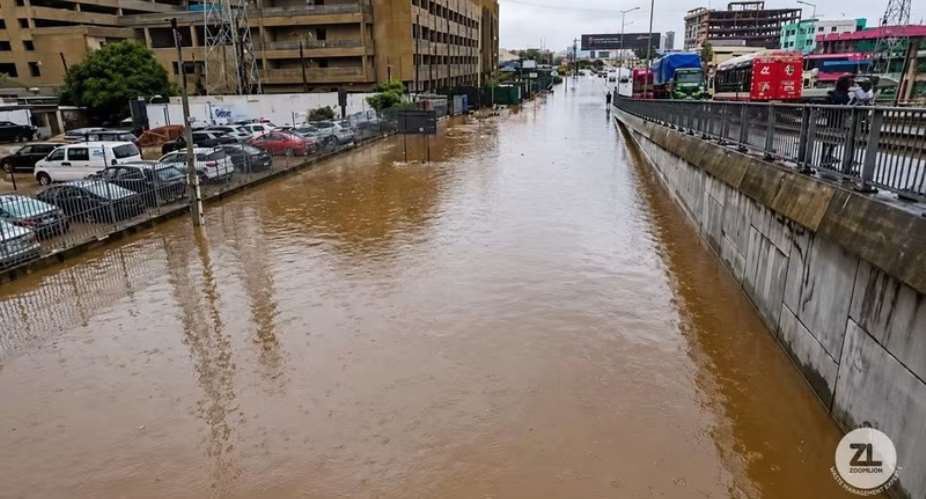
The torrential rains of June 28–29 once again exposed one of the most depressing truths about our condition in Ghana and, indeed, much of Africa: our astonishing inability to solve even the most elementary problems confronting our societies.
Every year, we witness roads turn into rivers, homes disappear under muddy water, businesses destroyed, and families watch helplessly as years of hard work are swept away in a matter of hours.
Every year, our theatrics in Africa follow the same stupid and predictable script. Citizens lament and wail as only Africans are capable of lamenting and wailing. The television cameras arrive with politicians rushing to affected areas and pretending to care. Presidents will fly over in their helicopters and pretend to cry. Officials will issue meaningless bureaucratic statements. Clergymen will organize prayer meetings and other useless religious pyrotechnics. Serious-looking experts in expensive suits will be summoned to TV panels where they will repeat the same stupid recommendations they have been repeating for decades.
Then, the floodwaters will recede, presidents will disappear into the comfort of their comfy palaces, the cameras will disappear, and Ghana will return to its normal state of collective forgetfulness until the next disaster arrives.
We are a people without memory.
What makes this tragedy particularly painful for me is that I have seen this movie before. Actually, I have seen it several times. In fact, I see it every year. Thirty years ago, shortly after moving to Ghana, I wrote about the same problem. The title of the piece I wrote in the now-defunct Horizon magazine is: Perennial Flood and the Lamentation of Presidents.
You can read it here: https://alaye.biz/perennial-flood-and-the-lamentations-of-presidents/
At the time, President Jerry Rawlings was appealing to Ghanaians to stop abusing the environment, stop dumping refuse into drains, and stop treating public spaces as personal rubbish dumps.
The country was flooding then; the country is flooding now. Three decades have passed. Governments have come and gone. Five presidents have changed. Countless ministers have changed. Ghana’s two political parties have alternated in power.
Yet the problem remains exactly where it was when I first wrote about it in 1996.
Pause for a moment and consider what that means. An entire generation has been born, has attended school, has entered adulthood, has married, and has raised children of its own. Yet, Ghana remains trapped in the same annual cycle of flooding, lamentation, promises, and amnesia.
What kind of society repeatedly suffers from the same preventable disaster for thirty years and learns absolutely nothing from the experience?
Only in Africa.
Some years ago, while attending a lecture in Amsterdam by the distinguished Caribbean scholar Sir Hilary Beckles, I listened as he described Africans and the wider Black world as “recovering people.”
He was referring to the enduring psychological consequences of slavery and colonialism. It is a thoughtful and sympathetic description.
Yet there are moments when one cannot help wondering whether we are recovering at all. For how else does one explain a society that knowingly blocks drainage systems with garbage and then acts surprised when floods occur?
How does one explain people who build on waterways and then blame God when water returns to territories it has occupied for centuries? How does one explain citizens who convert gutters into refuse dumps and then organize prayer meetings to plead with heaven for protection from the consequences of their own actions?
As Robert Ingersoll warned, nature is neither sentimental nor negotiable. Water does not care about political affiliations, religious beliefs, ethnic identities, or prayer vigils or the burning of colored candles.
Rain falls according to natural laws. Water seeks the path of least resistance. If drains are blocked, water will overflow. If waterways are obstructed, water will reclaim them. These are not mysteries requiring divine revelation.
They are facts known to every schoolchild.
The flood that devastated parts of Ghana this week was not principally a natural disaster. While the rain was natural, the catastrophe was man-made.
Many years ago, President Rawlings provoked outrage when he suggested that some of our habits were below those of animals.
For this statement, he was attacked by the professional hypocrites who dominate our public discourse.
Rawlings has joined the ancestors; one is compelled to ask whether he was entirely wrong in his description of our wayward lifestyles.
As a farmer, I know that even animals demonstrate a greater instinct for preserving their habitat than many of us in Africa do. Birds do not deliberately destroy their nests. Ants maintain remarkably organized colonies. Weaver birds are constantly repairing their nests. Beavers engineer sophisticated water management systems.
Human beings, supposedly endowed with reason and intelligence, throw plastic waste, mattresses, furniture, and household refuse into drainage channels and then react with shock when flooding follows.
Of course, responsibility does not rest solely with ordinary citizens. The uncaring reprobates who preside over our affairs deserve their share of condemnation.
Our chiefs illegally sell lands reserved for waterways. Municipal officials paid to maintain social order approve the construction of unauthorized structures. Police officers accept bribes and look the other way. City authorities collect salaries while neglecting the basic responsibilities of urban management. Governments prefer public relations exercises to long-term planning.
But blaming politicians alone would be an exercise in convenient self-deception.
The more uncomfortable question concerns the rest of us.
What about our own inability to summon sufficient enthusiasm to care about the societies in which we live?
Years ago, a Member of the Parliament of Ghana told me bluntly, “Femi, we read all the things that you write, but we can choose to ignore you because there are so few of you.”
I disliked hearing it, but I could not deny its truth. Too few citizens demand accountability. Too few insist on standards. Too few are willing to challenge the culture of indiscipline that surrounds us. The few of us who dare to speak are condemned as “Too know.” The majority remain indifferent until disaster personally visits their homes.
That is why I increasingly believe there is wisdom in the old observation that people ultimately get the government they deserve.
We demand Scandinavian or Chinese governance while tolerating conduct that would disgrace a village of savages.
We complain about corruption while rewarding incompetence. We condemn official negligence while displaying our own civic negligence.
The comparison with the Netherlands that I made in my old article remains instructive. In 1953, the Dutch experienced a devastating flood. They responded not with endless prayers, emotional speeches, or annual commemorations. They responded with science, engineering, planning, and national discipline.
The result was the Delta Works, one of the greatest engineering achievements in human history. The Dutch collectively resolved that such a tragedy would never happen again.
We, on the other hand, seem determined to repeat the same mistakes indefinitely while hoping divine intervention will compensate for our refusal to behave rationally.
The most depressing aspect of the June floods is that nothing fundamental will change. In a few weeks, the football arguments will resume. The political tribalism will resume. The celebrity gossip will resume. Social media will return to its usual diet of trivialities. The blocked drains will remain blocked. Illegal structures will remain where they are. The next rainy season will arrive, and we will once again gather before television cameras to lament our fate.
When would we in Africa realize that nature, as Ingersoll warned, is indifferent to excuses? It recognizes only consequences. The floodwaters that swept through Ghana this week were delivering a verdict that has been in the making for thirty years or more. They were telling us that no society can permanently escape the consequences of negligence, indiscipline, corruption, and civic apathy.
As we maintain on this blog, until we Africans find the courage to confront the sad realities in our societies honestly, verily, verily, I say: the floods will continue to come, and each new disaster will serve as another reminder that a people unwilling to solve simple problems have little right to complain about the consequences of their own stubborn folly.
©️ Fẹ̀mi Akọ̀mọ̀làfẹ̀ (1st Dan)
(Farmer, Writer, Published Author, Essayist, Satirist, Social Commentator, Geopolitical Analyst.)

 France records 300 excess deaths during unseasonal May heatwave
 South Africa braces for violence as anti-migrant marches reach boiling point
 Stay indoors, evacuation is next week — Ghana Mission tells citizens in South Af...
 NPA orders closure of flooded fuel stations, warns operators against safety brea...
 GMet warns of more rain, thunderstorms across Ghana as Benin rainstorm approache...
 Let's find out officials who approved building on waterways and punish them — En...
 'Beware of diseases and snakebites' — GHS issues public health alert over rainy ...
 ‘I’m grateful for the support, It’s the hazard of the job’ — Larry Dogbey after ...
 We need to keep development away from certain areas to curb flooding — GARID Coo...
