




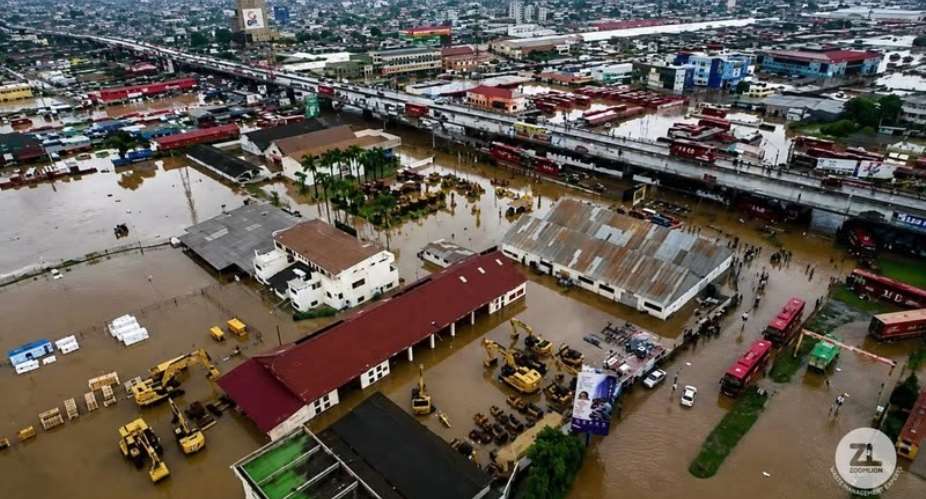
Yesterday’s floods in Accra were heartbreaking.
Lives were lost. Families were displaced. Businesses were destroyed. Vehicles were swept away. Once again, a few hours of rain brought our national capital to its knees.
My thoughts and prayers are with every family affected. I sincerely hope you and your loved ones are safe.
Predictably, the search for someone—or something—to blame has begun.
“It is because Ghanaians are indisciplined.”
“It is because people dump refuse into drains.”
“It is climate change.”
“It is because people build on waterways.”
“It is poor planning.”
For once, everyone is right.
And yet, everyone is also missing the point.
These are not competing explanations; they are symptoms of a much deeper governance failure. They are interconnected pieces of the same puzzle.
In this series, I want to focus on just one piece of that puzzle—not because the other factors are unimportant, but because I believe this one sits at the foundation of them all.
Land use planning.
Or, more accurately, the complete disconnect between those who own our land and those charged with planning our cities.
If Ghana is serious about solving flooding—not just in Accra but across the country—we must stop treating floods as drainage problems.
They are governance problems.
And governance begins long before the first concrete drain is constructed.
It begins with the first allocation of land.
Here lies a paradox that should concern every Ghanaian.
Nearly 80% of land in Ghana is held under customary ownership by stools, skins, clans and families. The remaining 20% is vested in the State.
There is nothing inherently wrong with this arrangement. Our customary land tenure system is one of our oldest and most enduring institutions. It has served communities for generations and remains an integral part of our national identity.
The problem is not who owns the land.
The problem is how decisions about that land are made.
Today, in many parts of Ghana, land is allocated before anyone asks a simple question:
How should this area develop?
Before planners draw a single line…
Before city engineers design a drainage network…
Before environmental experts identify flood-prone areas…
Before utility providers reserve corridors for water, electricity and sewerage…
Before transport planners determine where roads should pass…
…plots have already been sold.
By the time the planning authorities become aware of what is happening, foundations have been dug, walls have been erected and substantial investments have already been made.
The planner arrives with a notice reading:
“STOP WORK. PRODUCE PERMIT.”
But everyone knows the uncomfortable truth.
By then, planning has already failed.
Planning cannot begin after development has begun.
That is not planning.
That is damage control.
Every city in the world that functions well starts with a plan.
Roads are reserved before houses are built.
Drainage corridors are protected before plots are sold.
Public open spaces are identified before developers arrive.
Schools, hospitals, parks and utility corridors are planned before communities emerge.
In too many of our towns and cities, however, we reverse the sequence.
We sell first.
We plan later.
Then we spend decades demolishing, relocating, compensating, dredging, widening drains and wondering why flooding keeps getting worse.
Nature, however, does not negotiate.
A river remembers where it flowed long before we arrived.
A wetland does not cease to exist because we have issued an indenture.
Floodwater does not respect land titles.
Eventually, water reclaims the space we denied it.
That is exactly what we continue to witness.
The consequences extend far beyond flooding.
This same disconnect between customary landowners and planning authorities is why roads become impossibly expensive to construct.
It is why traffic congestion worsens year after year.
It is why utility providers struggle to install infrastructure.
It is why public spaces disappear.
It is why governments spend billions correcting mistakes that could have been prevented at virtually no cost.
It is why our cities expand, but rarely develop.
The painful irony is that none of this requires abolishing customary land ownership.
That would be both unnecessary and undesirable.
What is required is something far simpler—and far more profound.
Traditional authorities, family heads, planners, surveyors, city engineers, transport planners, environmental officers, utility providers and local assemblies must begin working together before land is allocated—not after.
Planning must become the first conversation, not the last.
Imagine if every major customary landowner could only open new areas for development after sitting around one table with the professionals responsible for shaping our settlements.
Imagine if roads, drainage corridors, schools, hospitals, parks and utility corridors were agreed upon before the first plot was sold.
Imagine how many future demolitions could be avoided.
Imagine how much public money could be saved.
Imagine how many lives could be protected.
The truth is uncomfortable.
If we genuinely want to solve flooding, traffic congestion, urban sprawl, infrastructure deficits and many of the governance challenges confronting Ghana, then we must start where every city starts:
With the land.
Everything else is merely responding to decisions that have already been made.
The rain did not create yesterday’s disaster.
It merely exposed years of decisions made without planning.
In Part II, I will examine why Ghana’s land governance architecture unintentionally creates this disconnect, and why institutional reform—not simply stricter enforcement—is the missing ingredient in building resilient, sustainable and liveable cities.
Sheriff A. Idriss-Yahya (PhD)
Land Economist | Transport Planner
 Mahama announces national security council meeting to tackle flooding
 Flood crisis: 'Identify every blockage in your Assembly for removal' — Mahama o...
 Mahama directs immediate release of GH¢300 million for flood relief, mitigation ...
 Stop redirecting blame to citizens and address flooding crisis — NPP tells Maham...
 Cedi ends June 2026 selling at GHS12.30 on forex market, GHS11.34 on BoG interba...
 ‘Guard Lake Bosomtwe with special task force like River Nile in Egypt’ – KsTU le...
 Dr Osei Adutwum condemns alleged illegal mining around Lake Bosomtwe
 KNUST Planning lecturer urges Bosomtwe residents to lead fight against illegal m...
 Akufo-Addo-Bawumia govt did not ignore Accra flooding crisis — Ahiagbah
 Police arrest four suspected drug peddlers, recover firearm and narcotics in Ash...
