




AN OPEN LETTER TO HIS EXCELLENCY JOHN DRAMANI MAHAMA
Your Excellency,
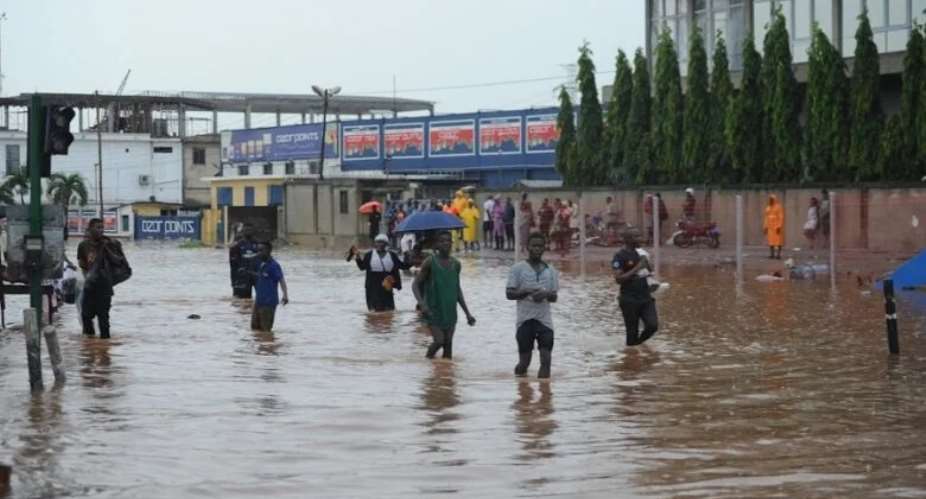
I have watched the same flood footage for more years than I care to count. Cars half-submerged on the Kaneshie overpass. A trader wading chest-deep through what used to be a street near Circle. A family carrying what they could save out of a compound in Alajo. The faces change, the streets sometimes change, but the story does not. Every rainy season we mourn, the emergency services do what they can, the drains get a desilting exercise, somebody promises it will not happen again — and then it happens again.
I write to you not as a critic standing outside the problem, but as someone who has spent my working life inside environmental management, water systems, and infrastructure compliance, watching this same pattern from a professional vantage point. And from that vantage point, I want to put a hard question to you plainly: is Accra really fighting a drainage problem, or are we watching an entire urban water system fail, year after year, while we keep treating it as a maintenance issue?
Because here is the uncomfortable truth I think the country has been reluctant to sit with: the rain is not the cause of Accra’s flooding. It is the trigger. The rain simply finds whatever weaknesses are already built into the city and exposes them, all at once, in public.
We Have Been Arguing About the Wrong Problem
Every time the floods return, the national conversation runs the same well-worn track — blocked drains, plastic waste, illegal structures on waterways, assemblies that did not desilt in time. These are real problems and I am not dismissing them. But they sit on the surface of something much bigger, and I think we have spent more energy debating the surface than the structure underneath it.
At its core, what Accra is dealing with is a catchment management problem, not simply a drainage problem. There is a difference, and it matters.
When rain falls on natural land, it does not all become runoff. Some of it sinks into the soil. Some is taken up by vegetation. Some evaporates back into the air. What is left moves slowly, gradually, into streams and rivers, and eventually out to sea. That is how the system was designed to behave, long before anyone built a road or a drain.
Across Greater Accra, we have steadily dismantled that balance. Land that once soaked up rainfall is now roofed, paved, or compacted — housing estates, shopping centres, factory floors, car parks, kilometre after kilometre of asphalt. Every one of those surfaces takes water that used to disappear into the ground and sends it straight into the drains instead, almost the moment it falls.
We have, in effect, built a giant concrete funnel and called it a city.
The Drains Were Never Built for the City We Have Now
A good deal of Accra’s drainage infrastructure dates back to a much smaller city than the one we live in today. Since those channels were designed, the population has multiplied, the built-up area has expanded in every direction, and thousands of hectares that used to absorb water have been converted into hard surface.
The network carrying that water away has not grown to match. So even where a drain has been properly cleared and is in good repair, it can still be overwhelmed — not because anyone failed to maintain it, but because it was never sized for the volume of water now reaching it. This is not only a maintenance gap. It is a capacity gap, and the two require very different responses.
Nature Used to Do This Job for Free
Long before anyone in Accra poured concrete for a drain, the landscape already had its own way of managing floodwater. Wetlands held the excess. Vegetation slowed it down before it could gather speed. Floodplains gave rivers somewhere safe to spread out during a heavy storm. Natural depressions in the land worked as informal detention basins, quietly doing what we now spend public money trying to engineer.
Much of that has been built over. And once it is gone, the consequences show up immediately downstream — flood peaks arrive faster, rise higher, and do more damage, because the systems that used to absorb the shock are no longer there to do it.
Our Rivers No Longer Have Room to Be Rivers
Another pattern I would ask the country to look at honestly is how much building has crept into river corridors and floodplains — land that rivers need, especially during extreme rainfall, to spread out safely rather than push through whatever stands in their way.
When that space is built on, the river has nowhere left to go but into the nearest neighbourhood, and it arrives there with more force and more depth than it would have if it still had room to breathe. We are, in a very literal sense, squeezing our rivers until they overflow into people’s homes.
Some of Our Roads Have Quietly Become Rivers
Anyone who has driven through Accra during a downpour has seen this without needing it explained: certain roads behave less like roads and more like emergency floodways. That is not an accident of bad luck. It is a sign that overland flow — where water naturally wants to travel when it cannot get into a drain — was never properly planned for.
Instead of routing that water deliberately and safely toward rivers or retention areas, we have allowed the road network itself to become the default channel. The cost shows up everywhere at once: transport grinds to a halt, emergency vehicles cannot move, businesses lose the day, and people are simply not safe.
Climate Change Is Real, But It Is Not Where the Story Ends
I want to be careful here, because this point gets misused in both directions. Climate change is genuinely intensifying rainfall, and that is not in dispute. But it should not become the explanation we reach for when the deeper planning and engineering failures are uncomfortable to name.
Plenty of cities around the world face increasingly intense rainfall and still manage it, because they pair serious engineering with serious environmental planning. Climate change makes existing weaknesses worse and more visible. It did not create those weaknesses in the first place.
No Single Ministry Can Fix This Alone
I would also gently push back on the instinct to treat flooding as something that belongs mainly to the local assemblies or to whichever agency runs the drains. It does not. The institutions that each hold a piece of this puzzle include, at minimum:
- Ministry of Works, Housing and Water Resources
- Ministry of Local Government
- Ministry of Roads and Highways
- Ministry of Environment, Science and Technology
- Lands Commission
- Town and Country Planning
- Hydrological Services Department
- Environmental Protection Agency
- National Disaster Management Organisation
- Metropolitan and Municipal Assemblies
Flooding is a systems problem. It will only ever be solved by systems governance — institutions actually working from the same map, not nine separate ones.
What I Believe a Real National Flood Resilience Programme Should Contain
Your Excellency, I believe Ghana has a genuine opportunity here — not just to recover faster from the next flood, but to build one of the more credible urban flood management programmes anywhere on the continent. In my view, that programme would need to include the following.
1. Complete hydrological mapping. A proper, modern digital model of the Greater Accra catchment — built with LiDAR, satellite imagery, GIS, and hydraulic modelling — so that for the first time we actually know, with precision, how water moves through this city rather than guessing from experience.
2. A real drainage capacity assessment. Every primary and secondary channel reviewed against current and projected rainfall, not just against whether it was cleared this month.
3. Restoring what wetlands we have left. Protecting what remains, and where possible, rehabilitating what has been degraded, so these areas can go back to doing the job they were doing for free before we built on top of them.
4. Upstream flood storage. Detention reservoirs and retention basins built upstream of the city, so that stormwater has somewhere to wait before it reaches Accra at full force.
5. Sustainable urban drainage built into new development, not bolted on afterward. Permeable paving, bioswales, rain gardens, infiltration trenches, green roofs, on-site retention. Every new development should be reducing runoff, not adding to it — and that has to be a planning condition, not a suggestion.
6. Genuine protection of floodplains. Enforced, not simply written into a policy document somewhere — paired with fair, humane relocation support where it is truly necessary.
7. Flood risk built into the planning approval process itself. No development should be approved without evidence that it will not increase flood risk downstream. A hydrological impact assessment should be as routine as a building permit.
8. One authority that actually owns this. Right now the responsibility for flood management is scattered across so many institutions that no single one can be properly held accountable. A dedicated national urban water authority, with planning, engineering, environmental management and emergency preparedness genuinely under one roof, would change that.
Prevention Costs Far Less Than Recovery
Every year, Ghana spends considerable sums repairing roads, rebuilding infrastructure, compensating families, running emergency operations, and putting communities back together after the water recedes. A meaningful share of that cost is avoidable, and avoidable cost is, in the end, simply money we have chosen to spend the hard way.
I would ask that flood resilience be understood not as an environmental nicety but as an economic decision — one that protects lives, yes, but also businesses, infrastructure, investor confidence, and the basic productivity of the nation's capital.
A Vision That Goes Beyond Wider Drains
Your Excellency, I do not believe the answer here is simply bigger pipes. I think the real task in front of the country is to re-engineer the relationship between this city and the water that falls on it — to stop asking only “how do we move the water away faster” and start asking “how do we restore some balance between the rain, the land, the rivers, the wetlands, and everything we have built on top of them.”
That is a systems question. It will take patience, long-term planning, and the kind of political courage that does not always show results before the next election cycle. It will require treating flooding not as a yearly emergency we brace for and recover from, but as a preventable failure we actually fix.
History, I think, will be kind to whichever administration finally moves Accra from a city that reacts to floods to a city that has learned, deliberately, to live safely alongside water. I believe that is genuinely within reach. The science exists. The engineering exists. What is needed now is the will to act on both.
Respectfully submitted,
Philip Kyeremanteng, MSc, CSci, FCIWEM
Environmental Professional
United Kingdom


 'Ghana Jollof' case is a foolish case – Martin Kpebu tells Police CID
 'I don’t know Kevin Taylor, I will speak to his father to stop him from insultin...
 CPP appeals to Mahama for return of confiscated party property after overthrow o...
 Drug bust: 'Ghana’s reputation is not one party’s reputation’ – Dr. Adomako Kiss...
 ‘What is happening in the media space is horrifying’ – Kwesi Pratt condemns ‘irr...
 Mahama asks MFWA, GJA to lead national dialogue on hate speech
 Teenage pregnancy: Parents ‘too busy’ to notice warning signs – Protect Our Futu...
 NPP intelligence points to cocaine manufacturing in Ghana – Baffour Awuah
 NPP's Obiri Boahen sues two Tiktokers over alleged defamation
 Ghanaian Pastor Rev Emmanuel Boakye-Danquah on the run over alleged counterfeit ...


