




Ghana stands today at a painful moral crossroads. For decades, political corruption has drained the nation’s wealth, crippled development, and destroyed public trust. Millions of dollars have vanished through fraudulent contracts, inflated projects, ghost payments, and outright theft by public officials.
Yet, despite the magnitude of these crimes, no major political figure has ever been jailed for financial wrongdoing. Ghana has become a country where goat thieves go to prison, but political criminals walk free with smiles, titles, and state protection.
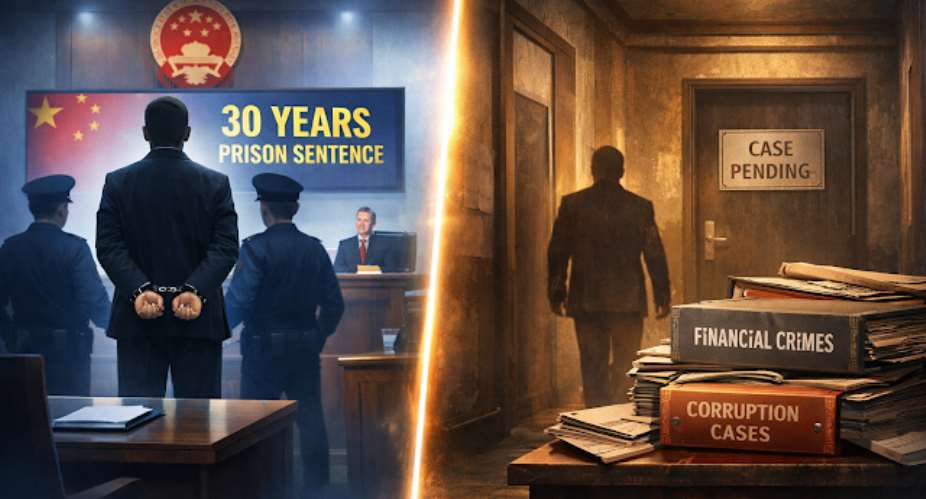
Meanwhile, the world is witnessing a very different story in China. Just recently, Chinese billionaire Guo Wengui, once among China’s wealthiest and most politically connected men, was sentenced to 30 years in prison for orchestrating a massive financial fraud scheme.
His crimes cost more than 1,000 victims hundreds of millions of dollars, and the court ordered him to forfeit $889 million in restitution. Victims testified that Guo’s deception “destroyed their lives,” and the judge emphasized that he preyed on people seeking hope and democracy. China’s message is unmistakable: no one is too rich, too powerful, or too connected to escape justice.
Ghana and China enjoy deep diplomatic and economic ties. China has invested heavily in Ghana’s roads, energy, mining, and industrial sectors. Yet Ghana has not adopted China’s uncompromising stance on corruption. Instead, Ghana has become a haven for political criminals who loot the nation and flee accountability.
When corruption is not punished, it becomes normalized. Investors lose confidence because they fear their money will be stolen without consequences. The rule of law collapses and is replaced by political protectionism.
The youth lose hope, seeing that hard work cannot compete with political theft. The nation’s global reputation suffers, making partnerships and investments harder to secure. China’s example shows that economic growth requires strict accountability, and no nation becomes successful by protecting thieves.
When political parties, including the NPP and the NDC, shield individuals accused of massive financial crimes, they send a dangerous message to Ghanaians. They show that party loyalty is more important than national interest. They demonstrate a willingness to sacrifice Ghana’s future to protect their own.
They reveal that they cannot be trusted with public resources. They also make it clear that if returned to power, they will repeat the same corruption. For the Ghanaian people, this is a warning: any party that protects financial criminals is unfit to govern. Ghana cannot continue pretending that corruption is a minor inconvenience.
It is a national emergency, and it is the silent war destroying the country from within. Guo Wengui’s sentencing shows that financial crimes destroy lives, and justice must be swift and uncompromising. His wealth, political connections, and international influence could not save him. Ghana must adopt the same principle: no political criminal should be above the law.
If China can jail a billionaire for fraud, Ghana can certainly jail politicians who steal millions from taxpayers. The refusal to do so is not a sign of democracy; it is a sign of weakness.
To restore confidence and rebuild the nation, Ghana must take decisive action. It must prosecute and jail high‑profile financial criminals, regardless of party affiliation. It must strengthen the Office of the Special Prosecutor with full independence and protection.
It must recover stolen assets through international cooperation. It must ban corrupt officials from holding public office for life. It must create fast-track financial crime courts to prevent endless delays. Above all, Ghana must show the world that it is serious about accountability.
Development is impossible without justice, and investors do not bring money to countries where thieves are protected by the state. The world is watching Ghana’s new government closely. Investors, diplomats, and international partners want to see whether Ghana will finally confront its corruption crisis or continue protecting political criminals.
No serious country or businessman will invest in a nation where goat thieves are jailed, but million‑dollar looters walk free. China has shown that economic success requires the courage to jail even the richest criminals.
Therefore, Ghana must find that courage now. If the government truly wants to rebuild trust, attract investment, and secure a prosperous future, it must prove that no thief is too powerful to face justice. Ghana’s destiny depends on it.


 Okoe Boye wins NPP Greater Accra Regional Chairmanship election
 Bagré dam nears spillway threshold as water level rises to 77.35%
 Sunyani Paramount Chief warns chiefs against sale of cemetery lands
 President Mahama announces US$10bn ‘New Economy’ investment programme
 Sustained peace will restore Bawku to its former glory – Mahama
 Plans advanced for University of Science and Technology in Damongo – Haruna Iddr...
 Inmate Peter Kyeremeh escapes from prison
 COKA floors Kokofu to win NPP Ashanti Regional chairmanship
 Abronye retains Bono NPP Chairmanship in Regional Executive Elections
 I accept responsibility for NPP’s poor performance in Greater Accra Region – Out...

