




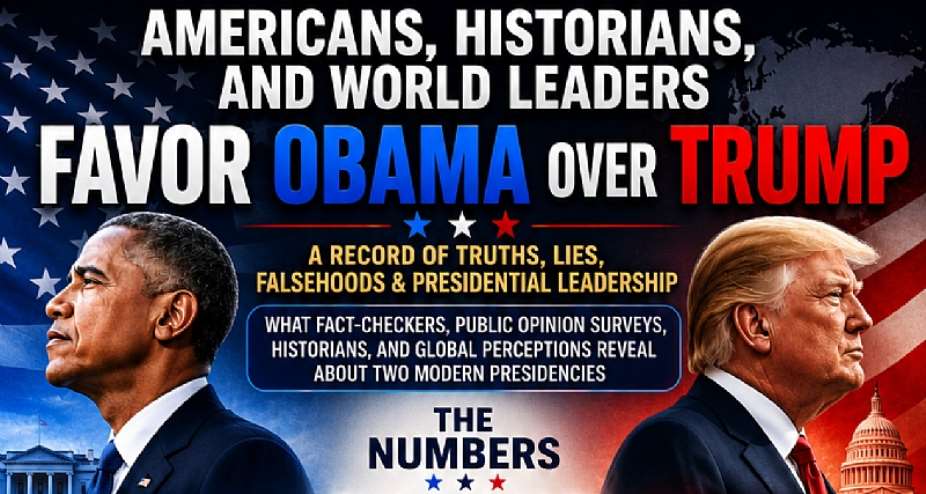
History often judges presidents differently from partisan politics.
In the heat of political campaigns, supporters and critics alike tend to focus on the controversy of the day. Historians, however, typically evaluate presidents through a broader lens that includes leadership, public trust, diplomacy, economic stewardship, communication, crisis management, and long-term impact on the nation and the world.
That broader perspective helps explain why many historians, public opinion surveys, and international observers have often viewed President Barack Obama more favorably than President Donald Trump.
The comparison is not merely about ideology. It is also about credibility.
Truthfulness matters in leadership.
Americans have long expected presidents to occasionally make mistakes, exaggerate achievements, or defend policies in the most favorable light possible. Every modern administration has faced criticism for inaccuracies and political spin. Yet fact-checking organizations documented a level of false or misleading statements during Trump's presidency that many scholars, journalists, and historians describe as unprecedented in modern American politics.
The Washington Post Fact Checker documented approximately 30,573 false or misleading claims during Trump's first term in office. That equates to roughly 20.9 claims per day over four years.
The mathematics alone are staggering.
30,573 claims divided by 1,461 days in office equals approximately 20.9 claims per day. That is nearly one documented false or misleading statement every hour throughout a four-year presidency. Supporters often argue that many politicians stretch the truth. That is certainly true. Yet many historians argue that frequency matters. Scale matters. Repetition matters. Several scholars have noted that repeated falsehoods can weaken public trust in institutions and blur the distinction between fact and opinion. Whether one supports Trump politically or opposes him politically, the volume of documented inaccuracies remains part of the historical record.
The Projection Question
As of June 23, 2026, Donald Trump has served approximately 520 days in his second presidency as the 47th President of the United States.
If the average rate documented during his first term—approximately 20.9 false or misleading claims per day—were maintained throughout a full second term, the projection would be substantial. 20.9 claims per day multiplied by 1,461 days equals approximately 30,535 claims during a second four-year term. Combined with the 30,573 claims documented during his first term, that would produce a cumulative total exceeding 61,000 false or misleading claims across two presidencies. Trump is the king of evidence-free assertions. Even if the rate declined significantly, historians and political scientists would still be evaluating one of the largest documented volumes of disputed presidential statements in modern American history.
What may be changing, however, is the public response. The political grip Trump maintained over much of the Republican Party and conservative media ecosystem during his first term appears less absolute than it once was. While he remains one of the most influential political figures in America, public opinion polling suggests growing divisions among independents, moderates, and even some traditional conservatives on questions involving leadership style, credibility, and political conduct. History may ultimately judge not only the number of disputed statements but also how Americans responded to them.
By contrast, Barack Obama's presidency was not free from criticism. Fact-checkers challenged a number of statements made during his eight years in office, and political opponents frequently accused him of misleading the public on issues ranging from health care to foreign policy.
However, historians generally distinguish between occasional inaccuracies and a sustained pattern of thousands of documented false or misleading statements. The difference is one of magnitude rather than perfection. Leadership is also measured beyond domestic politics.
Internationally, Obama was widely viewed as a stabilizing figure following the global financial crisis and the Iraq War era. His administration negotiated the Iran Nuclear Agreement, restored diplomatic relations with Cuba, expanded multinational climate cooperation, and emphasized coalition-building with traditional allies.
Critics disagreed with some of those policies, but few questioned America's commitment to diplomacy and international engagement during his presidency. Trump took a dramatically different approach. His supporters praised his willingness to challenge established norms, confront China, renegotiate trade agreements, and pressure NATO allies to increase defense spending. Critics argued that his rhetoric frequently strained relationships with allies while creating uncertainty in international affairs.
Public opinion surveys and historian rankings have often reflected those differences.
While historians debate individual policy outcomes, many surveys continue to rank Obama significantlyhigher than Trump in categories involving presidential temperament, communication, public trust, and international leadership.
The issue ultimately extends beyond either man. It raises a larger question about the standards Americans expect from their leaders. Should citizens judge presidents primarily by policy outcomes? By economic performance? By personal conduct? By truthfulness? By historical legacy?
Reasonable people may answer differently.
Yet history repeatedly demonstrates that trust is one of the most valuable assets a leader possesses. Once trust erodes, governing becomes more difficult. Public confidence declines. Institutions weaken. Civic discourse suffers.
Scripture speaks directly to the importance of truth.
Proverbs 12:22 reminds us:
"The Lord detests lying lips, but he delights in people who are trustworthy."
Truthfulness is not merely a political virtue; it is a moral one.
Ephesians 4:25 teaches:
"Therefore each of you must put off falsehood and speak truthfully to your neighbor."
In a democracy, citizens rely on truthful information from those entrusted with leadership.
John 8:32 declares:
"You shall know the truth, and the truth shall set you free."
A free society depends upon informed citizens capable of distinguishing facts from falsehoods.
Major Fact-Checking Organizations Frequently Used by Journalists and Researchers
- The Washington Post Fact Checker
- PolitiFact
- FactCheck.org
- CNN Fact Check
- Reuters Fact Check
- Associated Press Fact Check
- Snopes
- AFP Fact Check
- BBC Reality Check
- The New York Times Fact-Checking Reports
These organizations occasionally disagree on ratings and methodology, but together they form the backbone of modern fact-checking research used by journalists, historians, educators, and scholars.
The historical debate between Obama and Trump will continue for decades. New information will emerge. New historians will revisit their records. Future generations will offer fresh perspectives. Some view what he did on his return to the White House as justice, and others view it as retribution and revenge. An example of this is when President Donald Trump's January 20, 2025, blanket clemency for approximately 1,500 January 6 defendants was the largest single-day act of executive clemency in American history and included individuals convicted of violent crimes against law enforcement officers. Trump releases violent criminals back into society. At least 40 individuals who received pardons from President Trump for their involvement in the January 6, 2021, attack have subsequently been charged with new crimes. Of this group, dozens have faced arrests for fresh offenses after receiving clemency, ranging from violent assaults to DUIs, sex crimes, and firearms violations, according to Citizens for Ethics.
But as of today, many historians, public opinion surveys, and international observers continue to view Barack Obama more favorably than Donald Trump, not simply because of policy differences, but because leadership is measured by more than power.
It is measured by credibility. It is measured by trust. It is measured by character. And ultimately, it is measured by a commitment to truth. History, after all, keeps score.
ABOUT THE AUTHOR
Edmond W. Davis is a social historian, journalist, professor, and documentary host. Davis is the founder of the National HBCU Black Wall Street Career Fest. This native of Philadelphia, PA, his wife, and his son currently live in the Little Rock, Arkansas, area. Davis is committed to cultural empowerment and educational equity through storytelling and civic engagement. In 2026, Davis was a grand marshal at the 38th Annual African American History Month Celebration Parade, the largest in the U.S. during Black History Month.

 Trump says Russia, Ukraine agree to energy ceasefire – 'news for me', Zelensky s...
 Ethiopia intel chief visits flashpoint Tigray region
 Djibouti boat wreck leaves 139 migrants dead, 84 missing: UN
 Brazil's Lula accuses social media giant Meta of election interference amid tigh...
 Upper Dixcove: Dumsor is killing our business – Chief Fisherman
 South Africa protests: Ghanaians warned to limit travel in Johannesburg and Durb...
 UN cautions against forced tenant evictions without prior consultation
 UN advises Ghana to strengthen Rent Control Department with requisite logistics
 ECG announces three-day power outages in parts of Accra from Monday
 Ghana’s banking assets rise to GH¢500.2billion


