




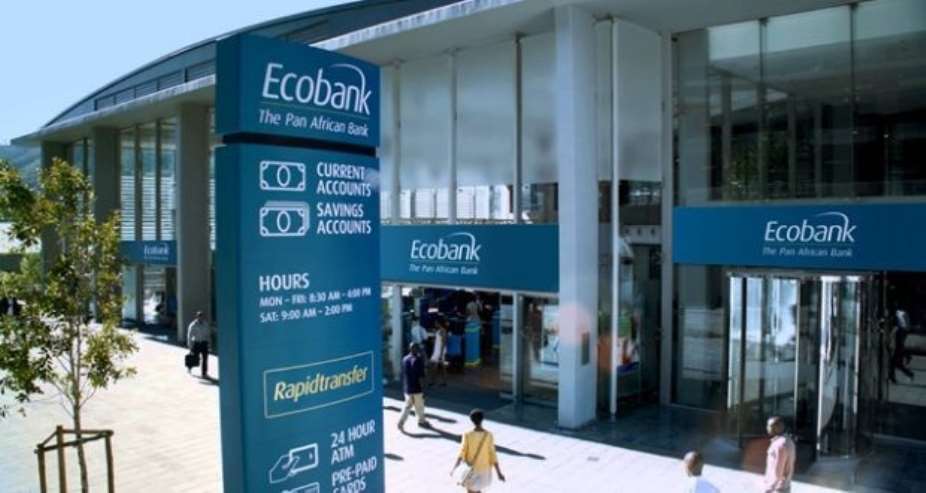
Africa is at a critical juncture with many opportunities for improving lives, livelihoods and living standards. While many countries have achieved high growth rates, in recent times, and many aspire structural transformation, the good performance has not translated into significant poverty reduction and shared prosperity. There are many low-income households and other vulnerable groups including women and youth who lack opportunities to improve their living standards. Across the continent, there is the challenge of inclusion, and inclusive growth. In particular, financial inclusion is required as one of the main building blocks for inclusive growth. That is why it is inspiring to see Ecobank, one of Africa’s leading pan-African banking groups, roll out a strategy, whose main thrust is inclusive growth.
In Sub-Saharan Africa (SSA), about 41 percent of the population live below the poverty line of USD 1.90 and another 23 percent of the population live on two to five dollars per day. Nearly two-thirds of the population depend on agriculture, exposing them to economic vulnerabilities, especially due to vagaries of the weather. Some 60 percent of the population in SSA and 37 percent of its workforce are youth under twenty-five.
These are dire numbers by any standards. However, as aptly put by Albert Einstein, “In the midst of every crisis lies great opportunity.” Rather than focus on the dire picture, Ecobank sees this situation as one that represents the opportunity to shape the African financial architecture in a way that serves the real economy. As a matter of fact, against these bleak statistics, the bank has come up with innovations and partnerships to help make real change in some of the continent’s critical sectors.
The bank has been very active over the past few weeks, announcing several ground breaking partnerships and financial instruments including Proparco, Alliance for Green Revolution in Africa (AGRA), African Continental Free Trade Area (AfCTA), and the nature bond.
At the recently concluded Africa Forward summit, Proparco, the private sector subsidiary of the French Development Agency (AFD) group, and Ecobank, signed a memorandum of understanding aimed at mobilizing up to 300 million euros ($352.7 million) over three years in support of the continent's agricultural value chains and expanding support for women-led businesses across Africa.
At the same time, as part of the efforts to transform agricultural value chains and drive inclusive growth in Africa, Ecobank Group and Alliance for Green Revolution in Africa (AGRA) have entered a strategic partnership to promote sustainable and climate resilient agriculture. The partnership signed during the Africa Forward Summit in Nairobi targets women and youth-led agribusinesses and is aimed at improving access to finance for agribusinesses, farmer organizations, and key value-chain actors.
Africa has a lot of untapped agricultural potential that can feed the continent and spur socio-economic growth right from the bottom of the pyramid. But the key to this lies in the mass of struggling smallholder farmers, women and a youthful population that unfortunately, have been left to their own devices.
Recent assessments by the Africa Development Bank (AfDB) reveal that there is increase in the severity of food insecurity in Africa, and urgent interventions are required in the continent. According to AfDB, Africa spends about USD 35 billion annually on food imports.
Africa should be a global powerhouse in food and agriculture because 65 percent of the cultivatable arable land left in the world is in Africa. What is needed is to ensure farmers, especially women, are provided with the support systems that they need, especially access to finance.
No doubt, women and youth in Africa can play a key role in ending food insecurity in the continent, if supported and included in the agriculture value chain. To achieve food sufficiency, and turn the continent into a net food exporter, Africa must empower women and youth to effectively engage in agricultural production.
That is why Ecobank’s move to support partnership with Proparco and AGRA in support of the continent's agricultural value chains and women-led businesses across Africa, is so important.
Also significant, Ecobank has signed a landmark agreement to strengthen partnership to close the trade finance gap for African businesses, equip Small and Medium Enterprises, women entrepreneurs and youth-led businesses with tools to compete, connect buyers and sellers across the continent through the African Continental Free Trade Area (AfCFTA) – to break down non-tariff barriers and cross border payment frictions.
According to the bank, 43.75 percent of proceeds will support intra-African trade activities, while 18 percent will target manufacturing projects, reflecting growing emphasis across Africa on local industrialisation and value addition instead of raw commodity exports.
AfCFTA is Africa’s strategic project to promote industrialization and enable countries to move up the value chain in sectors where they have historically been raw material suppliers. This shift can reverse decades of underperformance, laying the foundation for a prosperous and self-sufficient Africa.
The trade pact, which seeks to create a single market for goods and services and promote cross-border movement of capital and people, should boost intra-African trade — currently at only 18 percent—and regional integration. The pact connects 1.3 billion people across 54 countries with a combined gross domestic product (GDP) valued at USD 3.4 trillion.
Ecobank’s partnership also aligns with broader efforts under the African Continental Free Trade Area (AfCFTA), which seeks to increase trade among African countries, currently estimated at roughly 15 percent of total African trade, compared with significantly higher intra-regional trade levels in Europe and Asia.
The partnership would expand financing access for small exporters. Make no mistake, small businesses are the engine of economies, and access to appropriate, export-linked financing is what enables them to grow, create jobs, and compete regionally. And that is why Ecobank is exemplary.
The partnership supports Ecobank’s objective of contributing to the economic development and financial integration of the region. No doubt, the partnerships will support Africa’s economic development by enabling agricultural production, strengthening export proceeds, and reinforcing industrialization and value creation across the continent’s economy.
Additionally, Ecobank, marked another milestone, by issuing a landmark USD 450 million tier-2 nature bond, the first of its kind from any commercial bank globally with an International Capital Market Association (ICMA) nature bond designation. The transaction closed with a final orderbook exceeding USD 1.3 billion, enabling an upsizing from an initial target of USD 350 million, with investors participating from across the UK, Europe, Africa, Asia, the Middle East and the United States.
Nature bonds are a subset of green bonds, which have been designed to meet international climate and nature preservation goals. The bonds meet the strict eligibility of the ICMA Green Bond Principles and their proceeds will be distributed to a series of sustainable water and agriculture infrastructure loans across 24 African states.
If the example of Ecobank’s approach is replicated across the continent, Africa will find itself in a good place over the next decade.
Mr Obonyo is a Policy Analyst. He comments on global affairs and trends. Email: [email protected]
 World Cup 2026: 'Living statue' of Lumumba joins DR Congo fans after quarantine
 All guns blazing as Messi, Mbappé and Haaland lead World Cup Golden Boot race
 Prisons officer interdicted over alleged attempt to smuggle Indian hemp into Ket...
 Mineral royalties used for funeral donations, canopies hindering development in ...
 Energy levy generated GH¢8.81billion in 2025 — Government reports
 Mahama inviting NDC MPs to discuss welfare issues without NPP MPs discriminatory...
 Man fined GHS1,200.00 for sweeping plastic waste into rainwater in Takoradi
 Heavy rain collapses building in Sekondi
 NADMO to demolish 50 death trap buildings in Cape Coast
 Four, including juvenile arrested in Kugri hideout over couple's murder at Kusan...


