




The other autobiography
Frieda Schöngruber commented: “You want to tell us...If I get you right...the African problem is mental!“
I looked around in search of a sausage and mustard. Tobias Wittmann saw my hungry eyes and put one for me into the fire while I waited patiently: “Yes... First and foremost.” The sausage was ready, and I enjoyed every bite. „Let me use two examples that hit my mind till this day. Walking around Greda Estate, looking at uncompleted buildings, I came across a man standing outside the gate of a newly constructed house who asked me where I originally came from. We started a nice conversation when all of a sudden, he recalled a scene at Kotoka International Airport. He had observed two young girls, one white, one black. They had just entered Ghana through the Arrival Area. Both were holding plastic water bottles in their hands. Both bottles were empty. The black girl asked the white girl to throw the bottle anyhow, while the white girl refused to follow her advice, saying that in her society, people were not allowed to dump refuse anyhow, but use litter boxes or other forms of collective containers. After all, plastic can be recycled, make money for people working in the recycling industry and ensure protection of the environment. The black girl insulted the white girl, calling her a dummy. The white girl insisted her decision and view was the correct one. Both left in anger the airport and their friendship.
Another event I have often spoken about was my encounter with Joseph, an old man in his early eighties, almost blind, who lived at the outskirts of Greda Estate along an uncompleted muddy road. Before entering the very spacious, wide road, I had to pass the nice house of a man who owned another nice house, rented it out, and bought his own money. He was a simple customs officer in Tema with a very small monthly salary. I was not blind, and no Ghanaian needed to tell me anymore at that time how he made his fortune to buy a second home. I knew that man had large, very large open hands which only closed for actions when they were filled.
Joseph`s house was located near a giant mango in front of the gate. Inside the compound, another giant mango tree welcomed guests, and they were free to pick as many mangos as their hearts desired. The grey stone painted three-bedroom self-contained house was accessible through the kitchen. The kitchen was used by the house girl to bake cakes for weddings and funerals to generate some humble income for the family. Besides him, his wife lived in the house, and on occasions, his youngest daughter. We always met in the small living room leading to the back of the garden. The room was divided into two functions: one as a living room area, and one as a dining area. On the dining area table, the ready-made cakes waited to be picked up or delivered to the customers. The walls of the living room area were decorated from the ceiling to the floor with family pictures.
When I met him every four weeks, I was seated by the house girl in the living room on a comfortable red couch, waiting for Joseph to come around the corner, guided by the house helper. Sometimes he would come alone without her assistance, with a stick guiding him around the house. He was an old man, very friendly and cheerful. Joseph enjoyed our meetings as much as I did. He asked about Germany and how life was in my country. Some anecdotes about Germany he laughed about, as his character was always looking for the good sides in life. For sure, he was never a grumpy old man disappointed with God and life having made him blind over the years. Instead, he accepted the blessings God had given him. Before his eyes failed him, a few years before we met, he was able to see what was going on around him.
Asked to take one big special book from the bookshelf and have a closer look at it, he explained that this book was one of an intended series of ten volumes, but ended after volume three. As a lawyer, Dr Kwame Nkrumah had mandated him to be the editor of the ten-volume history of Africa financed by UNESCO. After Dr Kwame Nkrumah was ousted in a coup, the work on the series came to a sudden halt. The intention was that each African country should submit its history to be included in the compendium for the world to know where Africa came from, not written by whites but by nations as part of a united Africa. He was convinced that only when nations know where they come from can they manage the time they live in in preparation for tomorrow. Africa needs a memory written with their own hands. That was missing and still is, he told me.
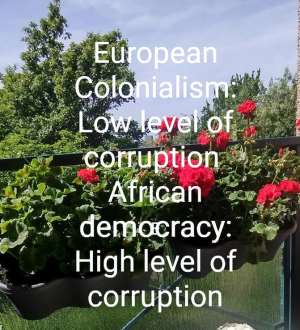
Lawyer Joseph taught me that he was of the view that African independence came too early. Africa was not yet ready for independence. He mentioned the level of corruption which destroyed the African nations as cancer does. Political parties use corruption to stay afloat and relevant while the people suffer under the system of democracy. Unlike in Europe, he said, where democracy was working more or less well for the benefit of the citizens, in Africa, it had created a new elite that was fast to take advantage of the blessings of Africa. Their short-term thinking made it impossible to develop Africa well, as most decisions in politics are long-term projects. In a statement, he sarcastically mentioned that as a sidekick and laughed that the worst the white man could have done to the black Africans was to let them have their independence and introduce them to the system of democracy.
He still remembered the time of British Colonialism. When someone was entitled to get a passport, the passport was given right in time without any bribes paid. The corruption level under the British Governor was close to non-existent. The British administration was serving the people well, very orderly and effective. When the black Ghanaian took over the responsibility, things changed drastically for the worse. Before he turned blind, he saw the filth in the streets of Accra. Everywhere, plastic bottles, paper, and other kinds of refuse were common in the streets. Under the British, he had never witnessed such ignorance concerning the environment and public space. Under the whites, there was discipline, he mentioned, and he got very angry, sharing his mind with me. He shouted and complained about his people comparing Ghana and the Gold Coast as if the two countries were really two in the same. Lawyer Joseph stressed that under the British ruler, Accra was a clean city. Democracy made Accra a dirty city, as even when J.J. Rawlings was ruling, Accra was not as dirty as under the two main political parties of Ghana. He was neither in favour of NDC nor NPP, seeing both as the same problem for the nation. He had stopped voting long ago, seeing it as an useless exercise. His presentations were very nostalgic, as if he wanted the olden days to come back and rule again.
Lawyer Joseph was not tired of stressing out again and again the admiration he had for us Germans. Germany a country that had survived two world wars, payed imense reparations, carried the shame and disgrace of six million Jews killed in concentration camps by Zyklon B produced by the biggest chemical factory in the world IG Farben in Hamburg, a country with no minerals only coal for heating and production of steel, a country with just over ten years excersie of democracy under the Weimar Republic, divided and controlled by the Allies until its independence in 1990 long after Ghana`s independence from British Colonialism asked fifeteen years after the last world war for workers from around Europe to come and help securing the Wirtschaftswunder, still a nation which depends on foreign labour to sustain its economy and secure the social systems. He attributed it all to the mindset of us Germans and concluded that a mindset does not come from money or status but is freely given by God, free of charge. He was sceptical about the possibility that Ghanaians and Africans at large, for that matter, could adopt a mindset like Germans with hard work, discipline, thinking as a nation and for generations unborn. When both come together, minerals and a correct mindset, paradise on earth is created. In the paradise mentioned in the Bible, it was just the combination of the two milk and honey, so Ghana`s minerals, and the mindset to follow the instructions of God. When Eva asked Adam to eat from the forbidden fruit, they were corrupted. That is what lawyer Joseph saw in Ghana. Very interesting if you ask me.“

 World Cup 2026: 'Living statue' of Lumumba joins DR Congo fans after quarantine
 All guns blazing as Messi, Mbappé and Haaland lead World Cup Golden Boot race
 Prisons officer interdicted over alleged attempt to smuggle Indian hemp into Ket...
 Mineral royalties used for funeral donations, canopies hindering development in ...
 Energy levy generated GH¢8.81billion in 2025 — Government reports
 Mahama inviting NDC MPs to discuss welfare issues without NPP MPs discriminatory...
 Man fined GHS1,200.00 for sweeping plastic waste into rainwater in Takoradi
 Heavy rain collapses building in Sekondi
 NADMO to demolish 50 death trap buildings in Cape Coast
 Four, including juvenile arrested in Kugri hideout over couple's murder at Kusan...


