




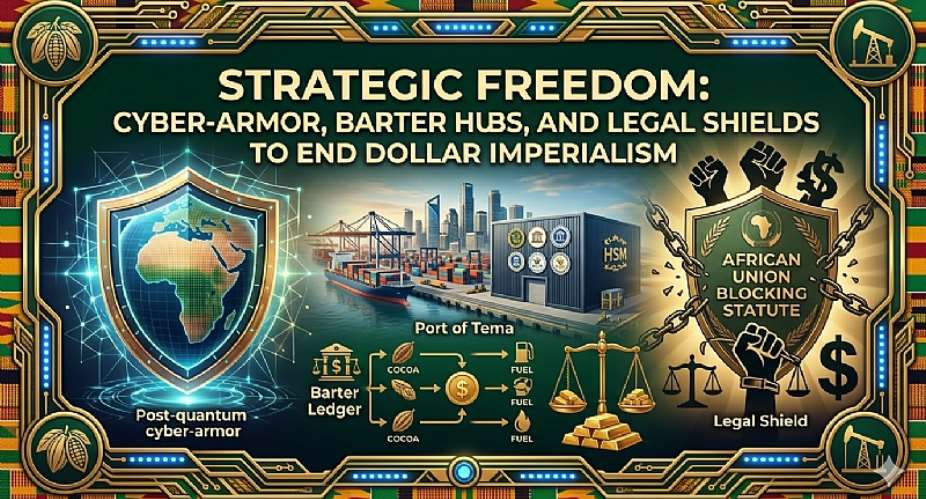
The Great Western Bluff Unmasked
The Islamabad Memorandum of Understanding (MoU) has torn away the veil of Western economic invincibility. When the constriction of the Strait of Hormuz froze global energy arteries, the United States was forced to expose its deepest vulnerability: its strategic petroleum reserves would collapse in less than thirty days, threatening total economic paralysis across the West.
The hurried issuance of General License X by the U.S. Treasury—which temporarily lifted a decades-old ban to allow dollar-denominated trade with Iran—was not a gesture of diplomacy. It was an act of pure desperation. It revealed a superpower scrambling to shield its domestic economy from imminent implosion.
For Africa, and for Ghana in particular, this is not a moment to celebrate a temporary reprieve. It is a clarion call. True national sovereignty cannot be rationed in sixty-day foreign waivers. The Global South must seize this unprecedented geopolitical window to permanently dismantle the petrodollar’s grip and construct independent financial networks immune to Western coercion.
The Technical Blueprint: Linking PAPSS to SEPAM
The path to financial liberation begins by directly linking the Pan-African Payment and Settlement System (PAPSS) with Iran’s SEPAM financial messaging network. By bypassing the Western-dominated SWIFT system and New York clearinghouses, Africa can establish an untouchable financial pipeline anchored on three architectural pillars:
- Sovereign API Gateways: Establishing fully encrypted, direct ISO 20022 messaging protocols between the central banks of Accra, Cairo, and Tehran.
- Post-Quantum Cyber-Armor: Deploying Post-Quantum Cryptography (PQC) over dedicated dark fiber networks and sovereign satellite constellations, rendering state communications immune to Western interception.
- Hardware Security Modules (HSMs): Implementing air-gapped, multi-signature transaction validation across the participating central banks to completely eliminate single points of failure.
Sovereign Barter Ledgers: Breaking the Liquidity Wall
Bulk commodity trade must no longer be shackled to fragile, weaponized fiat currencies. We must transition to a digitized barter ledger directly anchored in physical gold.
+------------------------------------------------------------+ | Sovereign Barter Ledger | | [ 1 Metric Ton of 99.9% Pure Gold = 10,000 Credits ] | +-----------------------------+------------------------------+ | +----------------------+----------------------+ | | v v IRAN DELIVERS: GHANA DISPATCHES: Fuel & Fertilizer Cocoa, Lithium & Gold | | +----------------------+----------------------+ | v [ Port of Tema Verification ] | v [ Quarterly Bullion Settlement ] (Net balances cleared vault-to-vault)
- The Neutral Anchor: Establish a fixed value baseline where 1 Metric Ton of 99.9% pure gold strictly equates to 10,000 Sovereign Barter Credits (SBC).
- The Swap Mechanism: Iran delivers essential fuel and fertilizer to the Port of Tema; Ghana dispatches equivalent values of cocoa, lithium, and gold. Customs verification instantly logs these values into the ledger.
- Quarterly Settlements: Any net balances at the end of a quarter are cleared via physical bullion transfers between central bank vaults—entirely bypassing Wall Street oversight and foreign currency volatility.
The Legal Shield: An African Union Blocking Statute
Fear of secondary sanctions remains the West's most potent weapon, causing local African banks and logistics firms to retreat under U.S. pressure. The antidote to this fear is aggressive legislation. We must advocate for an African Union Blocking Statute designed to:
- Criminalize Compliance: Declare unilateral, extra-territorial foreign sanctions null and void within African jurisdictions, making it an offense for local institutions to enforce them.
- Impose Severe Domestic Penalties: Revoke operating licenses, seize local assets, and criminally prosecute corporate executives who bow to foreign financial dictates over sovereign African law.
- Activate Sovereign Claw-Backs: Empower domestic courts to seize the local subsidiaries and assets of sanctioning foreign nations to fully indemnify affected African enterprises.
Transition Timeline: Bank of Ghana’s Gold Reallocation
To anchor our economic sovereignty in tangible wealth rather than foreign paper, the Bank of Ghana must aggressively reallocate its reserves into physical bullion over a clear 36-month timeline:
[ Phase I: 0-6 Months ] --> Convert 25% of FX reserves to gold bars in Accra. [ Phase II: 6-18 Months] --> Expand to 50% gold reserves; open Tema & Kumasi vaults. [ Phase III: 18-36 Mos ] --> Reach 75% gold-backed reserves; establish West Africa Bullion Hub.
This strategic shift ensures absolute resilience against global currency shocks and firmly secures Ghana’s role as the financial anchor of the regional barter ledger system.
Port of Tema Protocols: A Sanction-Free Logistics Corridor
The Port of Tema must be legally and physically re-engineered to become Africa’s premier sanction-free logistics corridor. This requires:
- Dedicated Sovereign Berths: Creating isolated, high-security docking zones exclusively for barter-ledger cargo, entirely immune to foreign maritime interference.
- Customs Blockchain Registry: Utilizing a decentralized blockchain ledger for real-time tracking, customs clearance, and immutable verification of goods exchanged under Sovereign Barter Credits.
- Security Integration: Deploying permanent Ghana Navy and Coast Guard patrols to guarantee the uninterrupted, safe flow of strategic commodities in and out of our territorial waters.
Media Mobilization: Rallying West Africa
Technical policy cannot succeed without a mass movement. A coordinated pan-African media mobilization campaign must be launched to capture the public imagination:
- Narrative Reframing: Consistently frame de-dollarization not merely as an economic policy, but as the ultimate phase of liberation from neo-colonial economic slavery.
- Amplifying Regional Voices: Mobilize influential journalists, civic advocates, intellectuals, and faith leaders to normalize the discourse surrounding monetary sovereignty.
- Digital Grassroots Content: Flood digital and social media platforms with clear infographics, podcasts, and explainer videos breaking down the mechanics of PAPSS, barter ledgers, and blocking statutes.
- Youth-Led Advocacy: Position the transition away from dollar imperialism as a defining generational mission, ensuring the youth champion and sustain this economic shift.
A Call to Action
The Islamabad MoU exposed the critical fractures in Western economic hegemony. It proved that when the Global South stands firm on its resources, the West is forced to bend. However, true liberation cannot be rented under temporary, transactional waivers—it must be engineered from within.
By fortifying our communications with quantum-safe encryption, anchoring our trade in tangible assets, outlawing foreign coercion, reallocating our national reserves into gold, securing the Port of Tema as a sovereign gateway, and mobilizing the public, Africa can forge a genuinely multipolar economic order.
Ghana, Iran, and the wider Global South must now stand shoulder to shoulder. Let us bridge our sovereign systems and break the spine of dollar imperialism once and for all.
✍️ Retired Senior Citizen
On behalf of the Senior Citizens of the Republic of Ghana 🇬🇭
Teshie-Nungua, Accra
[email protected]

 World Cup 2026: 'Living statue' of Lumumba joins DR Congo fans after quarantine
 All guns blazing as Messi, Mbappé and Haaland lead World Cup Golden Boot race
 Prisons officer interdicted over alleged attempt to smuggle Indian hemp into Ket...
 Mineral royalties used for funeral donations, canopies hindering development in ...
 Energy levy generated GH¢8.81billion in 2025 — Government reports
 Mahama inviting NDC MPs to discuss welfare issues without NPP MPs discriminatory...
 Man fined GHS1,200.00 for sweeping plastic waste into rainwater in Takoradi
 Heavy rain collapses building in Sekondi
 NADMO to demolish 50 death trap buildings in Cape Coast
 Four, including juvenile arrested in Kugri hideout over couple's murder at Kusan...


