




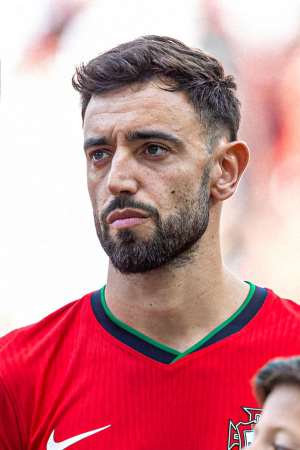
On manufactured outrage, mercenary culture, toxic loyalty, and why the most controversial captain in the Premier League might also be the most honest one.
Let me tell you what most football coverage will never admit.
The sport you watch every weekend — the one that fills stadiums, dominates social media timelines, and generates billions in broadcast revenue — is increasingly being shaped not by what happens on the pitch, but by what gets said about it afterwards. And what gets said about it afterwards is frequently, provably, and in some cases deliberately wrong.
Bruno Fernandes, Manchester United captain, sitting down recently for one of the most unguarded conversations a modern elite footballer has given in years, did something that the industry quietly discourages: he told the truth. About the media. About leadership. About loyalty. About what it actually costs to be the person standing in the eye of a storm that never fully stops.
Football was not entirely ready to hear it. Which is precisely why it needs to be repeated.
The Punditry Machine and the Lies It Tells at Volume
Roy Keane is, by any reasonable measure, one of the greatest midfielders in the history of English football. He is also, by any honest measure, a television personality whose commentary has drifted so far from factual analysis that it now operates in a category of its own — part theatre, part provocation, entirely dependent on the audience's willingness to accept assertion as evidence.
Fernandes addressed directly, and with remarkable composure, the specific instance of Keane attributing to him words he never said. Not misinterpreting. Not contextualising differently. Fabricating. Putting a version of events into the public record that bore no relationship to what was actually said or done, and broadcasting it to millions.
This matters beyond the personal slight to one footballer.
Modern football punditry has constructed an entire economy around manufactured intensity. The louder the condemnation, the more extreme the verdict, the more confidently delivered the fabrication — the higher the engagement, the more clips get shared, the more the algorithm rewards the content. Former players who built their reputations on actual expertise have discovered, often to their own surprise, that expertise is far less commercially valuable than controversy. And so controversy is what gets produced.
The line between legitimate critique and fiction has not been blurred. It has been strategically demolished. And there are no meaningful consequences for crossing it. No regulatory body holds pundits accountable for false statements about active players. No broadcaster loses advertising revenue because a former captain invented a quote. The player absorbs the reputational damage, the pundit collects the appearance fee, and the cycle continues.
Gary Neville — himself a pundit, and a considerably more principled one — acknowledged in a separate discussion that the current media environment incentivises character assassination over analysis. Jamie Carragher has spoken about the pressure to deliver "moments" rather than insight. The problem is not that individual pundits are uniquely dishonest. The problem is a structure that rewards dishonesty and penalises nuance.
Fernandes did not simply defend himself. He named the mechanism. And naming mechanisms is the first step toward dismantling them.
The Invisible People Who Actually Hold a Club Together
Here is something that receives almost zero coverage in the billions of words written about football annually: the physio who has been at a club for twenty years. The chef who ensures thirty elite athletes are fuelled correctly through a fixture congestion period. The kit manager who has seen managers come and go and whose institutional memory represents a continuity that no new signing can replace.
Fernandes was explicit on this point, and it reveals more about genuine leadership than anything he has ever done on a football pitch. His non-negotiable rule: absolute respect and care for every member of staff, regardless of their visibility, their salary, or their proximity to the glamour.
This is not a small thing dressed up as philosophy. It is a precise diagnostic of organisational health.
The culture of a club — real culture, not the values printed on the website or recited in press conferences — is most accurately read in how the highest-paid, highest-profile individuals treat the people who cannot fire them and cannot make headlines about them. The treatment of the invisible staff is the behaviour that happens when the cameras are off and the incentives for performance are removed. It is, therefore, the truest available evidence of character.
Research in organisational psychology consistently confirms what Fernandes instinctively understands. Amy Edmondson of Harvard Business School spent decades studying high-performance teams and found that psychological safety — the confidence that every member of a team can contribute, raise concerns, and be treated with dignity regardless of their status — is the single strongest predictor of collective performance. Not individual talent. Not tactical sophistication. Whether the people at the bottom of the hierarchy feel seen.
Manchester United have cycled through eight permanent or caretaker managers since Sir Alex Ferguson retired in 2013. They have spent in excess of £1.5 billion on transfer fees in the same period. They have had no shortage of tactical genius available to them.
What they have lacked, for most of that period, is a coherent culture. And culture is not built by the manager's press conference. It is built in the corridor, the canteen, the physiotherapy room — in whether the captain says good morning to the kit man and means it.
The Captain Who Shouts and the Public That Cannot Handle It
The complaints about Fernandes' on-pitch behaviour have become a ritual of Premier League discourse. The arms raised in frustration. The animated communication — critics prefer to call it screaming — directed at teammates. The body language that, depending on who is interpreting it, either reads as passionate leadership or as petulant aggression.
Fernandes' position is straightforward: he treats everyone exactly the same. If he would express frustration to the £300,000-a-week signing, he expresses it equally to the academy graduate making his debut. No hierarchy of accountability. No diplomatic immunity based on market value.
I want to ask a direct question about the criticism of this approach: what, precisely, do we want from a captain?
The leadership literature that has emerged over the past decade has produced, in many organisations and cultures, a sanitised model of leadership that prioritises the appearance of psychological safety over the substance of high accountability. Leaders are coached to soften feedback, to validate before critiquing, to manage tone with such care that the actual message is often lost somewhere beneath the layers of diplomatic cushioning.
This model has significant merit in many contexts. It also has significant limitations in an environment where the margin between success and failure is millimetres and seconds, where decisions made under extreme pressure in real time are the difference between a title and a relegation battle, and where a player who switches off for thirty seconds can cost the entire collective months of work.
Patrick Vieira, when asked about captaincy, said it plainly: "You cannot manage eleven individuals the same way in the changing room and expect the same result on the pitch. You have to know when to put your arm around someone and when to demand more." Vieira was not known for the arm-around-someone moments. He was known for the demand-more moments. He was also one of the most effective captains of his generation.
The public desire for a "polite" captain is, at its core, a desire for comfortable leadership theatre — something that photographs well, generates warm media coverage, and requires nothing uncomfortable from anyone watching. It is fundamentally incompatible with the reality of what elite sport requires.
Fernandes is not a media product. He is a leader of men in a high-stakes environment with a rapidly closing window for success. The frustration that reads as aggression from the stands is, from inside the dressing room, the evidence that he cares enough to demand more. Ask the players who play alongside him — consistently, across years of shared testimony — and that is what they say.
The £200 Million He Left on the Table
This is the detail that stops conversations.
Fernandes reportedly rejected an offer — the figures cited suggest in the region of £200 million — to leave Manchester United for a significantly wealthier, more stable, and more immediately competitive environment. He stayed. At a club in structural crisis, cycling through ownership disputes, managerial instability, and consecutive seasons without major silverware. He stayed.
The easy interpretation is romantic: a man committed to the badge, loyal to the institution, willing to sacrifice financial security for the chance to restore a great club to greatness.
The harder interpretation is worth sitting with. Manchester United in 2024 and 2025 are not the Manchester United of Ferguson's era. They are a club whose ownership has been contested, whose recruitment has been chaotic, whose recent trophy cabinet reflects the general disorder. Staying is not obviously rational. And £200 million is not an abstraction — it is generational wealth, security for children and grandchildren, freedom from every financial pressure a person will ever face.
Fernandes chose the badge over the bank transfer. In an era in which Kylian Mbappé made a move widely described as the most financially motivated in the history of football, in which state-backed clubs have made loyalty economically irrational for any player with elite market value, this is a genuinely remarkable data point.
Is it wisdom or sentiment? Is it sporting romanticism that future generations will admire, or a financial miscalculation that he may eventually come to regret?
I do not think there is a clean answer. But I think the question matters — because it forces us to ask what we actually value in sport, what we celebrate, what we want the culture of professional football to look like. If we believe that the sport is richer for having players who choose legacy over maximum extraction, then Fernandes is living out a value system we claim to want. If we secretly believe that rational financial maximisation is the only sensible framework for a short career in an inherently precarious industry, then we should say so clearly and stop pretending that loyalty is something we honour.
We cannot simultaneously admire the decision and mock the logic.
The Father Who Never Said Well Done
The detail about Fernandes' upbringing is, in some ways, the most important chapter of his story.
Score three goals. His father's response: what about the mistakes? No celebration. No acknowledgment of the achievement. Only a forensic focus on what fell short of perfection.
This is a methodology with a track record. The number of elite athletes who describe variations of this exact upbringing is not a coincidence — it reflects something real about the conditions that produce exceptional performers. Tiger Woods. Serena and Venus Williams. Cristiano Ronaldo, whose mother has spoken about the relentless drive instilled from childhood. The pattern repeats across sports, cultures, and generations.
It also carries a cost that we are only beginning to adequately measure.
The research on perfectionism in athletes is complex and uncomfortable. Adaptive perfectionism — high standards, genuine drive, the refusal to accept less than best effort — correlates strongly with elite performance. Maladaptive perfectionism — the inability to acknowledge achievement, chronic self-criticism, the experience of success as merely the absence of failure — correlates with burnout, anxiety, depression, and, in some cases, career-ending psychological collapse.
The difference between the two is not always visible from the outside. And the parenting methodology that produces one can produce the other in a different child, with a different nervous system, facing different pressures.
This is the conversation youth football is not having with adequate seriousness. The elite performance pathway in English football — and across European academies — continues to operate on models of pressure, criticism, and exclusion that discard vastly more young people than they develop. For every Bruno Fernandes who emerged from a hyper-critical environment forged rather than broken, there are players whose names we will never know because the pressure arrived before the resilience was built.
The methodology worked for him. That is not evidence that it works universally. And the ongoing, almost ritualistic glorification of tough-love parenting in sporting culture — without acknowledgment of its failure rate — is a conversation the industry urgently needs to have.
What Fernandes Actually Represents
Strip away the specific details — the club, the manager, the transfer fee, the pundit's fabricated quote — and what Bruno Fernandes represents is something that is increasingly rare in elite sport and increasingly rare in public life generally.
A person with a clear value system who applies it consistently regardless of the audience.
He is the same with the kit man and the television camera. He demands the same standards from the £300,000-a-week signing and the academy graduate. He rejected the offer that would have made him permanently financially secure because it conflicted with something he values more than money. He speaks plainly about what he believes, including to audiences that would prefer something more diplomatic.
This creates friction. It generates controversy. It makes him simultaneously one of the most admired and most criticised figures in English football.
That is, almost always, the signature of someone who is actually standing for something.
Football does not need more carefully managed, media-trained, brand-approved superstars who say nothing that could generate a negative headline. It has plenty of those. What it needs — what every high-performance environment needs — is people who tell the truth about what they see, hold themselves and others to standards they actually believe in, and accept the discomfort of being misunderstood rather than compromise the position.
Fernandes is not a perfect footballer. He is not a perfect captain. There is no such thing as either.
But in a sport drowning in performance and starved of substance, he is something increasingly valuable.
He is real. And right now, that is worth more than anyone is giving him credit for.
Chief Tutu Baffour Asare Brownsy Williams is an author, columnist, and founder of Brownsy Silva Company. He writes on gender, society, public health, and African affairs.

 World Cup 2026: 'Living statue' of Lumumba joins DR Congo fans after quarantine
 All guns blazing as Messi, Mbappé and Haaland lead World Cup Golden Boot race
 Prisons officer interdicted over alleged attempt to smuggle Indian hemp into Ket...
 Mineral royalties used for funeral donations, canopies hindering development in ...
 Energy levy generated GH¢8.81billion in 2025 — Government reports
 Mahama inviting NDC MPs to discuss welfare issues without NPP MPs discriminatory...
 Man fined GHS1,200.00 for sweeping plastic waste into rainwater in Takoradi
 Heavy rain collapses building in Sekondi
 NADMO to demolish 50 death trap buildings in Cape Coast
 Four, including juvenile arrested in Kugri hideout over couple's murder at Kusan...


