




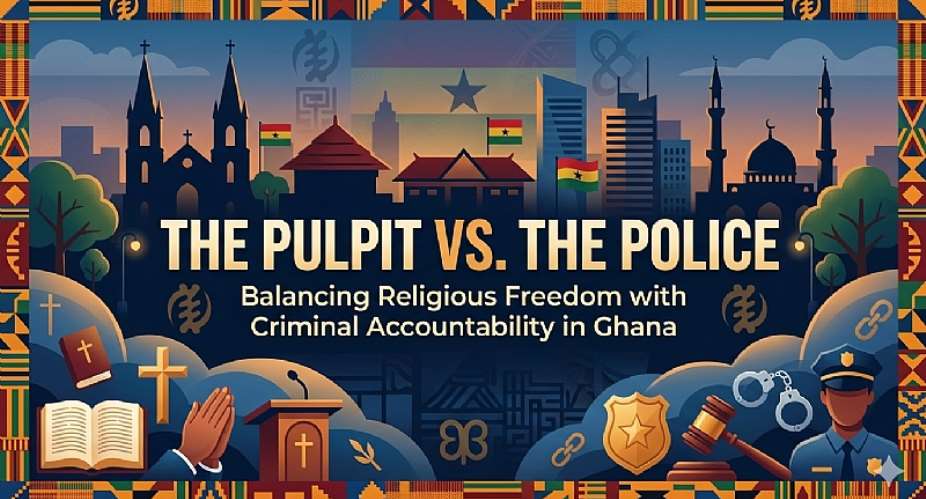
Ghana is widely celebrated as a haven of deep spiritual devotion and ethno-religious peace. However, the rise of rogue religious figures exploiting this faith has sparked intense state intervention and heated public debates. From social media commentary platforms like Frema Shows TV to the administrative desks of the Ghana Police Service, the nation is actively confronting a single question: Where does religious freedom end, and where does criminal exploitation begin? While Article 21(1)(c) of the 1992 Constitution safeguards the right to practice and manifest faith, recent actions by state security show that spiritual titles no longer grant immunity from criminal prosecution.
Dynamic Interventions: The Role of the Police
Under the administration of Inspector-General of Police (IGP) Dr. George Akuffo Dampare, the state has adopted modern strategies to tackle fraudulent and dangerous public pronouncements:
- Digital Extraction: The specialized Cyber Vetting and Enforcement Team (CVET) actively monitors internet broadcasts to preserve digital evidence before making operational arrests.
- Centralized Investigations: To limit regional interference and local crowd manipulation, high-profile religious figures are systematically processed by the Special Investigations Unit (SIU) within the Criminal Investigations Department (CID) in Accra.
- Targeted Charge Structures: Law enforcement prioritizes specific legal charges to address misconduct, including Defraud by False Pretenses, Publication of False News, and Offensive Conduct Conducive to the Breach of Peace.
Notable Precedents and Recent Legal Actions
The judiciary and police forces are setting severe examples for high-profile figures who cross legal boundaries:
- Prophet William Gyimah: The General Overseer of Elohim International Ministry was arrested by CVET in Kasoa. He was remanded by the Adenta Circuit Court for issuing digital death threats against public officials.
- Prophet Ebo Noah (Evans Eshun): Apprehended by the police after creating panic with a failed global flood prophecy. He was remanded into custody and ordered to undergo psychiatric evaluation.
- Reverend Edward Buabeng: In a landmark case of financial exploitation, an Accra Circuit Court sentenced the Chief Executive of Career Link Marketers Company Limited to 519 years in prison after convicting him on 173 counts of defrauding over 100 investors.
- Evangelist Patricia Asiamah (Nana Agradaa): Formerly arrested and hit with a GH¢50,000 bail condition, she was ultimately convicted and sentenced to 15 years in prison for running money-doubling scams and charlatanic advertisements.
- Rev. Isaac Owusu Bempah: Following charges of offensive conduct and assaulting police officers, the Accra High Court imposed a GH¢200,000 bail with two sureties, alongside mandatory weekly reporting conditions.
Legal Expert Perspectives on Article 21
Constitutional scholars and top legal practitioners in Ghana emphasize that the constitutional shield of religious liberty is not absolute:
- The Public Order Clause: Legal experts consistently highlight Article 21(4)(a), which clarifies that laws can restrict religious freedom if they are necessary in the interest of national security, public safety, or public order.
- The No-Immunity Doctrine: Legal scholars point out that ordination does not place anyone above ordinary statutory laws. A crime committed behind a pulpit remains a crime under the Criminal Offences Act.
- Separation of Faith and Fraud: Constitutional lawyers maintain that freedom of conscience protects belief, but it does not protect conduct that targets the financial security or physical safety of citizens.
How Vulnerable Victims Can Report Scams Securely
Victims of religious fraud or spiritual extortion do not have to suffer in silence. The state provides several discrete pathways to report crimes without fear of retaliation:
- The Cyber Security Authority (CSA): Victims can report digital extortion, online scams, or viral charlatanic advertisements through the secure CSA Reporting Portal, by calling the 292 toll-free hotline, or via WhatsApp at 050 160 3111.
- CID Cybercrime Unit: Victims can file formal, confidential complaints directly at the Police Headquarters in Accra to trigger investigations by cyber forensics.
- GPS Digital Channels: Secure tip-offs regarding fraudulent preachers can be submitted through the official Ghana Police Service Facebook Page inbox, where operational teams verify and escalate complaints anonymously.
Step-by-Step Guide: Filing a Civil Fraud Suit for Asset Recovery
When a victim seeks to directly claw back stolen funds or seized assets from a rogue preacher, they must navigate the civil court structure separate from police criminal actions:
- Retain Legal Counsel: The plaintiff must hire a licensed lawyer to draft a formal statement of claim outlining how the deception caused direct financial damage.
- Issue a Writ of Summons: A writ is filed at the appropriate Court registry (Circuit Court or High Court depending on the monetary value) and served directly to the pastor or church trustees.
- Application for Injunction: The plaintiff’s lawyer can immediately file an interlocutory injunction to freeze the pastor’s known bank accounts or place a lien on church properties to prevent them from hiding assets during the trial.
- The Trial and Burden of Proof: Unlike criminal cases, the plaintiff only needs to prove fraud on a balance of probabilities—demonstrating to the judge that it is more likely than not that the preacher used deliberate misrepresentation to acquire the assets.
- Enforcement of Judgment: Once won, the court issues a garnishee order or a writ of fieri facias (fifa), empowering court bailiffs to seize and sell the preacher’s luxury vehicles, lands, or structures to pay back the victim.
The Legal Distinction: Civil Fraud vs. Criminal Pretenses
Understanding how the Ghanaian legal system classifies a spiritual scam dictates how a case proceeds through the courts. When a rogue preacher deceives a congregant for financial gain, the act triggers two entirely separate legal mechanisms: civil fraud and criminal false pretenses.
A civil fraud action is a private lawsuit brought directly by the victim (the plaintiff) against the religious leader. Governed by common law principles of tort and contract, its primary goal is asset recovery and financial compensation. In a civil courtroom, the burden of proof rests on a "balance of probabilities." This means the victim’s legal counsel only needs to convince the judge that it is more likely than not that the preacher used deliberate deception to cause them financial harm. If the court rules in favor of the victim, it issues restitution orders, asset freezes, or permits the seizure of the pastor's property to pay back what was taken.
Conversely, criminal false pretenses is a public offence prosecuted under Section 131 of the Criminal Offences Act (Act 29). Here, the state acts as the prosecutor to protect public order, meaning the police step in to arrest the individual regardless of whether the victim wants to drop the case. The standard of proof is exceptionally high: state prosecutors must prove the preacher's intent to deceive "beyond a reasonable doubt." Instead of merely ordering financial compensation, a conviction under criminal false pretenses carries severe punitive state sanctions, often resulting in long-term prison sentences of up to 25 years.
The Legislative Battle: Regulating Independent Ministries
The rise of "one-man churches" has triggered intense legislative policy debates within Ghana's Parliament:
- The Proposed Trust Model: Parliamentarians have suggested bills to transform independent churches from personal businesses into public trusts governed by independent boards.
- Opposition from Coalitions: Groups like the Ghana Charismatic Bishops’ Conference strongly oppose these measures. They argue that state-enforced church regulation violates constitutional liberties and could easily be weaponized by political actors.
Policy Recommendations and Strategic Suggestions
To protect citizens while respecting democratic freedoms, the state and the public should adopt the following measures:
- Mandatory Fiduciary Registration: Independent ministries should be required to register through the Registrar General’s Department with transparent, audited financial reporting structures.
- Empowering Church Umbrella Bodies: The state should partner with established groups like the Christian Council of Ghana to create an internal self-regulatory framework, allowing the religious community to strip fraudulent actors of their credentials before police intervention becomes necessary.
- National Literacy Campaigns: The National Commission for Civic Education (NCCE) must run public campaigns to educate citizens that spiritual promises of "money-doubling" or financial miracles are scams under Act 29 of Ghanaian law.
- Fast-Track Financial Crime Courts: Establish dedicated judicial divisions to rapidly prosecute charlatanic advertisements, preventing long, drawn-out trials that exhaust victims.
Faith is a pillar of Ghanaian society, but it must never become an asset for exploitation or criminal protection. Our laws are explicitly clear: the constitution protects the freedom of conscience, not the freedom to commit fraud. When public figures mask criminal acts as divine operations, they threaten national security and exploit vulnerable families. By supporting the Ghana Police Service CVET units, maintaining strict judicial sentences, and practicing personal vigilance, Ghana can preserve its religious heritage while upholding absolute equality before the law.
✍️ Retired Senior Citizen
For and on behalf of all Senior Citizens of the Republic of Ghana 🇬🇭
Teshie‑Nungua
[email protected]

 GES must sanction SHSs that allowed flamboyant, extravagant graduation celebrati...
 NDC is stealing from Ghanaians over utility tariff adjustment — Miracles Aboagye
 Israel's 'deliberate targeting' of children part of ongoing Gaza 'genocide': UN ...
 Diaspora membership key in sustaining NPP's strength — NAPO
 Adwoa Safo to be flown abroad for further treatment over gunshot wounds — Aide
 If Kennedy Agyapong leaves NPP will not collapse — Kwadwo Poku
 Will the age of AI become a new Tower of Babel?
 I don't want nolle prosequi in corruption case filed against me by OSP — Charles...
 I lost my mother through OSP's protracted corruption investigation against me — ...
 England, Ghana eye last 32 as Portugal look for lift-off


