




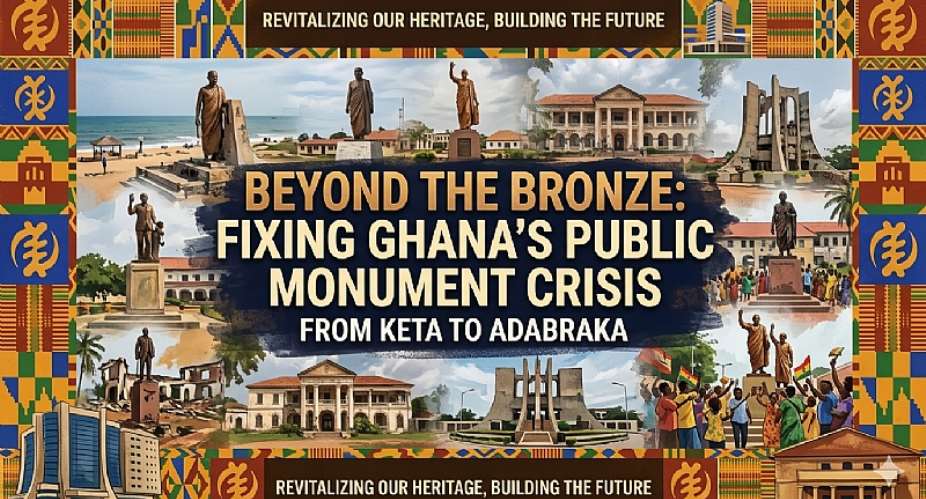
A Tale of Two Statues
The unveiling of the bronze‑colored bust of Flight Lieutenant Jerry John Rawlings at Adabraka has sparked a storm of public criticism. Many Ghanaians lament that the likeness bears little resemblance to the late president, appearing instead as a caricature. This stands in sharp contrast to the full‑body, Kente‑clad monument unveiled earlier in Keta‑Dzelukope, which was widely praised for its striking realism.
This discrepancy is not a mere artistic accident; it reflects a deeper institutional failure in how Ghana commissions, vets, and produces its public monuments. If our nation is to honor giants like Dr. Kwame Nkrumah and J.J. Rawlings, we must abandon rushed, lowest‑bidder contracts and instead ground our monuments in rigorous aesthetic and academic systems.
The Educational Divide: KNUST vs. UEW
The solution lies within our own universities, though their strengths remain underutilized:
- KNUST Sculpture Program: Built on a nonhierarchical community of contemporary fine art practice, KNUST emphasizes spatial philosophy, modeling, and casting. Yet many graduates gravitate toward global curation rather than local monument fabrication.
- UEW Art Education: Rooted in pedagogy, UEW trains professionals to implement creative arts curricula nationwide. Its innovations, such as the “skeletal bust model approach,” aim to correct stylistic shortcuts by enforcing anatomical precision.
Despite these academic strengths, both institutions face a shared vulnerability: outdated studio infrastructure and lack of commercial backing. Studies show that most graduates abandon active sculpting after national service, leaving a vacuum filled by commercial fabricators with limited training in hyper‑realistic portraiture.
Global Best Practices
Accra need not reinvent the wheel. In Washington D.C., public memorials undergo a rigorous pipeline managed by the National Capital Planning Commission and the Commission of Fine Arts. Sponsors must:
- Submit alternative site studies.
- Host open design competitions.
- Pay honorariums to finalists for physical maquettes.
- Pass technical reviews by panels of artists, architects, and stakeholders before casting begins.
This ensures durability, aesthetic value, and public accountability.
Blueprint for Ghana’s Monument Future
Ghana’s history with presidential monuments is profound. The decapitated bronze head of Kwame Nkrumah’s 1958 statue—preserved at the Kwame Nkrumah Memorial Park—reminds us that statues are sacred visual texts of our national journey. To prevent future embarrassments, three urgent reforms are required:
1. National Monument Review Board: A centralized body under the National Commission on Culture, including faculty heads from KNUST and UEW, must oversee all public installations.
2. Mandatory Clay Prototyping: Finalists in monument competitions should present full‑scale clay mock‑ups for peer and public review before casting.
3. Public Art Maintenance Fund: Ten percent of every monument budget should be reserved for perpetual preservation against weathering and erosion.
Public monuments are not mere decorations; they are the physical pages of our collective history. When sub‑standard work represents figures like Jerry John Rawlings, we dilute our heritage. Ghana must merge the academic rigor of its universities with transparent, expert‑led commissioning systems that treat our history with the reverence it deserves.
✍️ Retired Senior Citizen
For and on behalf of all Senior Citizens of the Republic of Ghana 🇬🇭
Teshie‑Nungua
[email protected]

 World Cup 2026: We know how England play, and we know how to control them – Ghan...
 GES must sanction SHSs that allowed flamboyant, extravagant graduation celebrati...
 NDC is stealing from Ghanaians over utility tariff adjustment — Miracles Aboagye
 Israel's 'deliberate targeting' of children part of ongoing Gaza 'genocide': UN ...
 Diaspora membership key in sustaining NPP's strength — NAPO
 Adwoa Safo to be flown abroad for further treatment over gunshot wounds — Aide
 If Kennedy Agyapong leaves NPP will not collapse — Kwadwo Poku
 Will the age of AI become a new Tower of Babel?
 I don't want nolle prosequi in corruption case filed against me by OSP — Charles...
 I lost my mother through OSP's protracted corruption investigation against me — ...


