




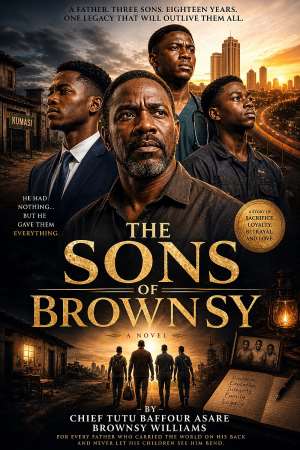
There is a particular kind of African story that the world has not yet told enough of. Not the story of war or migration or survival against colonial odds — though those stories matter and deserve their telling. The story the world has undertold is quieter and more interior than that. It is the story of an ordinary African father who gets up before dawn, goes to work, comes home, and does it again — for twenty years — so that his children can become something he never had the chance to be.
That story, in all its dignity and complexity and heartbreak, is what The Sons of Brownsy tells.
Written by Chief Tutu Baffour Asare Brownsy Williams and published under Brownsy Silva Company, The Sons of Brownsy is a contemporary African family drama set across Kumasi and Accra, spanning nearly two decades in the life of one man and the three sons he raises largely by the force of his own refusal to surrender. It is currently available on Wattpad and Medium, where it has begun attracting the kind of reader response that suggests it is touching something real — something that existing African fiction, for all its considerable recent achievements, had left slightly uncovered.
This is a novel worth knowing about. Here is why.
What the Novel Is About
The story opens in Kumasi, with a collapse.
Tutu Baffour Brownsy Williams — engineer, father, and the kind of man who keeps his accounts in a small notebook because precision is the one thing poverty cannot take from you — loses his business to debt, his home to creditors, and his footing in the life he had carefully constructed. With two bags and three sons, the youngest of whom still believes his father can fix anything, he boards a taxi heading south to Accra.
The city does not welcome him. It tests him.
What follows is the story of eighteen years — of a third-floor apartment on a road that is never quite enough, of school fees calculated against grocery costs, of a father who treats every modest domestic gain as a foundation to build from rather than a ceiling to settle beneath. Three sons grow up inside this story and grow in different directions: Kwame, the eldest, becomes a lawyer and spends a decade being ashamed of the apartment he came from. Kofi, the middle son, becomes a gifted doctor who cannot discipline his own brilliance into consistency. Ebo, the youngest, becomes a mechanic and the quiet load-bearer of the family — working six days a week so his brothers can study, contributing without accounting, sacrificing without announcement.
Then secrets surface. A stranger knocks on the wrong door. The past — which has always been present, just unspoken — walks back into the family's life and demands a reckoning.
And everything that was built on half-truths must be rebuilt, painfully, on the whole ones.
The Character at the Heart of It
What separates The Sons of Brownsy from competent family drama and pushes it toward something genuinely memorable is the construction of its central figure.
Tutu Baffour Brownsy Williams is not a saint. He carries a secret for thirty years that he should have shared sooner and does not. He is stubborn in the particular way of men who have carried things alone for so long that accepting help feels like a structural failure. He is also — and this is the achievement — completely, unmistakably real. He treats an ordinary apartment as though it is a palace worth building toward. He makes tea with the same ritual care in crisis as in calm. He puts on his shoes every morning and goes to work, and this is presented not as heroism but as what it actually is: the daily choice of a man who has decided that his children's future outweighs his own comfort, indefinitely and without condition.
Scenes between Tutu and his sons — particularly the kitchen table conversations, which become the novel's recurring emotional setting — carry a restraint that makes them land harder than louder writing would. When Tutu tells Kwame, after thirty-four years of chosen fatherhood: "I have never once — not in one day — wished you were not my son," the sentence does what the best sentences in literary fiction do: it arrives with the full weight of everything that has come before it, and it opens something in the reader that stays open.
Among fictional fathers in contemporary African literature, Tutu Williams earns his place in the front row.
The Three Sons: A Study in Contrast
The novel's structural intelligence lies in the way the three Williams sons are designed to illuminate different responses to the same formative experience.
Kwame represents the ambition that curdles into shame. He is not a villain — the novel is too honest for that simplicity — but he is a study in what happens when a gifted man decides that where he comes from is something to be managed rather than claimed. His arc from calculated deception to broken-open truth is the novel's most dramatically compelling journey, and his final reconciliation with his father earns its emotional resolution because it has been genuinely paid for.
Kofi represents talent in conflict with character. His medical brilliance is never in question; his judgment is perpetually on trial. His storyline — which takes a genuinely dark turn involving illegal pharmaceutical activity and an arrest — raises the stakes of the novel's second half and forces a confrontation between Kwame's professional identity and his fraternal obligations. The scene in which Ebo arrives at Kwame's glass-walled office in workshop clothes and asks, simply, "He's your brother. He's in a police station. And you are the lawyer" — is the kind of scene that makes readers set down a book for a moment.
Ebo is the novel's quiet revelation. He is, on the surface, the least dramatic of the three: no prestigious career, no moral crisis, no grand arc of public failure and redemption. What he has instead is consistency — the consistency of a person who shows up, contributes, and loves without requiring an audience for any of it. He is also secretly in love with a woman he has not told, and when the novel finally brings this storyline to its resolution, the simplicity of the scene — a veranda, an evening, four years of feeling finally spoken — is as moving as anything in the book.
The Twist That Reframes Everything
Without diminishing the experience of encountering it cold, it is fair to say that The Sons of Brownsy contains a plot revelation in its second half that is both genuinely surprising and, on reflection, structurally inevitable.
The arrival of Emmanuel Asare-Kusi — the man whose unpaid debt started the family's collapse in Kumasi, who resurfaces eighteen years later by knocking on the wrong door — is handled with the confidence of a writer who understands that the best revelations in family drama are not twists for their own sake. They are the moment when scattered threads suddenly resolve into a pattern that was always there, waiting to be seen.
What Asare-Kusi's arrival reveals changes how readers understand every scene that preceded it. The re-reading, whether literal or mental, rewards the attentive.
Writing That Earns Its Emotional Weight
The Sons of Brownsy is written in a prose style that prioritizes precision over ornamentation. The sentences are clear and deliberate, the imagery grounded in the specific textures of Accra life — the smell of kelewele and exhaust, the light on a kitchen table at six in the morning, the watermarks on a rented ceiling that tell the story of years in a way no lease agreement does.
The dialogue is the novel's most consistently excellent technical achievement. It is the dialogue of people who have been having difficult conversations in the same rooms for decades — people who know which words carry the most weight and therefore use fewer of them. When Tutu Williams speaks to his sons, he communicates as much through what he does not say as what he does, and the novel understands this and uses it.
The Accra setting is rendered with the comfortable authority of someone who knows the city not as backdrop but as organism — a place with its own rhythms, its own particular cruelties and generosities, its own way of shaping the people who try to build lives inside it.
Where It Sits in the Landscape of African Fiction
Contemporary African literary fiction has had a remarkable two decades. Chimamanda Ngozi Adichie's excavations of Igbo family life and colonial inheritance. Yaa Gyasi's multi-generational sweep through Ghanaian and American history. Lesley Nneka Arimah's compressed, mythological short fiction. NoViolet Bulawayo's formally experimental political novels. The field is rich, diverse, and operating at a high level.
The Sons of Brownsy occupies a specific space within this landscape that is somewhat its own. Where much celebrated contemporary African fiction is interested in the macro — history, politics, migration, the architecture of oppression — this novel is interested in the micro. The kitchen table. The notebook. The reading glasses purchased from a market stall for twelve cedis because precision must be maintained even when resources cannot.
It is a novel in the tradition of social realism, deeply invested in the proposition that the interior life of an ordinary man navigating economic hardship with love and dignity is as worthy of serious literary attention as any grand historical canvas. In the Ghanaian context specifically, it speaks to an experience — the father who moved to the city and built something from very little — that is both statistically common and, in fiction, underrepresented.
That representation matters. Readers who see their own fathers in Tutu Williams will not forget this book quickly.
Areas the Novel Continues to Develop
An honest assessment acknowledges that The Sons of Brownsy is a work with room to grow. The female characters — Adaeze, Abena, Efua — are well-drawn within their current scenes but deserve fuller interior lives in future editions. Their emotional journeys are largely rendered through their relationships with the Williams men; giving each of them a more fully realized independent arc would strengthen the novel's world considerably.
The early Kumasi chapters, which establish the life that collapses, could expand to give readers a deeper before — a more fleshed-out sense of what was lost, so that the loss lands with greater force. And the novel's final section, which moves through revelation and reconciliation at a pace that occasionally feels slightly compressed, would benefit from a slower unwinding — more time in the emotional aftermath of each disclosure before the next arrives.
These are not criticisms of fundamental conception. They are the observations of a novel that knows what it wants to do and has not yet fully exhausted the space it has opened up. A revised or expanded edition addressing these dimensions would be formidable.
The Critical Assessment
Evaluated across its core elements, The Sons of Brownsy performs at a level that places it among the more accomplished debut-adjacent African family novels of recent years:
Storytelling and Structure: The architecture of the novel — its movement from collapse to reconstruction, its management of multiple timelines and character arcs, its placement of revelation — demonstrates genuine craft. The Kumasi opening, the eighteen-year compression, and the Accra present are balanced with intention.
Characters: The Williams family is one of the most fully realized fictional families in recent Ghanaian fiction. Tutu Williams, in particular, is a character who will stay with readers considerably past the final page.
Emotional Resonance: This is the novel's most undeniable quality. It builds its emotional power slowly and deploys it precisely — the kitchen conversations, the tarmac visits, the veranda confession, the hospital waiting room. These scenes are constructed by a writer who understands that emotional impact in fiction is a function of accumulated context, not isolated intensity.
Dialogue: Consistently the novel's most polished technical element.
Thematic Coherence: The central argument — that fatherhood is not a biological event but a daily act of chosen love — runs through every subplot and character arc without ever being stated explicitly. It is demonstrated, which is the only way it could work.
Overall: A genuinely accomplished, emotionally serious family novel with a protagonist who earns his place among the memorable fathers of African fiction.
Where to Read It
The Sons of Brownsy by Chief Tutu Baffour Asare Brownsy Williams is available on Wattpad and Medium under the Brownsy Silva Company publishing banner. Readers who begin it should expect to find themselves thinking about Tutu Williams — about his notebook and his reading glasses and his cup of tea at six in the morning — well after they have finished.
That is the mark of a novel that has done its job.
About the Author
Chief Tutu Baffour Asare Brownsy Williams is an engineer, author, and multi-disciplinary creative strategist whose work spans analytical thinking and cultural commentary. He holds a BSc in Mechanical Engineering and an Advanced Diploma in Software Engineering, and brings a structured, problem-solving orientation to literary fiction and national discourse.
He is the founder of Brownsy Silva Company — a Pan-African creative enterprise spanning literature, film, and digital content — and a columnist on major national platforms. His work includes the African mythology novel Reborn: The River of Girls, the short film Silence (2025), and several works of serialized fiction exploring identity, sacrifice, and contemporary Ghanaian life.
The Sons of Brownsy is available now on Wattpad and Medium.
Published June 2026 | Literary Review and Profile All rights reserved — Brownsy Silva Company

 World Cup 2026: We know how England play, and we know how to control them – Ghan...
 GES must sanction SHSs that allowed flamboyant, extravagant graduation celebrati...
 NDC is stealing from Ghanaians over utility tariff adjustment — Miracles Aboagye
 Israel's 'deliberate targeting' of children part of ongoing Gaza 'genocide': UN ...
 Diaspora membership key in sustaining NPP's strength — NAPO
 Adwoa Safo to be flown abroad for further treatment over gunshot wounds — Aide
 If Kennedy Agyapong leaves NPP will not collapse — Kwadwo Poku
 Will the age of AI become a new Tower of Babel?
 I don't want nolle prosequi in corruption case filed against me by OSP — Charles...
 I lost my mother through OSP's protracted corruption investigation against me — ...


