




Says About the Decay of Its Democracy
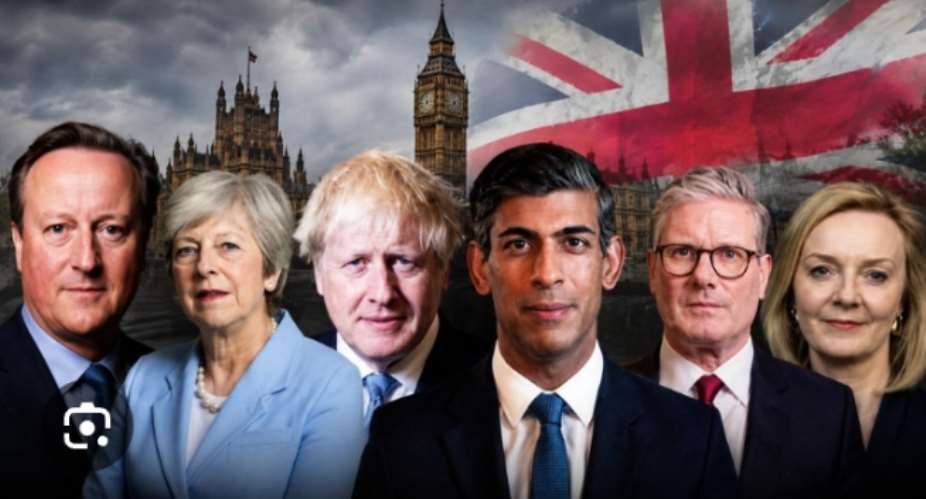
In the annals of modern British political history, there is no period quite as turbulent, as humiliating, and as revealing as the decade between 2016 and 2026. In that span of ten years, the United Kingdom a country that once prided itself on the stability and dignity of its constitutional order has cycled through six prime ministers and is now preparing to install a seventh. The latest departure came this morning, Monday, June 22, 2026, when Prime Minister Keir Starmer announced his resignation after less than two years in office, broken by a revolt from within his own Labour Party.
Nearly two years after leading the Labour Party to a landslide election victory, Prime Minister Keir Starmer announced his resignation amid a mounting rebellion within the party, kick-starting the race for the seventh prime minister of the United Kingdom in 10 years. In an emotional address on Monday, Starmer said he would remain in office until a new Labour leader and, by extension, the next prime minister is selected. The formal leadership contest is to begin on July 9 and is to be completed by the UK Parliament's summer recess.
Weeks of internal pressure after disappointing local election results had already weakened Starmer's position. A decisive parliamentary by-election victory in Makerfield by challenger and Greater Manchester Mayor Andy Burnham ultimately triggered the resignation.
The Six Who Came Before the Seventh
To understand how Britain arrived at this moment, it is necessary to walk through each resignation because each one is not merely a personnel change but a political failure, and the cumulative weight of six failures in ten years is something that demands serious accounting.
David Cameron resigned in 2016 after campaigning to remain in the European Union and losing the Brexit referendum.
Theresa May resigned in 2019 after repeated failures to secure parliamentary approval for her Brexit withdrawal agreement.
Boris Johnson resigned in 2022 after a series of scandals and a wave of ministerial resignations that undermined his government.
Liz Truss resigned in 2022 after 49 days in office amid market turmoil triggered by her government's economic plans.
Rishi Sunak left office after the Conservatives suffered a heavy defeat in the 2024 general election.
Keir Starmer resigned on Monday after growing pressure from within the Labour Party following poor local election results. Six departures. Six different reasons. One consistent thread: leaders chosen in haste, governing without a stable mandate, and removed before they could consolidate anything resembling a lasting programme.
Since 2016, the UK has had six prime ministers, averaging one every one and a half to two years, compared with the much longer tenures of Margaret Thatcher and Tony Blair, who each led the country for more than a decade.
The contrast is stark. Thatcher survived the Falklands War, the miners' strike, and multiple economic crises. Blair won three consecutive general election majorities. Both governed for over a decade. The current era has produced nothing resembling that kind of settled authority.
At the other end of the scale, Liz Truss holds the record for the shortest premiership in British history, lasting just 49 days in 2022.
She entered office with a mini-budget that crashed the pound, sent mortgage rates soaring, and triggered a gilt market meltdown. Financial markets had effectively removed her from office before her own party formally did. That a sovereign nation's leadership can be terminated by bond traders is a damning commentary on the brittleness of Britain's current political compact.
The Architecture of Collapse
What explains this extraordinary rate of political turnover? Three structural forces have been at work simultaneously, each reinforcing the others.
The first is Brexit. The 2016 referendum did not merely produce a policy outcome it fractured the two main political parties from within. Cameron called the referendum as an internal Conservative Party management exercise and lost.
May inherited the impossible geometry of a country half-in, half-out of the European Union, with a parliament that could block but not decide. Johnson delivered Brexit formally but at the cost of the integrity norms that make democratic governance function.
The Brexit decade consumed three Conservative prime ministers before the issue was formally closed, and its economic and diplomatic aftershocks continue to shape the environment in which every subsequent leader has governed.
The second force is the collapse of internal party discipline and the rise of the parliamentary assassination as a governing tool. The high turnover reflects a series of political shocks and party contests: the 2016 Brexit referendum precipitated David Cameron's resignation and the Conservative leadership change that brought Theresa May to power.
Subsequent parliamentary deadlock over Brexit and internal party pressures contributed to successive leadership changes that produced Boris Johnson and then, after scandal and resignations, the brief Truss premiership followed by Rishi Sunak's ascension. Labour's removal of Starmer through an internal rebellion follows the same logic: British political parties have become more effective at destroying their own leaders than at governing the country. The third force is the collapse of long-term strategic thinking in British politics.
Policy has become reactive, driven by media cycles, factional pressures, and the demands of perpetual electioneering. No leader since Blair has had the political breathing space to pursue a ten-year vision. Each has been consumed by the immediate crisis of their inheritance.
What the Seventh Premiere Will Inherit
Andy Burnham's return to the House of Commons has instantly placed him as the frontrunner to succeed Starmer, although other Labour leaders, such as former Health Secretary Wes Streeting, are expected to also consider a run. A candidate requires the nominations of 81 Labour MPs to make the ballot, which could either trigger a full summer campaign or a swift, uncontested handover if a backroom deal is struck.
Whoever becomes prime minister Number seven will inherit a Britain that is measurably weaker in international standing, economic competitiveness, and institutional confidence than the Britain of 2016. The National Health Service remains in structural crisis. The cost-of-living pressure on ordinary working families has not abated.
Britain's post-Brexit trade relationships, particularly with the European Union and the United States, remain unsettled. And the legitimacy of government itself has been eroded by a succession of leaders who promised transformation and delivered only their own removal.
What the Revolving Door Costs Governance
There is a seldom-discussed dimension of leadership instability that goes beyond the politics: the cost to policy continuity and institutional memory. Every new prime minister brings a new cabinet, new priorities, new advisers, and new departmental reorganizations. Civil servants spend months calibrating to the preferences of a new administration before having to recalibrate to the next one.
Long-term infrastructure investment, healthcare reform, housing policy, foreign policy none of these can be effectively prosecuted in eighteen-month leadership windows. Britain has effectively been running on political autopilot for a decade, with the machinery of state ticking over while the political leadership above it churns.
The longest-serving UK prime minister in history was Robert Walpole, who held office for more than two decades from 1721 to 1742.
That comparison is not made to romanticize dynastic tenure. It is made to illustrate how far from normal the current moment is. Even in the tumultuous twentieth century, leaders found ways to govern for sustained periods. The ten years from 2016 to 2026 have produced a quantity of political churn that has no modern British precedent.
A Message to the World
For Africa, and specifically for West Africa's relationship with Britain, this matters. The UK has long presented itself as a model of institutional stability, parliamentary democracy, and the rule of law. It has lectured developing nations on the importance of peaceful transfers of power, constitutional governance, and the separation of politics from crisis. It is not easy to receive those lectures from a country that has changed its head of government six times in a decade
once because of a botched budget, once because of a referendum gamble, and now because of internal party warfare that has nothing to do with the public interest.
This is not a schadenfreude observation. British democratic instability is not good for the world. It removes a serious, constructive voice from the councils of Western foreign policy at a time when the global order badly needs serious voices. It weakens the transatlantic alliance. It reduces Britain's credibility as a development partner, a security guarantor, and a diplomatic broker.
The seventh prime minister will face the same fundamental question that the six predecessors could not answer: how does Britain rebuild a politics that is capable of sustaining leadership long enough to actually govern?
Until that question is answered, the door at Number 10 will keep revolving.
Mustapha Bature Sallama
Medical/ Science Communicator
Private Investigator, Criminal Investigation and Intelligence Analysis.
International Conflict Management and Peace Building.(USIP)
+233555275880
mustysallama@gmail .com
References:
Mohammed Haddad, "Political turmoil: UK will see its seventh prime minister in 10 years," Al Jazeera, June 22, 2026. https://www.aljazeera.com/news/2026/6/22/political-turmoil-uk-will-see-its-seventh-prime-minister-in-10-years
"UK PM Starmer resigns as Britain faces its seventh leader in 10 years," CNBC, June 22, 2026. https://www.cnbc.com/2026/06/22/keir-starmer-resigns-uk-prime-minister.html
"U.K. Prime Minister Starmer resigns as Labour government seeks reboot," The Washington Post, June 22, 2026. https://www.washingtonpost.com/world/2026/06/22/uk-prime-minister-starmer-resigns-labour-government-seeks-reboot/
"How Many Prime Ministers Has the UK Had in the Last Ten Years?", Factually, February 19, 2026. https://factually.co/fact-checks/politics/how-many-uk-prime-ministers-last-10-years-10711e
Past Prime Ministers, UK Government official records. https://www.gov.uk/government/history/past-prime-ministers
"List of prime ministers of the United Kingdom," Wikipedia (updated June 22, 2026).https://en.wikipedia.org/wiki/List_of_prime_ministers_of_the_United_Kingdom
House of Commons Library, "Prime Ministers," Research Briefing SN04256. https://researchbriefings.files.parliament.uk/documents/SN04256/SN04256.pdf

 We're pushing for specialized courts to enforce rent laws — Rent Commissioner
 'The country needs to be governed' — Kemi Badenoch criticises Starmer's resignat...
 Lavish post-WASSCE celebrations show some parents can pay fees — Hamza Suhuyini
 Why this lavish post-WASSCE celebration when results are not yet out? -- Hamza S...
 Take a cue from Starmer and resign over your monumental failure — Obi tells Tinu...
 How NACOC picked up five Central University students on campus over cannabis inf...
 Kantanka family says Adwoa Safo attempted to serve court injunction on Akofena w...
 Kennedy Agyapong ought to have been questioned over 'contracts for sale' allegat...
 ACFO II Semey Mawuko bows out after 37 years in GNFS
 US cracks down on visa holders accused of abusing system and defrauding citizens


