




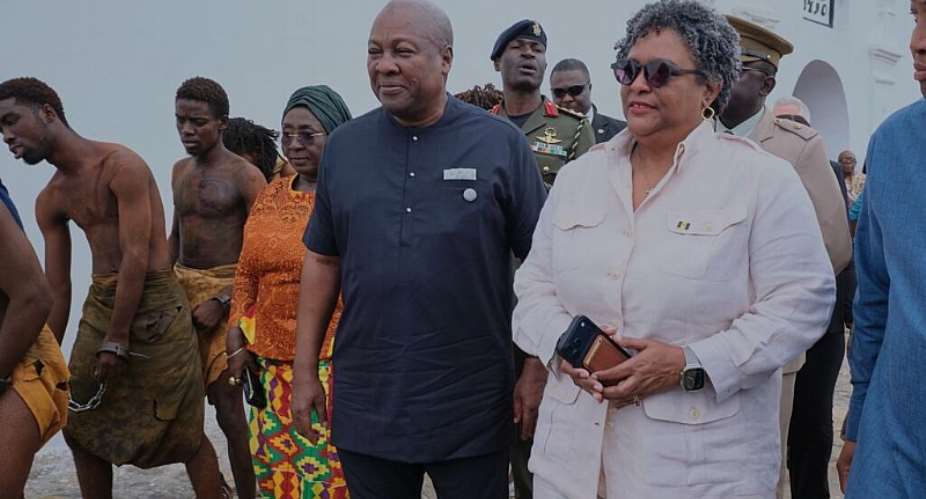
The three-day summit at Osu Castle in Accra, which ended on Friday, brought together African countries and descendants of enslaved people in the Caribbean, as well as other international allies.
It produced a 19-point plan laying out joint demands for justice, including formal apologies from nations that benefited from the slave trade as well as debt relief, financial compensation and the restitution of cultural property.
"We are putting an end to fragmentation," said Ghana's foreign minister, Samuel Okudzeto Ablakwa. "From now on, we are presenting a united front."
Concrete steps
The "Accra Next Steps Commitments" include the establishment of a global reparations fund, comprehensive debt relief for countries affected by enslavement and reforms to international financial institutions to ensure fairer representation.
They call on countries involved in the slave trade to offer "full, formal and unconditional apologies".
The plan also pushes for the restitution of looted cultural property and ancestral remains, climate justice financing and steps to address the impact of slavery specifically on African women and girls.
It urges African countries to grant the right of return and citizenship pathways for members of the diaspora, and to commit to preserving coastal forts used to confine enslaved people before they were shipped overseas.
Ghana summit charts path from 'recognition to action' on slavery reparations The summit in Accra, Ghana, brought together countries from Africa and the Caribbean to discuss a roadmap for reparatory justice.
The plan was adopted by the African Union and the Caribbean Community (Caricom) Commission on Reparatory Justice.
While the two bodies had previously developed separate reparations plans, the Ghana summit allowed them to combine their efforts. The resulting document will be presented jointly at the next United Nations General Assembly.
Speaking to RFI in Accra, a representative from India's foreign ministry welcomed the emergence of a "global movement" and suggested that the summit's conclusions could inform future international discussions on reparations.
French sons of slave traders and enslaved unite to seek a path to justice
Historic responsibility
This week's summit came after the UN in March adopted a non-binding resolution, championed by Ghanaian President John Mahama, recognising the transatlantic slave trade as the "gravest crime against humanity" and calling on countries involved to engage in restitution and compensation.
"History does not ask us to inherit guilt, but it asks us to inherit responsibility," Mahama told delegates in Accra, who included heads of state from Namibia, Liberia, Senegal and Barbados.
French President Emmanuel Macron also addressed the conference by video, encouraging efforts to confront historical injustices through education and outreach, and backing the restitution of looted artefacts.
He cautioned: "Making reparations can never just be a cheque written to bring the story to a close."
(with newswires)

 Israel strikes south Lebanon despite truce announced with Hezbollah
 'United front' on slavery reparations after historic summit in Ghana
 Trump unveils new Air Force One converted from luxury jet gifted by Qatar
 Mexican archaeologists unearth 'unprecedented' ancient ruins with Mayan features
 Trans-Saharan Gas Pipeline: an African dream that could reshape world energy mar...
 Israel, Hezbollah agree to ceasefire in Lebanon as attacks strain US-Iran interi...
 DR Congo's deadly Ebola outbreak is 'evolving fast', WHO warns
 Ireland deports 42 South Africans
 Chief Justice Baffoe-Bonnie's Canada trip self-funded — Judicial Service
 Boakye Agyarko is best suited to lead NPP as National Chairman – Kpandai MP


