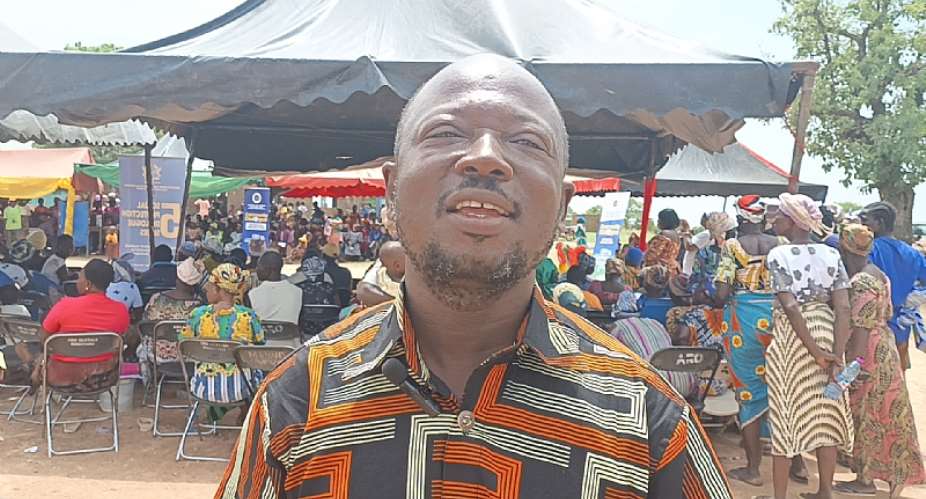
The Mental Health Coordinator at the Bongo District Health Directorate, Prince Kofi Yeboah, has called on traditional leaders and community members to take a leading role in addressing the growing menace of illicit drug use among young people in the Upper East Region.
Mr Yeboah made the appeal during a community dialogue and sensitisation programme held at Dachio and organised by the Ministry of Gender, Children and Social Protection. The programme focused on issues including gender based violence, child marriage, forced marriage, and gender inequality.
The event brought together traditional authorities, community members, officials from the Department of Social Welfare, civil servants, the District Chief Executive for Bolgatanga East, and residents of Dachio.
Addressing participants, Mr Yeboah stressed the need for a collective response to drug abuse, particularly given its increasing impact on young people across the region and the country.
He explained that the effects of illicit drug use are far-reaching and can be grouped into mental health, physical health, and overdose related consequences.
According to him, substance abuse contributes significantly to depression, anxiety, psychosis, and an increased risk of suicide. He noted that drugs such as tramadol, marijuana, and alcohol alter brain chemistry, often leading to addiction and poor decision making.
On physical health, he said prolonged drug use can result in liver disease, kidney failure, cardiovascular complications, and weakened immune systems.
He further warned that the absence of dosage control in illicit substances makes overdose a constant and potentially fatal risk.
Mr Yeboah also outlined several social and economic consequences associated with drug abuse among young people. These include school dropout, loss of productive potential, family breakdown, criminal activities, reduced productivity, and the erosion of cultural values and respect for authority.
He noted that many students who become involved in substance abuse lose concentration, miss classes, and eventually abandon their education. He added that addiction often prevents talented young people from contributing meaningfully to their families and communities.
The mental health officer also linked substance abuse to domestic violence, child neglect, financial hardship, theft, robbery, and violent behaviour.
To address the challenge, Mr Yeboah appealed to traditional leaders to introduce measures aimed at reducing the availability and use of illicit drugs within their communities.
He urged chiefs and community leaders to prohibit drug peddling at funerals, markets, and youth gatherings and to impose traditional sanctions on offenders.
He also encouraged them to use community meetings, festivals, and traditional gatherings as platforms to speak out against substance abuse.
“When chiefs condemn it, people listen,” he said.
Mr Yeboah further called for stronger collaboration between traditional authorities, law enforcement agencies, and health institutions through the sharing of information on drug dens and support for lawful interventions.
He also recommended the promotion of alternative livelihood opportunities, including youth farming initiatives and apprenticeship programmes, to reduce idleness among young people.
Addressing parents and guardians, he urged them to pay closer attention to their children's friendships, monitor behavioural changes, and engage in open discussions about the dangers of drug use.
He also advised parents to lead by example by avoiding the misuse of alcohol and other substances in the home.
“If we lose our youth to drugs, we lose the future of our communities,” Mr Yeboah emphasised.
The Ministry of Gender, Children and Social Protection said the dialogue was intended to move beyond awareness creation and encourage community-led action, with traditional leaders playing a central role in addressing social challenges and safeguarding the wellbeing of young people.
 Thunderstorm, heavy rain and strong winds expected across Ghana — GMet warns
 Tema Police intercept truck loaded with suspected Indian Hemp, arrest two
 World Bank approves US$300 million to support phase out of SHS double track syst...
 World Cup 2026: 'Play for the flag, the children who dream of following in your ...
 SHS students storm teacher’s residence to rescue female classmate found in his r...
 Ghanaian youth now turning to politics as 'shortcut to success' — Mary Addah
 About 18,000 premature child deaths would be averted with 7.2% GDP investment — ...
 June 17: Cedi sells at GHS12.30 on forex market, GHS11.16 on BoG interbank
 Prosecute Ofori-Atta in absentia if you have evidence — Ahiagbah tells OSP
 It's incompetent to claim NPP is responsible for bringing back Ofori-Atta — Ahia...