




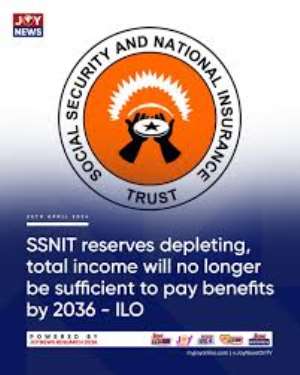
The recent assurance by the Director-General of SSNIT, Mr. Kwesi Afreh Biney, that Ghana’s pension scheme remains sustainable and capable of paying benefits for the next 40 years should ordinarily bring comfort to contributors and pensioners alike. According to him, the confidence stems from actuarial assessments conducted by the UK Government Actuary’s Department, which reportedly affirmed the long-term viability of the scheme.
Indeed, pensioners and workers must welcome any indication that the national pension fund is not on the verge of collapse. A stable pension system is critical for social protection, national confidence, and economic stability. The regular payment of pensions by SSNIT over the years deserves recognition, especially in an era where many countries struggle to finance retirement obligations.
However, the national conversation cannot end with assurances alone. The concerns that have emerged about the sustainability and adequacy of Ghana’s pension system are not coming from ordinary rumor mills or partisan actors. They are being raised by the International Labour Organization (ILO), a globally respected institution with technical expertise in labour and social protection systems. The ILO would not issue cautionary observations without examining actuarial data, demographic trends, contribution flows, and long-term liabilities.
This raises an important possibility. Perhaps SSNIT and the ILO are not necessarily contradicting each other but are looking at different dimensions of pension “strength.”
Sustainability Is Not the Same as Adequacy
SSNIT appears to be speaking from the perspective of operational sustainability --- the ability of the scheme to continue paying pensions regularly into the foreseeable future. The Trust points to growing contributions, investment returns, government compliance, and actuarial projections as evidence that the scheme remains financially stable.
The ILO, however, may be looking at structural sustainability over the very long term, especially issues such as:
- reserve depletion trends,
- demographic pressures,
- increasing life expectancy,
- low formal sector participation, and
- the future ratio between contributors and pensioners.
These are legitimate actuarial concerns. A pension scheme may continue paying benefits and still face long-term structural weaknesses if reforms are not continuously undertaken. But beyond sustainability lies an even more painful issue for many pensioners. And that is pension adequacy. For thousands of retirees, receiving pensions regularly is no longer enough if the pension itself cannot sustain dignified living.
The Silent Anger over Indexation
One of the most sensitive concerns among pensioners today relates to the annual pension indexation between 2022 and 2025, arguably some of the harshest economic years in Ghana’s recent history.
During that period, Ghana experienced severe inflationary pressures, sharp depreciation of the cedi, rising fuel prices, escalating food costs, utility tariff hikes, and increasing healthcare expenses. Yet many pensioners insist that the annual increases granted during those difficult years did not reflect the true erosion in purchasing power they suffered. This is where distrust begins to emerge.
SSNIT has consistently explained that pension indexation is based on several factors including inflation, average salaries of active contributors, affordability, and long-term sustainability of the scheme. The Trust stated in its 2025 Pension Indexation release that the annual review considers the Consumer Price Index (CPI), wage inflation, affordability, and the sustainability of the fund.
However, many pensioners still do not know the actual formula being used, the weighting attached to inflation, how affordability is determined, or how sustainability considerations affect the final percentage announced each year. Transparency is therefore becoming just as important as the increments themselves.
Why Pensioners Feel Shortchanged
The frustration among pensioners is not entirely emotional or political. Economic realities matter. A pensioner whose monthly pension increased modestly while prices of food, transportation, rent, electricity, medicine, and healthcare doubled or tripled within the same period would naturally feel poorer, even if actuarial reports describe the scheme as stable.
This explains why many retirees now differentiate between regularity of payment, and adequacy of payment. A pension paid promptly but incapable of meeting basic living costs still leaves pensioners vulnerable. This is the debate Ghana must courageously confront.
Lessons from International Best Practice
Across many advanced pension systems, indexation formulas are publicly known and often tied directly to measurable economic indicators such as inflation rates, wage growth, or blended social protection formulas.
In some countries, pension increases are automatically adjusted once inflation crosses certain thresholds. Such transparency helps build trust between pension institutions and retirees. Ghana can learn from these models. Pensioners deserve to clearly understand how indexation figures are arrived at, how inflation protection is calculated, how investment returns affect sustainability, and what reforms are needed to strengthen the scheme.
The Way Forward: Reform without Hostility
To be fair, SSNIT has undertaken significant reforms over the years. Digitization, contribution monitoring, improved compliance systems, and redistribution mechanisms favoring low-income pensioners. These efforts deserve commendation, not hostility. But constructive criticism is not an attack.
Calling for more transparency, better engagement with pensioners, clearer communication on indexation, and stronger protection against inflation does not amount to undermining SSNIT. Rather, it reflects the desire to strengthen public confidence in one of Ghana’s most important social protection institutions. The discussion therefore must shift from whether SSNIT can survive, to whether pensioners themselves can survive comfortably under prevailing economic conditions.
My Thoughts: “He Who Feels It, Knows It”
Ultimately, actuarial projections and technical reports are important, but pensioners live within practical realities. They buy food from the market. They pay hospital bills. They purchase medication. They pay transport fares. They support dependents and grandchildren. The true strength of any pension scheme should therefore not only be measured by its ability to continue existing, but by its ability to preserve the dignity, health, and welfare of those who spent decades contributing to it. SSNIT may indeed be financially strong. But pensioners are asking a different question. Is the pension itself strong enough for the ordinary retiree to live with dignity? That question deserves honest national reflection, not defensiveness.
FUSEINI ABDULAI BRAIMAH
+233550558008 / +233208282575
[email protected]

 We have paid too high a price to allow freedom of speech diminish — Osahen Afeny...
 No disciplinary concern justifies violence against students - EduWatch condemns...
 Introduce regular criminal background checks into teacher recruitment — EduWatch...
 Bank of Ghana mops up GH¢17.24bn in major liquidity tightening move
 NDC marks 34 years of political influence and democratic governance
 UTAG threatens nationwide strike over delayed book and research allowances
 808 presidential staffers on payroll as Parliament receives annual staffing repo...
 24-Hour Economy cannot succeed without data — GSS tells Parliament
 Captain Smart declares bid for NDC parliamentary slot in Gomoa West
 24-Hour Economy will promote prostitution – NPP Chairman warns government


