




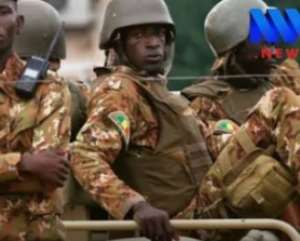
For more than a decade, Mali has been a laboratory for failed security experiments. First came the French, with their helicopters, Special Forces and the grand promise of Operation Barkhane. Then came the United Nations, with its sprawling peacekeeping mission MINUSMA and billions of dollars in stabilization funding. Both eventually left, not in triumph, but in quiet strategic retreat. Now Russia has inherited the laboratory. And the experiment, once again, is failing.
But here is what is different this time: nobody is allowed to say so.
The war in Mali has entered a new and particularly dangerous phase not because the violence has escalated beyond all precedent, though it has intensified considerably, but because the very mechanism by which the state responds to failure has itself become a weapon.
Mali's military junta, propped up by Russian Africa Corps operatives and sustained by a relentless information architecture centered in Moscow, has made narrative control the centerpiece of its survival strategy. When you cannot win the war on the ground, you fight it on screens. When your soldiers retreat, your propagandists advance.
The events of April 2026 exposed this strategy with brutal clarity. Reports of Malian forces and Russian operatives losing control of Kidal, Tessalit and Aguelhok within less than a fortnight did not simply represent military setbacks. They shattered the central myth upon which the junta's political legitimacy rests. When Malian forces recaptured Kidal in late 2023 after the MINUSMA withdrawal, Bamako treated it as a civilization moment.
Russian support was declared the decisive factor that achieved what France and the United Nations had supposedly failed to accomplish. State media amplified the triumph. Russian information networks echoed it across the continent. African audiences, exhausted by years of Western paternalism and broken security promises, found the message compelling.
That moment of triumph now sits uneasily against the reports emerging from northern Mali. If Kidal has indeed slipped from government control again, then the 2023 celebration was not the beginning of a new chapter but rather an intermission in a story of persistent state fragility. The political consequences of this realization are potentially more damaging than the military losses themselves.
Military juntas do not govern through consent. They govern through the perception of strength. When that perception cracks, so does the architecture of authoritarian stability. This is why Bamako and Moscow have responded to battlefield reversals not with transparency but with escalating information warfare.
Russian-linked platforms have characterized reports of strategic collapse as Western disinformation campaigns. Official Malian military communiqués continue to announce the neutralization of terrorist elements without providing territorial maps, verified casualty data or honest operational assessments. The silence where facts should be is not incidental. It is strategic.
Yet silence carries its own costs in the digital age. Armed groups operating across northern and central Mali have become remarkably sophisticated propagandists in their own right. Drone footage, battlefield videos and images from contested territories circulate almost in real time across social media platforms, creating powerful visual narratives that official statements cannot easily counter.
Every image of an abandoned military position, a damaged convoy or fighters moving openly through territory that Bamako claims to control chips steadily away at the government's credibility. In modern insurgent conflicts, perception is territory. And Mali's government is losing both.
What makes the current moment strategically significant is the nature of the threat the Malian state now faces. JNIM, the al-Qaeda-linked coalition operating across the Sahel, is not simply a collection of armed bandits exploiting weak governance. It is a politically sophisticated organization that has learned from decades of insurgent experience across Afghanistan, Iraq and the wider Muslim world. According to ACLED data, the Sahel has become the deadliest region globally for extremist violence, accounting for more than half of worldwide terrorism-related fatalities in recent years.
JNIM has expanded steadily into central Mali, regions that were long considered beyond the reach of northern insurgencies. It has done so not only through violence but through governance providing rudimentary dispute resolution, taxation and security in areas where the Malian state is functionally absent.
This point to the deepest structural problem that neither French intervention, United Nations peacekeeping nor Russian military support has seriously addressed: Mali's crisis is fundamentally a crisis of governance, not merely of security. Rural communities across the Sahel have lived for generations with weak or predatory state institutions. When armed groups arrive offering order, however brutal, they sometimes fill a vacuum the state itself created.
Counterinsurgency theory established decades ago that military force alone cannot defeat insurgencies embedded in local grievances. Hearts and minds are won through justice, services and genuine political inclusion none of which figure prominently in the current Malian government's programme.
The documented allegations of massacres and extrajudicial killings involving Malian forces and Russian operatives, most notoriously at Moura in 2022, illustrate how counterproductive the current approach has become. Heavy-handed military operations may temporarily suppress visible insurgent activity in targeted areas.
But they simultaneously generate new recruits for armed groups by deepening local resentment and convincing communities that the state is as dangerous as the insurgency. Every civilian killed in an indiscriminate operation is a potential future fighter radicalized by loss and injustice.
For Russia, the stakes extend well beyond Mali's borders. Moscow entered the Sahel with a carefully constructed brand: pragmatic, post-colonial, results-oriented. Where Western governments came with human rights conditions and democracy lectures, Russia came with weapons, operatives and unconditional solidarity. The message resonated. Russian flags appeared at pro-junta rallies across Bamako. France's exit was celebrated as a victory for African sovereignty.
The departure of MINUSMA was framed as Africans finally taking their destinies into their own hands with Moscow's quiet assistance.
But geopolitical branding eventually collides with operational reality. If Africa Corps operatives are retreating from positions they were deployed to hold, if supply convoys require armed escorts to navigate roads that should be under state control, and if insurgent groups are expanding rather than contracting, then Russia's central marketing claim that it delivers security where the West delivered only lectures is being tested and found wanting.
The implications extend to Burkina Faso and Niger, where similar military juntas have embraced similar Russian partnerships under similar promises of restored order.
The tragedy nested inside this geopolitical competition is the one most easily overlooked in the noise of competing propaganda: the civilians of Mali, who have now endured more than a decade of compounding catastrophe. They have watched French soldiers, United Nations peacekeepers, Malian military governments and Russian operatives each arrive with promises and each struggle to deliver lasting peace.
Communities in rural Mali navigate their survival not through loyalty to any state or armed movement but through the pragmatic calculation of which force is least likely to harm them on a given day. That is not stability. It is the permanent emergency of a population abandoned by every power that has claimed to speak in its name.
No one is winning Mali's war. But ordinary Malians are losing it every day not in the geopolitical ledgers of Moscow or Paris or Washington, but in destroyed livelihoods, displaced families, shuttered schools and the slow erosion of any faith that the state exists to serve rather than to prey upon them.
That is the truth no propaganda operation, from any side of this conflict, has yet found a way to erase.
Mustapha Bature Sallama.
Medical/ Science Communicator,
Private Investigator, Criminal investigation and Intelligence Analysis.
International Conflict Management and Peace Building.USIP
[email protected]
+233-555-275-880


 Ghana Medical Trust Fund briefs Otumfuo on progress, vision for expanding specia...
 KGL partners Ghana Medical Trust Fund to build ultra-modern diagnostic centre at...
 Finance Ministry tables six bills in Parliament to tighten revenue collection, r...
 Second batch of Ghanaians evacuated from South Africa expected home today
 Indian education minister resigns after mass protests over exam paper leaks
 Gbese Court Orders Extradition Of Alleged Abu Trica Accomplice To U.S. In $8m Ro...
 Gov’t Taskforce Storms Accra With Demolitions, Dredging In Massive Anti‑Flood Bl...
 Wontumi Sentence A “Turning Point” In Galamsey Fight — UESD Lecturer Says Financ...
 Health Minister Updates Asantehene On Sweeping Reforms: “No Ghanaian Should Be D...
 Afenyo‑Markin Explodes In Parliament: “Mahama’s Mid‑Year Budget Is A Third‑Term ...

