




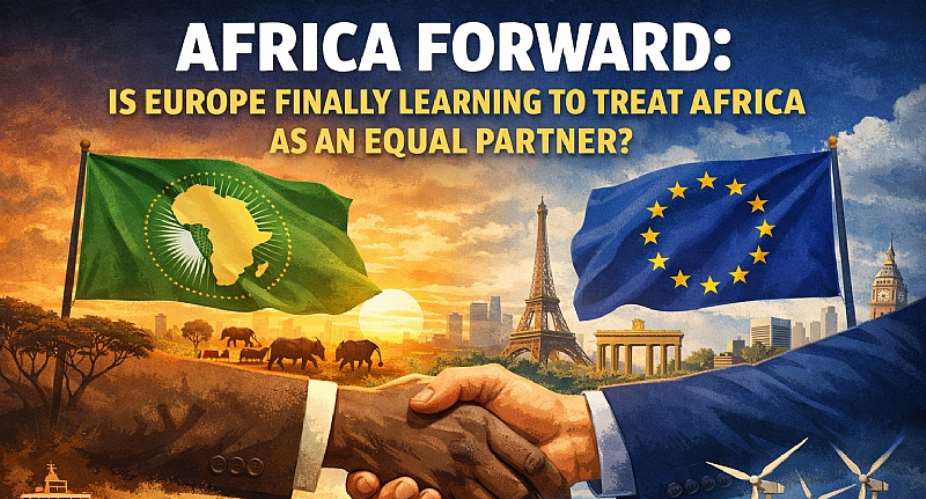
For decades, Africa's summits with external powers have followed a familiar script. African leaders fly to Paris, Brussels, Washington, Beijing, Moscow or New Delhi; their hosts roll out the red carpet, deliver speeches about partnership, announce ambitious initiatives and pose for the customary family photograph. Communiqués are issued, declarations adopted, and everyone returns home—yet little changes. Investment gaps stay wide, trade stays lopsided, industrialisation crawls, and Africa keeps exporting raw materials while importing finished goods.
That is why the Africa Forward Summit, held in Nairobi on 11 and 12 May 2026, deserves attention; not because Africa needs another summit, but because it signals a possible shift in how Europe, and France in particular, sees the relationship. The symbolism was hard to miss. For the first time, a summit between Africa and France was jointly chaired on African soil with an anglophone African state. President William Ruto of Kenya and President Emmanuel Macron of France stood not as host and guest, but as partners on the same platform. Africa was not summoned to Europe; Europe was invited to Africa. Yet symbolism is not changed. Nairobi will matter only if equality and genuine reciprocity outlast the communiqué.
The more telling shift was in the cast. Summits between Africa and Europe have long belonged to presidents, diplomats and development agencies, with the private sector seated politely at the back. This time, business sat at the centre. The Inspire and Connect forum gathered heads of state alongside scores of African and French company chiefs to discuss industrialisation, value chains, energy and human capital. The message was blunt: the future should rest less on aid and charity between states, and more on investment, entrepreneurship and industrial partnership. African governments no longer seek the role of recipients; they want capital, technology, expertise and market access. Where old summits asked what Europe could do for Africa, this one asked a sharper question: what can African and European firms build together?
There were numbers to match the rhetoric: roughly €23 billion, about $27 billion, in fresh commitments, comprising some €14 billion from French public and private actors and €9 billion from African investors, aimed at energy, digital technology, artificial intelligence, agriculture, health and industry. More striking than the figures was the emphasis. French and European firms voiced interest in investing and producing alongside African companies inside Africa, rather than merely selling into its markets. The most concrete example came from Nigeria, where Accor and the African energy and infrastructure group Shoreline signed a letter of intent for the country's first national hotel platform: a $300 million project of ten hotels across eight cities, more than 1,200 rooms by 2030, with a training academy to build local skills.
If such partnerships multiply across manufacturing, agriculture, energy, health and digital technology, Africa could enter a new phase of competition. Unlike the scramble of the nineteenth century, driven by extraction and conquest, this one would turn on investment, production, and market opportunities, with Europe, China, the Gulf, India, and Türkiye all competing for a seat at the table. African governments may be better placed than ever to play these suitors against one another in their own interest. The question is no longer who claims to be Africa's best friend, but who will invest, produce, transfer technology and create jobs.
Here lies the lesson Africa keeps relearning: a good partner is not the one you like most, but the one who brings you the most advantage. France's history on the continent is singular, not because of a colonisation now decades past, but because the relationship that followed it never truly ended. Several capitals took the easy road, leaning on Paris for their security and quietly surrendering a slice of their sovereignty, while Paris was content to play suzerain. In 2013, Mali hailed France as its saviour when French troops drove back the jihadists closing on Bamako; a few years later, its junta cast that same France as worse than the seven plagues of Egypt. Such incestuous, melodramatic attachments had to end. External powers are neither saviours nor devils; they are partners pursuing their interests, as African states pursue theirs.
That is why Africa can no longer tolerate the old arrangements: military protectorates dressed up as protection; the abuses of foreign mercenaries in its conflict zones; or the economic colonisation that surrenders strategic assets, ports, airports, and railways to whichever state writes the cheque. The withdrawals from Mali, Burkina Faso and Niger were not merely a rejection of France; they marked the exhaustion of a framework inherited from colonial times that no longer fits African aspirations. If Nairobi means anything, it is that Paris may finally grasp that the age of the suzerain is over. France matters here for one further reason: it is a gateway to the wider European market. Should its approach shift from paternalism to brokering business between African and European firms, that would be welcome news for both continents.
Africa's most urgent task is economic transformation. With millions of young people entering the labour market each year, the world needs productive capital, industry, technology transfer, and jobs; aid alone has never delivered these. What it seeks now is straightforward: investment without domination, cooperation without dependency, partnership without paternalism. Like Saint Thomas, Africans will believe what they eventually see rather than what they are promised. The elegance of its communiqué will not judge the summit, but by visible progress: in artificial intelligence, where Africa must become a creator and not merely a consumer; in infrastructure, the roads, railways, ports, power and connectivity that carry an economy; in food systems, through higher local output and lighter dependence on imports; and in industry, the move beyond raw exports toward manufacturing and value addition.
History will not remember what was promised in Nairobi. It will remember what was built, what was transformed, and what was delivered. Until then, Africa will watch carefully.
Joseph McCarthy is an analyst and researcher specialising in governance, security, and political transitions in the Sahel. He writes on geopolitics, development, and African diplomacy. Email: [email protected]

 Ghana Medical Trust Fund briefs Otumfuo on progress, vision for expanding specia...
 KGL partners Ghana Medical Trust Fund to build ultra-modern diagnostic centre at...
 Finance Ministry tables six bills in Parliament to tighten revenue collection, r...
 Second batch of Ghanaians evacuated from South Africa expected home today
 Indian education minister resigns after mass protests over exam paper leaks
 Gbese Court Orders Extradition Of Alleged Abu Trica Accomplice To U.S. In $8m Ro...
 Gov’t Taskforce Storms Accra With Demolitions, Dredging In Massive Anti‑Flood Bl...
 Wontumi Sentence A “Turning Point” In Galamsey Fight — UESD Lecturer Says Financ...
 Health Minister Updates Asantehene On Sweeping Reforms: “No Ghanaian Should Be D...
 Afenyo‑Markin Explodes In Parliament: “Mahama’s Mid‑Year Budget Is A Third‑Term ...

