




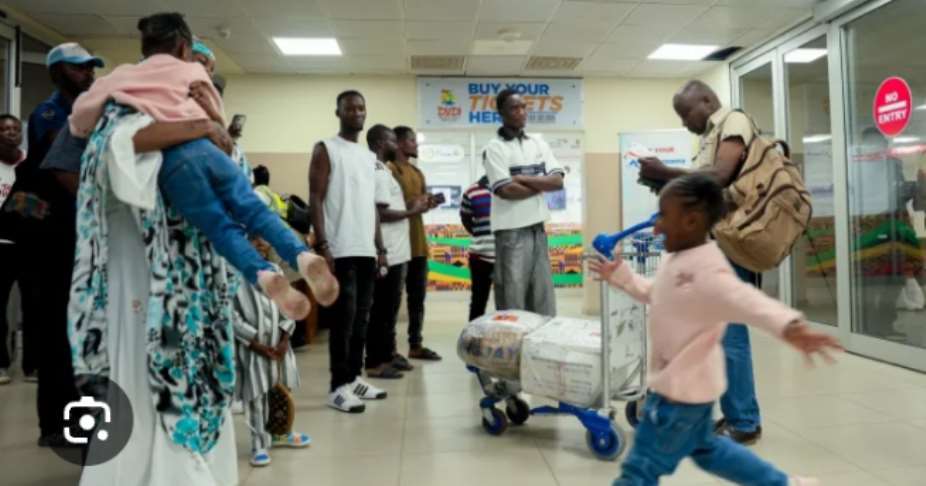
As Accra receives its expelled sons and daughters, the harder question is what becomes of the economic niches they leave behind and whether South Africa's self-inflicted wound will heal
The patriotic songs blasting through the speakers at Accra International Airport on Wednesday carried a bittersweet melody. A plane carrying 300 Ghanaian nationals evacuated from South Africa due to anti-immigration protests had touched down in Accra, the group including women and children who arrived following weeks of rising xenophobia that left migrants facing harassment, job losses and violence.
Ghana's Foreign Minister Samuel Okudzeto Ablakwa was there to receive them but his presence, however reassuring, could not mask the weight of what the moment represented: the involuntary unraveling of a decades-long African migration story.
The returnees were not tourists overstaying a welcome. They were breadwinners, traders, artisans and entrepreneurs who had carved out livelihoods thousands of kilometers from home, only to be driven back by a tide of fear that their host country insists is not xenophobia.
The South African government has rejected all characterizations of xenophobia, with presidential spokesman Vincent Magwenya telling reporters that South Africans are not xenophobic and framing the protests as "pockets of protest" permissible within the constitutional framework.
Magwenya went further, shifting the analytical focus away from domestic bias toward what he described as broader structural failures across the continent conflict, instability, and cases of "misgovernment" driving waves of migration.
It is a convenient deflection. It also happens to contain a grain of truth but not in the way Pretoria intends.
THE PRESSURE BEHIND THE PROTESTS
South Africa's recurring xenophobic cycles is not born of cultural hatred alone. They are the political expression of an economy that has failed its own people. Unemployment is running at 30 percent, fuelling a zero-sum perception of economic survival among disenfranchised locals, with migrants blamed for scarcity that is in fact the product of decades of post-apartheid structural failure.
The scapegoat is a migrant trader in Johannesburg; the real villain is an economic model that left millions of Black South Africans behind even after liberation.
This displacement crisis fits into a well-documented historic cycle. In the worst violence against immigrants in the post-apartheid era, 62 people were killed in 2008. The structural drivers of that catastrophe were never fully resolved, leading to recurring crises with violent clashes erupting again in 2015, 2016 and 2019.
Each time, African governments have lodged diplomatic protests. Each time, South Africa has issued partial apologies. Each time, the cycle begins again.
This time, Ghana has acted differently not with rhetoric alone, but with aircraft.
THE EVACUATION AND WHAT IT COSTS GHANA
Out of an estimated 25,000 Ghanaians currently living in South Africa, hundreds abandoned their livelihoods to seek safety back home. South Africa's Border Management Authority revealed that about 90 percent of Wednesday's travelers were undocumented, with most having overstayed a visa by more than 30 days and some by a year or more. Ghana's High Commissioner to South Africa, Benjamin Quashie, however, placed part of the blame on Pretoria itself, criticizing South African authorities for backlogs in immigration processing for those seeking to renew their permits.
The economic consequences of this forced homecoming are far from trivial. For decades, the Ghanaian diaspora in South Africa served as a vital financial lifeline, sending home millions of dollars annually in remittances that directly funded local real estate developments, family healthcare, and school fees in regions like Greater Accra and Ashanti. The abrupt severance of those income streams is not merely a personal tragedy for individual families it is a macroeconomic shock landing on a country already managing a complex post-IMF recovery.
The government is aware of this. Foreign Minister Ablakwa announced psycho-social support and financial reintegration packages for the returnees (Vanguard News) , while High Commissioner Quashie said the government is willing to establish returnees in whatever business they were engaged in while in South Africa.
Good intentions. The test will be in delivery.
THE QUESTION SOUTH AFRICA HAS NOT ANSWERED: WHO FILLS THE VOID?
Here is the dimension of this crisis that Pretoria's spokesmen have not publicly reckoned with: the economic spaces vacated by Ghanaians and by Nigerians, Zimbabweans, and Malawians facing the same pressures do not simply disappear. Markets abhor a vacuum. The hairdressing salons, the wholesale food stalls, the informal logistics networks, and the cross-border trade operations someone will fill them.
The uncomfortable irony that South African xenophobia has never fully confronted is that many of the business roles occupied by migrants exist precisely because local South Africans had not occupied them. Migrant entrepreneurs often established businesses in under-served townships and peri-urban zones where formal capital and corporate investment never reached. They served populations that formal South Africa ignored. Their expulsion, far from opening jobs for locals, is more likely to create service deserts that will be filled not by struggling South African youth but by migrants from a different geography, or by larger corporate interests moving in on cleared terrain.
Pan-African ideals are clashing sharply with economic realities and the result is a continent-wide humiliation dressed up as constitutional protest.
GHANA'S HARDER RECKONING
The returnees singing on the tarmac in Accra deserve their welcome. But Ghana's government must now ask itself an equally uncomfortable question: why did 25,000 Ghanaians need to be in South Africa in the first place?
Remittances remain crucial to Ghana's domestic economy, contributing $4.6 billion in 2022 three times the country's official development assistance.
That figure does not reflect charity it reflects the productive labour of Ghanaians who could not find comparable economic opportunity at home and were forced to seek it thousands of kilometers away, in a country that ultimately did not want them.
The repatriation flights are a necessary act of statecraft. They are also an implicit indictment of the structural conditions at home that made departure attractive in the first place. The government's reintegration packages, if properly funded and implemented, offer a rare opportunity: to redirect skilled and experienced labour people who built businesses in one of Africa's most competitive markets back into Ghana's own economy.
The returnees know how to survive in difficult markets. They understand supply chains, informal credit networks, and cross-border commerce. Ghana should treat them not as rescued victims but as returning assets.
THE BROADER AFRICAN FAILURE
The latest tensions have revived uncomfortable debates across Africa about xenophobia, migration, and the gap between pan-African rhetoric and the realities facing migrants on the ground. The African Union's founding vision of a continent in which Africans move freely across borders, invest in each other's economies, and build shared prosperity is being systematically dismantled not by external enemies but by internal contradictions: unemployment, governance failure, and the politics of scapegoating.
South Africa, which once symbolized the moral pinnacle of Africa's liberation struggle, increasingly risks becoming the continent's most visible rebuke of pan-Africanism. It received the solidarity of the entire continent during the anti-apartheid struggle. It now responds to that history by expelling the descendants of those who stood with it.
The Ghanaians who landed in Accra on Wednesday evening did not need to be there. They needed to be in a South Africa that honored its African commitments, or in a Ghana that gave them sufficient reason to stay. Both countries have some accounting to do.
Foreign Minister Ablakwa's words at the airport "if you mess around with Ghanaians anywhere in the world, thinking that they are orphaned or nobody cares about them, you are mistaken" were the right words for the moment. The harder words, the ones Ghana and Africa must now speak to themselves, are about why this moment keeps happening and what structural changes will ensure it does not happen again.
The songs at Kotoka were patriotic. The policy response must be practical.
Mustapha Bature Sallama.
Medical/ Science Communicator,
Private Investigator, Criminal investigation and Intelligence Analysis.
International Conflict Management and Peace Building.USIP
[email protected]
+233-555-275-880


 NPP rejects Mahama's appointment of Emelia Agbenyo as EC deputy, demands withdra...
 Excessive consumption of processed meat can expose one to cancer – Health expert...
 Education Minister appeals to University Administrators to call off strike, resu...
 'You're doing yeoman’s job' — Mahama lauds Police over declined unresolved murde...
 Wilmar Africa, De Heus, other food processing companies face CID action over dat...
 NPP’s Baba Amando runs to police over alleged death threats
 Ghana repatriates 120 Nigerians arrested in cybercrime operations
 PIAC unable to verify GH¢21million petroleum-funded projects in Ayawaso West
 Wontumi pleads not guilty to five charges in GH¢30m Exim Bank fraud case
 Ghana among stronger-performing economies in sub-Saharan Africa — IMF


