




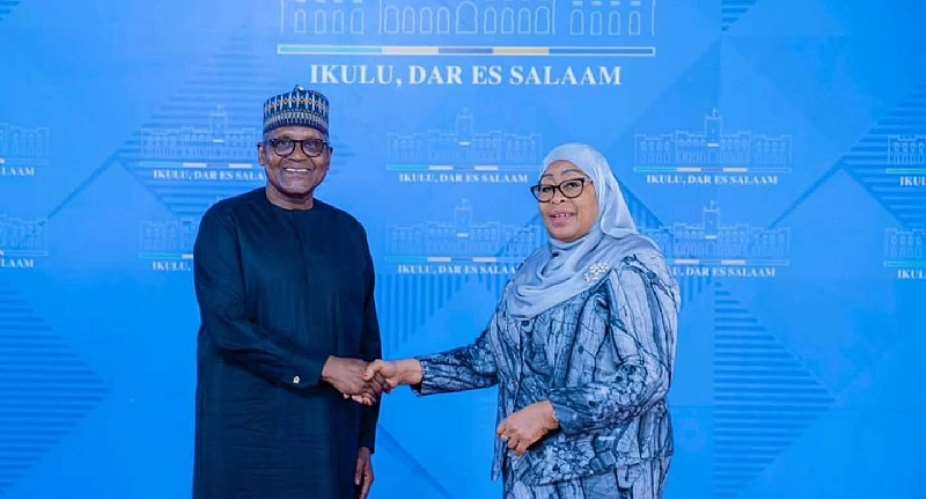
The meeting at State House in Dar es Salaam on May 16, 2026 was brief, closed-door, and stripped of fanfare. Yet it carried unmistakable diplomatic weight. President Samia Suluhu Hassan held talks with Nigerian billionaire Aliko Dangote, Founder and Chairman of the Dangote Group, and his delegation, at the State House in Dar es Salaam a face-to-face encounter that Tanzania's government clearly judged necessary to protect its interests in one of the most consequential investment decisions in East African history.
The meeting came at a moment of acute regional turbulence. Within a matter of weeks, the proposed site of what would be Africa's second mega-refinery had migrated in public statements from Tanzania's Tanga to Kenya's Mombasa driven by a combination of Dangote's infrastructure calculations, Kenyan diplomatic agility, and a serious protocol breakdown that had left President Samia furious and Tanzania looking like a bystander in a project ostensibly meant for its own soil.
The Summit That Started It All
The sequence of events begins on April 23, 2026, at the JW Marriott in Nairobi, during the inaugural Africa We Build Summit hosted by the Africa Finance Corporation. Dangote appeared on a panel alongside Kenya's President William Ruto and Uganda's President Yoweri Museveni, and made a bold statement that caught the room off guard. "My commitment is, if we agree here with the three or four governments, we will lead and make sure that the refinery is built within the next four to five years," he told the assembled heads of state. At the time, the location being discussed was Tanga.
Dangote urged Ruto and Uganda's President Yoweri Museveni to support a similar facility to his Nigerian refinery, and said Africa had the capacity to finance large-scale industrial projects without heavy reliance on external investors. President Ruto publicly backed the Tanga proposal that day, framing it as a joint regional project.
Ruto doubled down five days later. At the Kenya Mining Investment Conference and Expo in Nairobi on April 28, 2026, he said the four countries had agreed in principle to develop a shared refinery. "We're going to have a joint refinery in Tanga to benefit all of us because that refinery is going to take on board the oil from DRC, the oil from Kenya, the oil from South Sudan, and the oil from Uganda. We have made the decision that we are going to do this together," he disclosed. The problem was self-evident almost immediately. Tanzania had not made any such decision.
The Public Dressing-Down
The diplomatic reckoning came during the Kenya-Tanzania Business Forum at the Julius Nyerere International Convention Centre in Dar es Salaam on Monday, May 4, 2026. In a subtle tone a pointed broadside delivered in Kiswahili Suluhu publicly questioned Ruto's announcement. "While we were speaking inside, I pressed Ruto and asked him: you went ahead and announced a refinery in Tanga why was I not aware? He will explain, himself, why he made that announcement," she said.
It was, by any measure of East African diplomatic convention, a remarkable moment. Presidents do not publicly embarrass counterparts on their official state visits without calculation. Suluhu's 20-second rebuke in Kiswahili was not an oversight or an emotional outburst it was a deliberate signal, to Dar es Salaam's domestic audience and to the broader region that Tanzania would not be written into other people's press releases.
Ruto, for his part, acknowledged the concerns in his response. "I have been informed that my decision to announce the building of a refinery in Tanga has not sat well with you, Tanzanians. The private sector has made it clear that the continued export of raw materials results in exporting jobs, opportunities and wealth, while importing inflation, an approach that is counterproductive. I have engaged with Tanzanian leadership on the need for the country to take the lead in ensuring that regional resources are used effectively," he said.
The two leaders subsequently witnessed the signing of eight bilateral agreements. The memoranda of understanding covered energy, legal cooperation, agriculture, railway development, public service capacity building, and maritime affairs and standards harmonization. A key agreement between the Kenya Bureau of Standards and Tanzania Bureau of Standards established a joint framework to reduce duplication in certification at border points, while another focused on reviving the Voi–Mwatate–Taveta railway line and linking it to the Standard Gauge Railway to improve freight movement to northern Tanzania. But the refinery question remained conspicuously unresolved.
Dangote Pivots to Mombasa
Six days after the Dar es Salaam summit, Dangote told the Financial Times he was leaning toward Kenya's port city of Mombasa as the site for the proposed refinery a significant shift away from Tanzania's Tanga port. "I'm leaning more towards Mombasa because Mombasa has a much larger, deeper port. Kenyans consume more. It's a bigger economy," he said.
The commercial logic was unsparing. A 650,000-barrel-per-day facility requires the kind of VLCC (Very Large Crude Carrier) draft clearances that Tanga, still a developing port, struggles to offer. Mombasa's Kilindini Harbour, by contrast, is East Africa's busiest deep-water terminal and already handles the bulk of the region's petroleum imports. Beyond port infrastructure, Dangote pointed to economic scale a reference to Kenya's position as East Africa's largest economy by GDP and its established petroleum distribution network, which already serves Uganda, Rwanda, and South Sudan through the Port of Mombasa pipeline system.
Dangote was equally direct about what he needed to proceed: land, a contribution from East African governments toward financing, and, critically, protection against the dumping of cheap refined fuel from Russia and India. "There is no refinery in the world that can survive without that protection," he said. "If we have an agreement, we can start this year." He placed the entire decision with Kenya's president. "The ball is in the hands of President Ruto.
Whatever President Ruto says is what I'll do." He left a narrow opening for Tanzania, saying he could still site the refinery there "if they can sort themselves out."
Samia's Countermove
Tanzania's response to this unfolding loss of leverage was the May 16 meeting. During the meeting at State House, Suluhu described Dangote as one of Tanzania's key investors, citing his cement factory in the Mtwara region. "Dangote is one of the major investors in Tanzania, where his cement factory in the Mtwara region is boosting our economy through the cement trade and employment for Tanzanians," she said.
The framing was deliberate: Tanzania was reminding Dangote of an existing relationship, not just competing for a new one. The cement factory in Mtwara represents years of operational history, local employment, and embedded supply chains precisely the kind of foundation that a billionaire building a 650,000-barrel-per-day refinery might factor into a site decision that is as much about long-term political reliability as it is about port depth.
The State House in Dar es Salaam released no detailed outcomes from the session. By 13:00 East African time on the day of the meeting, the State House had not disclosed details, with photographs released showing both sides in discussion. The silence was itself informative: Tanzania was not yet in a position to announce a breakthrough, but was clearly no longer content to watch events unfold from the sidelines.
The EACOP Variable
Underpinning Tanzania's position is a piece of infrastructure that neither Mombasa's port depth nor Kenya's consumer market can easily replicate. Tanzania and Uganda are in the process of finalising the East African Crude Oil Pipeline (EACOP), which runs from Hoima in Uganda to Chongoleani in the Tanga Region. Uganda's Hoima oil fields are expected to produce about 230,000 barrels of oil per day once commercial production begins later this year. EACOP is jointly owned by TotalEnergies with a 62 per cent stake, while the Tanzania Petroleum Development Corporation and the Uganda National Oil Company each hold 15 per cent, and China National Offshore Oil Corporation owns the remaining 8 per cent.
That pipeline and the crude it will move is an argument for Tanga that no FT interview can neutralize. A refinery at Mombasa would require Ugandan crude to travel overland or be re-shipped by sea at significant additional cost. Tanga, as the EACOP terminus, would receive that crude by pipe a logistical advantage that becomes more compelling as Uganda's production ramps up.
For Tanzania, the project is a diplomatic setback. President Samia Suluhu's expression of surprise at the Tanga proposal suggests that coordination between Nairobi and Dodoma was weaker than Ruto had assumed. Tanzania may respond by accelerating its own energy infrastructure plans, including developing its offshore gas resources and building a liquefied natural gas export facility. The
Larger Stakes
East Africa currently imports every liter of refined petroleum it consumes, mainly from the Middle East, making the region one of the most energy-vulnerable in the world. Supply disruptions and price spikes linked to regional instability have rippled through East Africa's fuel markets, hitting transport costs, food prices and household budgets hard.
The Nigerian billionaire has repeatedly warned that Africa risks becoming a dumping ground for imported refined petroleum products if governments fail to support local refining and industrial investments. That warning resonates differently in Dar es Salaam and Nairobi but both capitals understand that the stakes of getting this decision wrong extend well beyond the refinery itself.
Bilateral trade between Kenya and Tanzania reached $860.3 million in 2025, accounting for nearly 40 per cent of intra-EAC trade, making the two countries the bloc's largest trading partners. A refinery sited in either country would reshape that relationship in ways that neither set of economists has yet fully modeled.
What is clear is that the race is not over. Dangote has conditionalized his commitment on political decisions yet to be made. Ruto has not yet produced a formal offer. And Samia, having absorbed a public slight from a neighbor and watched the investment briefly slip toward Mombasa, is now making her case directly not through intermediaries, not through diplomatic communiqués, but in person, across the table at State House.
That she chose to meet Dangote at this particular moment, days after he told the world his preference had shifted, says everything about her intent. Tanzania is not conceding the refinery. It is negotiating for it.
Mustapha Bature Sallama.
Medical/ Science Communicator,
Private Investigator, Criminal investigation and Intelligence Analysis.
International Conflict Management and Peace Building.USIP
[email protected]
+233-555-275-880


 FDA confiscates fish processed under unhygienic conditions after viral video at ...
 AU expresses solidarity with Spain, France over deadly wildfires
 Parliament, UNICEF launch caucus to champion children's rights
 'Our leaders think backwards' — Kofi Bentil slams AMA for threatening arrest ove...
 'On July 30 we will go to Gomoa Mpota to bury my late father' — Adwoa Safo dismi...
 Archbishop of Canterbury pays courtesy call on Mahama
 Govt awaits autopsy report in South Africa death case
 Court dispute halts Apostle Kwadwo Safo’s burial set for July 30 as family seeks...
 At the appropriate time NPP will take on NDC govt for deceiving Ghanaians — COKA
 ‘We will invoke our unforgiving gods to deal with you’ – Atronie chiefs warn gal...

