




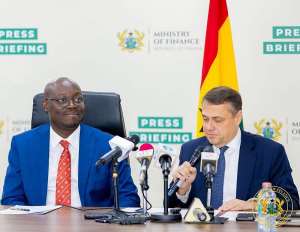
Ghana has ruled out any return to the international capital market in 2026, signalling a significant shift in the country’s post-bailout financing strategy following the conclusion of its three-year Extended Credit Facility programme with the International Monetary Fund (IMF).
Finance Minister Dr Cassiel Ato Forson said although Ghana would maintain close engagement with the IMF after the current programme, government has no immediate plans to seek another bailout arrangement or issue fresh Eurobonds on the international market.
Instead, government intends to transition onto the IMF’s non-financing Policy Coordination Instrument (PCI), a framework designed to support policy credibility and macroeconomic discipline without direct financial assistance from the Fund.
The announcement represents one of the clearest indications yet that authorities are seeking to reduce Ghana’s dependence on external commercial borrowing after the country’s debt restructuring exercise and prolonged exclusion from the global capital market.
Addressing journalists at a joint press conference with the IMF Mission in Accra, Dr Forson stressed that the Mahama administration was prioritising fiscal stability over aggressive borrowing despite signs of improving investor confidence in Ghana’s economy.
“We are not in a hurry to go unto the International Capital markets and if we find a need to go to the international capital markets we will accordingly inform the people of Ghana,” he stated.
The Finance Minister further disclosed that government’s 2026 budget assumptions do not include any form of external commercial borrowing, effectively ruling out a Eurobond issuance for the year.
“One thing is for sure, the 2026 budget never assumed that we are going to the international capital markets for any form of financing, so it is off the table for at least for this year,” he added.
The comments are expected to reassure investors and multilateral institutions that have consistently cautioned Ghana against a premature return to the international debt market before consolidating gains made under the debt restructuring programme.
Dr Forson, however, left open the possibility of a return to the market in the medium term, explaining that future decisions would depend on financing conditions and the government’s economic priorities.
“In the medium term it will depend on what the government seeks to do so I can assure that we are not in a hurry to go back to the International capital markets,” he said.
Ghana has remained shut out of the international debt market since 2022 after losing market access amid rising debt levels, sharp currency depreciation and weakening investor confidence, which eventually pushed the country into debt restructuring negotiations with domestic and external creditors.
Government’s decision to adopt the Policy Coordination Instrument instead of pursuing another bailout programme is also being interpreted as a sign that authorities believe Ghana has moved beyond the emergency phase of its economic crisis.
Under the PCI arrangement, the IMF will continue to monitor and assess Ghana’s macroeconomic reforms without providing direct financial support.
For his part, IMF Mission Chief to Ghana, Dr Ruben Atoyan, maintained that any future decision regarding Ghana’s return to the international capital market rests solely with the government.
“In terms of the access to the capital market, it is a sovereign decision for Ghana,” he stated.
 Allow the law to deal with defilement perpetrators - Director tells families
 Gov’t to develop policy for Ghanaian sign language in education
 Two Ada SHS students plead guilty to assault, slapped with 12-month bond
 Enlistment: GAF begins documentation, body selection from September 28
 Violent rainstorm rips off roofs, displaces residents in Krachi Nchumuru
 Ghana risks EU gas market access over methane emissions
 Tumu landlord gives road encroachers 2-week ultimatum to relocate for road const...
 Serbian President Aleksandar Vucic resigns
 Tigray TV station hit by drone, rebels advance in north Ethiopia
 Swiss reject plan to toughen neutrality


