




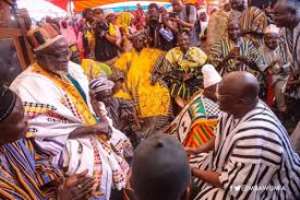
In Ghana’s complex traditional governance system, few issues test the nation’s constitutional balance, ethnic sensitivities, and peace architecture more than chieftaincy disputes. These conflicts are often more than contests over skins, stools, or titles; they touch identity, history, political representation, land ownership, and community legitimacy. Among all such disputes in recent memory, the crisis in Bawku remains one of the most explosive and emotionally charged. Over the years, the conflict has claimed lives, displaced families, disrupted economic activity, and placed enormous pressure on national security structures. Yet beyond the violence itself lies another debate. One that has increasingly captured public attention across Ghana. Was the mediation role played by Otumfuo Osei Tutu II merely a pragmatic search for peace, or did it create a precedent that raises uncomfortable questions about constitutional consistency and selective justice? The issue is sensitive. It demands caution, fairness, and intellectual honesty. In a country where traditional authority still commands enormous influence, discussions around mediation and jurisdiction can easily become politicized or ethnically interpreted. But analysts say the national conversation should not be avoided simply because it is uncomfortable.
The Weight of Bawku
The Bawku conflict predates Ghana’s Fourth Republic and has roots stretching deep into colonial administrative arrangements, ethnic contestation, and disputes over traditional legitimacy between the Mamprusi and Kusasi groups. Over successive governments, attempts at resolution have included commissions of inquiry, military deployments, curfews, judicial processes, peace councils, and political negotiations. Despite these interventions, tensions have repeatedly resurfaced.
Security analyst Kwesi Aning has often argued that conflicts like Bawku cannot be viewed solely through a security lens because they are deeply tied to identity, governance, and historical grievances. Similarly, political scientist Ransford Gyampo has repeatedly emphasized in public discussions that Ghana must strengthen institutions in a manner that preserves both constitutional order and social cohesion. It was against this difficult background that the state turned to the Asantehene as mediator. For many observers, the decision reflected one undeniable reality. Ghana’s political leadership was searching for a figure with enough moral authority, national respect, and perceived neutrality to bring the feuding sides to dialogue.
Formal Authority versus Moral Influence
The controversy surrounding the mediation largely stems from a distinction many Ghanaians continue to debate. Does moral influence amount to constitutional authority? Legally, Ghana’s chieftaincy framework provides institutional mechanisms for resolving disputes through the National and Regional Houses of Chiefs, supported where necessary by the courts. Critics therefore argue that the Asantehene had no direct constitutional jurisdiction over Bawku’s traditional affairs.
Others counter that he was not acting as a judicial authority but rather as a peace mediator invited to facilitate dialogue. That distinction is crucial. Professor H Kwasi Prempeh has consistently stressed in governance discussions that constitutional democracies must carefully balance formal legal structures with practical mechanisms for national stability.
In many African societies, traditional diplomacy has historically complemented state institutions, especially in conflict resolution. Ghana itself has witnessed several moments where influential chiefs, religious leaders, and elder statesmen stepped beyond their immediate jurisdictions to mediate national tensions. Supporters of the Bawku mediation therefore see the Asantehene’s role as part of a broader African tradition of consensus-building rather than constitutional overreach.
The Selective Justice Question
Yet critics remain uneasy. Their concern is not necessarily about the personality of the Asantehene himself, but about consistency. If the state allows extraordinary mediation arrangements in one chieftaincy dispute, should the same flexibility apply to all comparable conflicts? This is where the debate becomes nationally significant. Observers point to historical and ongoing disputes in areas such as Dagbon, Nkonya-Alavanyo, Bimbilla, Sefwi, and other traditional areas where tensions periodically emerge.
Some ask: Why does one conflict attract extensive national intervention while others appear left to local institutions or prolonged litigation? Others worry that inconsistent approaches may create perceptions, fair or unfair, that some traditional authorities possess broader national legitimacy than others. Political sociologist E Gyimah-Boadi has long argued that public confidence in democratic governance depends heavily on institutional fairness and equal treatment under national systems. In deeply divided conflicts, even perceptions matter. Where citizens begin to believe that rules shift depending on political pressure, influence, or the personalities involved, trust in institutions can weaken.
Peace versus Procedure
Still, defenders of the mediation process argue that rigid procedural purism may not always deliver peace in fragile environments. The Bawku conflict has repeatedly demonstrated the limits of conventional state interventions. Security crackdowns alone have not produced lasting calm. Court rulings have often failed to settle underlying grievances. Political actors themselves are frequently accused by local populations of bias or inconsistency. In such situations, governments sometimes turn to what conflict experts call “non-state legitimacy.”
This refers to respected figures whose authority derives not from constitutional text alone but from public trust, historical stature, and perceived neutrality. International conflict resolution scholar John Paul Lederach has written extensively on the role of culturally respected intermediaries in divided societies, arguing that sustainable peace often depends on trusted local or symbolic actors who can bridge institutional distrust. Seen through that lens, the Asantehene’s involvement may represent less a constitutional anomaly and more an attempt at pragmatic peace building. The challenge, however, lies in ensuring that pragmatism does not undermine legal clarity.
A Dangerous Precedent --- or a Useful Model?
Whether the Bawku process becomes a dangerous precedent or a useful national model may ultimately depend on its outcome. If the mediation contributes to durable peace, reconciliation, and reduced violence, future governments may increasingly rely on eminent traditional figures to intervene in difficult conflicts. But if the process is perceived as biased, inconclusive, or politically manipulated, critics may cite it as evidence that Ghana selectively bends its own rules when convenient.
There is also concern among governance experts that overreliance on informal mediation risks weakening formal institutions that are constitutionally mandated to handle chieftaincy disputes. Professor Kwaku Asare has frequently argued in governance commentary that democratic societies must avoid situations where institutional authority becomes overshadowed by personalities, regardless of how respected those personalities may be. The dilemma therefore is not simple. Ghana must simultaneously preserve constitutional order, respect traditional systems, prevent violence, and maintain national cohesion. Balancing all four is extraordinarily difficult.
The Historical Sensitivity of Chieftaincy
Unlike ordinary political disagreements, chieftaincy conflicts often carry historical memories stretching back generations. In many traditional areas, disputes are tied to ancestral legitimacy, colonial-era administrative decisions, migration narratives, land boundaries, and ethnic identity. As a result, legal rulings alone do not always heal emotional and historical wounds. This partly explains why some peace building experts support mediation frameworks that combine legal processes, traditional dialogue, local consultations, and symbolic reconciliation. The National Peace Council has repeatedly emphasized the importance of community ownership in conflict resolution, particularly in northern Ghana where historical grievances often intersect with socioeconomic frustrations and political competition.
Could the Bawku Approach Be Replicated?
The broader national question now emerging is whether Ghana should formalize a system where eminent traditional leaders can mediate conflicts outside their immediate jurisdictions. Some analysts believe this could strengthen indigenous peace building mechanisms. Others fear it may blur constitutional boundaries. A possible middle ground, according to governance observers, would involve clearly defined mediation mandates, consent of all disputing parties, parliamentary or judicial oversight where necessary, and transparent frameworks that prevent accusations of favoritism. Such reforms could allow Ghana to benefit from respected traditional diplomacy while still protecting institutional integrity. Importantly, neutrality would remain essential. No mediation effort can succeed if either side believes the process is predetermined.
Beyond Bawku: The Bigger National Lesson
Perhaps the most important lesson from the Bawku debate is not about one king, one government, or one conflict. It is about the evolving relationship between traditional authority and constitutional democracy in modern Ghana. For decades, Ghana has managed to maintain relative stability partly because it blended formal democratic governance with enduring respect for traditional leadership.
But as conflicts become more complex and politically sensitive, the country may need clearer national frameworks defining when extraordinary mediation is appropriate, who may lead it, and how consistency can be maintained across regions. Without such clarity, accusations of selective justice will continue to surface whenever exceptional arrangements are introduced.
The Need for National Fairness
Ultimately, peace processes succeed not only because they end violence but because they are seen as fair. In divided societies, perception can be as powerful as legality. If citizens believe that similar conflicts receive different treatment based on political influence or traditional hierarchy, national cohesion can suffer. At the same time, refusing pragmatic peace initiatives simply because they fall outside rigid institutional patterns may also prolong suffering in conflict zones. Ghana therefore faces a delicate balancing act. The country must avoid two extremes. Constitutional rigidity that ignores practical realities, and political flexibility that weakens institutional credibility. The Bawku mediation debate sits precisely at that intersection.
My Thoughts: Peace Must Walk Together With Justice
The Bawku crisis remains one of Ghana’s deepest national wounds. Every effort toward peace deserves serious consideration. Yet peace building in democratic societies must also preserve public trust in fairness, consistency, and institutional legitimacy. Whether history ultimately judges the mediation initiative as visionary statesmanship or problematic precedent will depend largely on one question: Did it strengthen both peace and justice simultaneously? For now, the debate continues. And perhaps that debate itself is healthy. Because in democracies, difficult questions about authority, fairness, and national consistency should never be silenced. They should be examined carefully, respectfully, and without prejudice. Only then can Ghana continue building a republic where peace is pursued not selectively, but equitably, and where justice is not only done, but seen to be done.
FUSEINI ABDULAI BRAIMAH
+233208282575 / +233550558008
[email protected]


 FDA confiscates fish processed under unhygienic conditions after viral video at ...
 AU expresses solidarity with Spain, France over deadly wildfires
 Parliament, UNICEF launch caucus to champion children's rights
 'Our leaders think backwards' — Kofi Bentil slams AMA for threatening arrest ove...
 'On July 30 we will go to Gomoa Mpota to bury my late father' — Adwoa Safo dismi...
 Archbishop of Canterbury pays courtesy call on Mahama
 Govt awaits autopsy report in South Africa death case
 Court dispute halts Apostle Kwadwo Safo’s burial set for July 30 as family seeks...
 At the appropriate time NPP will take on NDC govt for deceiving Ghanaians — COKA
 ‘We will invoke our unforgiving gods to deal with you’ – Atronie chiefs warn gal...

