




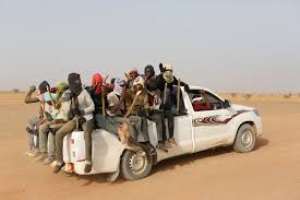
In the dusty outskirts of Tamale, 24-year-old Azindow scrolls endlessly through TikTok videos showing migrants crossing the Sahara Desert. Some videos display overcrowded boats drifting helplessly on the Mediterranean Sea; others show young Africans smiling in Italy or Germany, proudly displaying new jobs, apartments, and designer clothes. For many West African youth, these clips have become digital recruitment posters for migration. Azindow is a graduate. Yet his university degree sits idle in a brown envelope, while his hopes slowly evaporate under the crushing weight of unemployment and underemployment. “If I stay here, I am already dead,” he says quietly, staring at his phone. “In Europe, even if I die, I died trying to live.” His words capture the emotional crisis confronting thousands of young people across Ghana, Nigeria, Senegal, Gambia, Mali, and other West African countries. Their frustration raises a deeply uncomfortable question. If democracy is truly delivering freedom and development, why are so many young Africans risking death to escape democratically governed states? For over three decades, West Africa has celebrated democratic transitions, constitutional rule, and periodic elections. International observers regularly praise countries like Ghana as “beacons of democracy.” Yet beneath the applause lies a painful contradiction. Democracy has expanded political rights faster than economic opportunity. The result is a generation that can vote freely but cannot find dignified work. According to the International Labour Organization, youth unemployment and vulnerable employment remain among the highest socio-economic threats facing Africa. Even where official unemployment figures appear moderate, the deeper reality is widespread working poverty. In Ghana, official unemployment rates often fail to reflect the severity of economic hardship because millions survive in the informal economy selling sachet water, second-hand clothing, phone accessories, or working unstable jobs that barely sustain daily living. The World Bank has repeatedly warned that Africa’s labor force is growing faster than the creation of quality jobs. By 2035, Africa is expected to have the world’s largest working-age population. Yet economic growth has not translated into sufficient industrialization or employment. This is the tragedy of the African democratic experiment: political liberation without corresponding economic transformation.
The Illusion behind the Statistics
On paper, some West African countries appear stable. Ghana’s youth unemployment figures may seem lower than parts of Europe, but comparing statistics without context is misleading. A young unemployed person in Germany or the United Kingdom often has access to unemployment benefits, social housing support, healthcare, and retraining opportunities. In contrast, a jobless graduate in Tamale, Wa, or Kumasi frequently depends entirely on aging parents who themselves are struggling with rising food prices and utility costs. The World Data Lab estimates that although many African youths are technically “employed,” a significant proportion survive on less than $2.15 a day. These are not unemployed citizens in the traditional sense; they are economically trapped workers. They wake up every morning to work, yet remain poor. Former Nigerian central bank governor Lamido Sanusi once warned, “Africa’s problem is not merely unemployment. It is the absence of productive economic structures capable of absorbing the energy and creativity of young people.” This explains why migration has become psychologically attractive. To many young Africans, Europe is no longer simply a destination; it is perceived as an escape route from stagnation. The Mediterranean Sea increasingly appears less frightening than a lifetime of hopelessness.
Democracy’s Broken Promise
For many Africans, democracy was supposed to deliver more than elections. It was expected to produce jobs, accountability, infrastructure, affordable education, and social mobility. Instead, many citizens now associate democratic politics with corruption scandals, political patronage, nepotism, and elite competition over state resources. Election seasons often bring dramatic promises, but after the campaigns end, ordinary youth return to overcrowded cities with poor sanitation, failing public transport, and shrinking opportunities. Renowned economist Dambisa Moyo has argued that African governments cannot sustain legitimacy if democratic systems fail to produce visible economic outcomes. Similarly, Ghanaian economist George Ayittey famously criticized what he called “the politics of consumption,” where governments prioritize short-term political survival over long-term industrial transformation. The frustration is particularly dangerous because West Africa is one of the youngest regions in the world. A continent with millions of ambitious but economically excluded youth faces a ticking social time bomb. Migration becomes the safety valve.
The Policy Paradox: ECOWAS and the Failure of Regional Mobility
One of Africa’s greatest ambitions was regional integration. In 1979, the Economic Community of West African States introduced the Free Movement Protocol, designed to allow citizens to travel, reside, and establish businesses freely across member states. In theory, a trader from Bolgatanga, Bontanga or Bincheratanga should be able to establish a business in Lagos, Abidjan, or Dakar with minimal restrictions. However, reality tells a very different story. Across many West African borders, travelers routinely encounter harassment, extortion, endless checkpoints, and illegal fees imposed by officials. Truck drivers transporting goods across borders frequently complain that corruption delays commerce and increases transportation costs. Unlike Europe’s Schengen system, where internal movement is largely seamless, ECOWAS mobility often exists more on paper than in practice. Only a limited number of member states have fully implemented the right of establishment provisions necessary for deeper regional integration. As a result, many young Africans still face bureaucratic and financial obstacles when attempting to seek opportunities within Africa itself. Ironically, European governments continue funding African border security initiatives aimed at reducing irregular migration toward Europe. Critics argue that this policy effectively transforms African borders into defensive barriers that restrict African mobility more than they facilitate continental trade. Senegalese scholar Felwine Sarr has argued that Africa cannot achieve meaningful development while continuing to treat African movement as a security threat instead of an economic asset. The contradiction is painful. Europe itself became prosperous partly through integration and labor mobility, yet African integration remains constrained by fear, bureaucracy, and political mistrust.
A Continent Turning Against Itself
Africa’s migration history is also scarred by cycles of scapegoating. When economies struggle, foreigners often become convenient targets. In 1969, Ghana’s Aliens Compliance Order led to the expulsion of thousands of undocumented migrants, many of them Nigerians. Years later, Nigeria retaliated during the infamous 1983 “Ghana Must Go” expulsions, forcing nearly two million West Africans, including hundreds of thousands of Ghanaians, to leave the country abruptly. The phrase “Ghana Must Go” became permanently etched into African political memory. More recently, South Africa has experienced repeated outbreaks of xenophobic violence targeting migrants from Nigeria, Zimbabwe, Mozambique, Somalia, and elsewhere. Shops have been looted. Migrants have been assaulted. Some have lost their lives. These tensions reveal a deeper crisis within African unity.
The Apartheid Legacy and Modern Xenophobia
Many sociologists argue that South Africa’s xenophobia cannot be separated from the psychological legacy of apartheid. Under apartheid, segregation was institutionalized through pass laws, restricted movement, and systematic “Othering.” Communities were conditioned to view outsiders with suspicion and hostility. Today, some analysts believe that mindset has merely shifted targets. The Nigerian shopkeeper, the Zimbabwean trader, or the Somali businessman now becomes the “outsider” blamed for unemployment and crime. South African political analyst Moeletsi Mbeki has warned that persistent inequality and unemployment create fertile conditions for xenophobic politics. It is one of Africa’s deepest ironies. A nation once supported by continental solidarity during the anti-apartheid struggle now wrestles with hostility toward fellow Africans.
Integration or Disintegration?
The African Union continues promoting Agenda 2063 --- “The Africa We Want.” The vision includes free movement, continental trade, infrastructure integration, and economic transformation. Yet recent developments suggest fragmentation rather than unity. The withdrawal tensions involving Mali, Burkina Faso, and Niger from ECOWAS highlight growing dissatisfaction within regional politics. Political instability, military coups, and diplomatic disputes threaten decades of integration efforts. At the same time, climate change, inflation, insecurity, and debt pressures continue worsening economic hardship across the region. If these trends persist, migration pressures will intensify dramatically.
What Must Be Done?
West Africa does not necessarily suffer from a lack of democracy. It suffers from a deficit of delivery. Young people need visible evidence that democratic governance can improve living standards. This requires bold economic transformation policies rather than endless political rhetoric.
- First, Africa must industrialize agriculture --- West Africa exports enormous quantities of raw cocoa, cashew, cotton, gold, and shea products while importing finished goods at higher prices. Processing agricultural products locally could generate thousands of jobs for youth. Tamale, Techiman, Sunyani, and Wa should become agro-industrial hubs rather than merely transit points for raw commodities.
- Second, educational systems must align with modern economic realities --- Many universities continue producing graduates whose skills do not match labor market demands. Africa requires stronger technical education, digital training, entrepreneurship support, and innovation ecosystems. An African student exchange framework similar to Europe’s Erasmus Programme could strengthen continental integration while expanding opportunities for youth mobility.
- Third, Africa must embrace digital mobility --- Young African software developers, designers, writers, and remote workers should be able to work across borders without excessive bureaucracy. A continental digital work framework could unlock massive opportunities in the technology sector.
- Fourth, ECOWAS border reforms must become urgent --- Digitized border systems, biometric verification, and anti-corruption monitoring could significantly reduce extortion and delays at border crossings.
Ghana, often celebrated as one of West Africa’s democratic leaders, has an opportunity to champion these reforms.
My Thoughts: The Uncomfortable Truth
The Sahara Desert is not the real enemy. The Mediterranean Sea is not the real enemy. Hopelessness is. When young people lose faith that hard work, education, and democratic participation can improve their lives, migration becomes rational. The tragedy is that many of Africa’s brightest minds are not leaving because they hate their countries. They are leaving because they cannot see a future within them. If democracy cannot create pathways to dignity, then desperate youth will continue replacing ballot papers with migration routes. The “Ghana Must Go” bags of the 1980s should remain symbols of a painful past, not blueprints for Africa’s future. West Africa must decide whether it wants to become a region of walls, suspicion, and expulsions --- or a truly integrated community where talent, labor, and opportunity move freely across borders. The youth are already voting with their feet. The question is whether African leaders are listening.
FUSEINI ABDULAI BRAIMAH
+233208282575 / +233550558008
[email protected]


 FDA confiscates fish processed under unhygienic conditions after viral video at ...
 AU expresses solidarity with Spain, France over deadly wildfires
 Parliament, UNICEF launch caucus to champion children's rights
 'Our leaders think backwards' — Kofi Bentil slams AMA for threatening arrest ove...
 'On July 30 we will go to Gomoa Mpota to bury my late father' — Adwoa Safo dismi...
 Archbishop of Canterbury pays courtesy call on Mahama
 Govt awaits autopsy report in South Africa death case
 Court dispute halts Apostle Kwadwo Safo’s burial set for July 30 as family seeks...
 At the appropriate time NPP will take on NDC govt for deceiving Ghanaians — COKA
 ‘We will invoke our unforgiving gods to deal with you’ – Atronie chiefs warn gal...

