




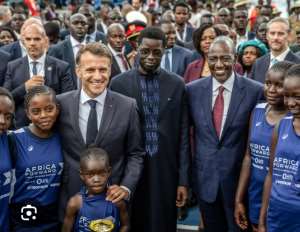
A Summit Divided: Optimism in the Halls, Protest in the Streets
The Africa Forward Summit in Nairobi has produced a striking split in African opinion. Inside the conference halls at the University of Nairobi and KICC, heads of state and business leaders are speaking the language of partnership, investment, and sovereignty. Outside and in parallel gatherings civil society groups and pan-African activists are calling it a rebranding of the same old colonial system. Here is what every side is saying.
President William Ruto Kenya's Host Voice
President Ruto has been perhaps the most emphatic African voice at the summit, setting the tone from the moment Macron landed in Nairobi.
Ruto on Sunday said Nairobi seeks to nurture a wide array of relationships and was "neither looking East nor West" but "looking forward." The phrase echoing the summit's name is deliberate: Kenya refuses to be defined by bloc politics in a world increasingly divided between East and West, China and America, Russia and Europe.
Officials in Nairobi say they have spent most of the preparatory months ensuring each participating country comes to the table not with a begging bowl, but with clarity on what Africa needs for its future. That framing Africa as a negotiating party, not a supplicant has run through Kenya's entire hosting of this event.
Ruto said in his formal welcome: "Our shared objective is clear to unlock capital, scale innovation, deepen trade and investment linkages, and create inclusive growth pathways that are resilient, sustainable, and African-led."
Foreign Affairs Minister Musalia Mudavadi The Business Case for Change
Kenya's Foreign Minister went straight to the structural issue African leaders care about most: the cost of money.
"Africa has always been regarded as a high-risk area. And therefore access to credit, both for governments and for businesses, has always been pegged at higher interest rate," Mudavadi told Reuters. "We need to address that. We need to have a situation where the financial markets globally start looking at Africa differently."
Mudavadi pointed out that the war in the Middle East proves all regions carry risk, and Africa should not be judged disproportionately. Conflict risk, he said, "was the excuse that was always bandied about Africa. But now it is clear that we have to have a relook at how we assess Africa."
He called the African Union's plan to establish a continental credit ratings agency "critical," and said the presence of global and regional lenders at the summit including the European Bank for Reconstruction and Development and the African Development Bank would support the effort. "This dialogue should help produce better financing mechanisms to support Africa so that jobs can be created on the African continent," he said.
President Julius Maada Bio of Sierra Leone
President William Ruto welcomed Sierra Leone's President Julius Maada Bio to State House in Nairobi for the summit, with Bio among the Anglophone African leaders whose presence signals the summit's break from the old Francophone-only format. His attendance reflects a growing belief among English-speaking African leaders that the France-Africa conversation must include them and that investment flows from Europe should not be limited by language or colonial history.
Nigeria's President Tinubu
Nigeria's President Bola Tinubu arrived in Kenya for the Africa-France Summit, making his presence one of the most significant signals of African engagement. Nigeria Africa's largest economy attending a France-Africa summit underscores that this is no longer simply a Francophone affair.
African Business Leaders: "Design With Africa, Not For Africa"
The business community present at the summit over 1,500 executives, entrepreneurs, and investors has been consistent in demanding a fundamentally different model of engagement.
Africa House at Davos, representing African business thinking at the highest global forums, issued a three-point call to action for 2026: design with Africa, not for Africa; align capital with African priorities, not imported templates; and move from presence to partnership.
Analysts and business leaders at the summit noted that African banks are now financing larger transactions, pension funds are growing steadily, and regional investors are becoming more sophisticated. African entrepreneurs are increasingly building infrastructure, logistics systems, manufacturing platforms, and technology ecosystems at scales previously considered improbable on the continent.
Sandra Kassab of AFD Group captured the business community's core demand: "This is a continent where the economic fabric relies heavily on the dynamism of individual entrepreneurs. Addressing issues of inclusion support for SMEs, and entrepreneurship is essential to meet the challenges of economic prosperity and inclusion, particularly for young people and women."
The Analysts: A Different Kind of Summit
The Nairobi summit, by contrast to older frameworks, appears increasingly focused on investment, industrialization, private capital mobilization, and long-term economic competitiveness. That evolution reflects changing realities on both sides. The importance of the Africa Forward Summit lies not merely in its communiqués or ceremonial declarations, but in what it reveals about the changing balance of global necessity.
Africa's growing relevance today is no longer rooted primarily in moral arguments about development or historical responsibility. It is increasingly grounded in strategic realities the world can no longer ignore: demographics, industrial supply chains, market expansion, and geopolitical competition. The relationship between Africa and the West is therefore becoming less transactional and increasingly reciprocal.
Civil Society: The Counter-Summit Speaks
But not everyone is inside the hall and those outside have been loudly vocal.
A section of civil society and pan-African lobby groups organized a parallel counter-summit in Nairobi opposing what they called France repackaging neo-colonial influence under the guise of economic cooperation. The counter-summit was dubbed the Pan-Africanism Summit against Imperialism (PASAI) 2026.
"The France–Africa Summit is not a gesture of goodwill, or a platform for equal partnership. It is a rebranded offensive of imperialist decolonization disguised behind the mask of environmental diplomacy and financial reform," said the organizer of the counter-summit.
"This summit emerges in the wake of France's military and diplomatic retreat from West Africa, where anti-imperialist uprisings expelled colonial troops from Mali, Burkina Faso, and Niger. French imperialism is now turning to East Africa, with Kenya as its principal gateway."
International civil society organizations went further. More than 100 civil society organizations released a joint statement saying: "The Summit is being presented as a partnership, yet appears to be a coordinated effort to reassert French influence over Africa's development trajectory. By centering private investments and corporate-driven innovation, the Summit reinforces the dominance of institutions like the World Bank and International Monetary Fund whose policies have systematically constrained Africa's policy space. We therefore reject this framing with urgency and clarity as this is an extension of the same neoliberal economic model that has kept African countries structurally dependent, unequal, and vulnerable to global crisis."
On the climate agenda specifically, the organizations warned that France and its allies are promoting "green partnerships" that promote market-based mechanisms, including carbon markets, and public-private partnerships that expand the role of private capital in public services. This, they argued, often results in land grabbing, the commoditization of ecosystems, and allows developed countries to continue emitting while shifting responsibility onto Africa.
The French Response to the Critics
France has not ignored the criticism. The French Ambassador to Kenya acknowledged the weight of history, saying: "It is true that we have a past, but over a couple of years, especially under the leadership of the current President (Macron), we have made bold steps in looking into our past objectively. We are totally open to criticism, but we want to open a new partnership that is mutually beneficial. An Africa that prospers is in the interest of France."
The Verdict So Far
The summit has put on vivid display what has always been true of the France-Africa relationship: it means very different things to different Africans. For heads of state and business leaders, it is an opportunity to rewrite the terms of engagement to demand better credit ratings, fairer investment structures, and technology on African terms. For civil society, the rebranding has not gone far enough; the architecture, they argue, remains the same even if the language has changed.
Critics of France see the Nairobi summit as Paris's way to dodge its reputational damage in other parts of Africa where it had stayed for decades moving east because it can no longer operate in the West. Whether that is cynical repositioning or genuine renewal is the question that the Nairobi Declaration, expected tomorrow, will need to answer.
Mustapha Bature Sallama.
Medical/ Science Communicator,
Private Investigator, Criminal investigation and Intelligence Analysis.
International Conflict Management and Peace Building.USIP
[email protected]
+233-555-275-880


 Halt proposed VALCO sale — ICU-Ghana tells Mahama
 Security beef up at Krobo College of Nursing and Midwifery during students prote...
 EOCO probe: IMCC insists forensic audit findings implicated Miracles Aboagye
 NDC rules out deadline extension for govt appointees seeking party positions
 80 to 90% of the people you saw wearing red protesting were not VALCO workers — ...
 Here are areas to be affected by ECG's planned maintenance on Tuesday
 NDC supporters mass at Kasoa Police Station after arrest of Zongo Ward Organiser
 Police arrest 93 suspected drug traffickers in Major Ashanti Region crackdown
 Chief Justice directs all courts to suspend sittings for Supreme Court 150th ann...
 63% Ghanaians support establishment of tribunals – Global InfoAnalytics poll

